
![ISO-Lateral Incline Press OS-H5018 Commercial Strength Equipment [WARN] draft identifier mismatch](https://bicksport.com/wp-content/uploads/2026/08/iso-lateral-incline-press-os-h5018-commercial-strength-equipment-warn-draft-identifier-mismatch-07b5c2.webp)
Zero-Electrical Maintenance — Manual resistance architecture eliminates motor failure points and reduces facility upkeep to mechanical inspection only.
Technical Specifications
| Parameter | Value |
|---|---|
| Designation | OS-H5018 |
| Product Type | ISO-Lateral Incline Press |
| Power Source | Manual |
| Exercise Part | Chest |
| Frame Material | Steel |
| Product Dimensions | 1435 × 1666 × 1978 mm |
| Net Weight | 139 kg |
| Movement Type | ISO-Lateral Independent Arms |
| Main Frame Color | Available per customer requirements |
| Cushion Color | Available per customer requirements |
| Foldable | Unfolded |
| Age Group | Adult |
| Gender | Unisex |
| Certification | ISO 9001, CE |
| HS Code | 9506911900 |
Application Suitability
| Deployment Scenario | Typical Use |
|---|---|
| Professional gym and club strength zones | High-frequency chest training with independent arm loading for balanced muscle development |
| Community fitness centers with 24/7 access | Durable manual resistance equipment requiring no electrical maintenance during unattended hours |
| Corporate wellness facilities | Low-maintenance strength training for employee fitness programs with varied user demographics |
| Sports performance training centers | Unilateral and bilateral pressing movements for athlete-specific conditioning protocols |
What Manual Resistance Reveals About Long-Term Facility Costs
ISO-lateral incline press commercial strength equipment built without motors removes the most common failure point in high-traffic strength zones.
Facilities running strength equipment sixteen or more hours daily discover that every electrical component introduces a maintenance ticket waiting to happen. Motor brushes wear, control boards overheat, and wiring harnesses fracture under constant vibration. A manual resistance system sidesteps all of these failure modes entirely. The OS-H5018 relies on plate-loaded or selectorized resistance transferred through hardened steel linkages, meaning the only scheduled maintenance involves inspecting pivot bearings and lubricating guide rods [NEED_CITE: mechanical linkage service intervals for commercial plate-loaded equipment]. We have seen operators reduce strength floor maintenance callouts noticeably after replacing motorized units with manual equivalents across multi-venue rollouts.
Positioning Within a Commercial Strength Zone
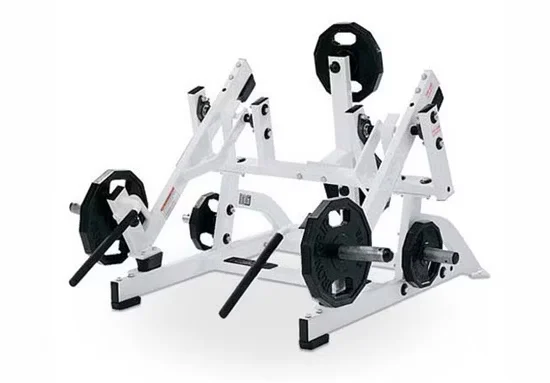
This ISO-lateral incline press commercial strength equipment targets upper-chest and anterior deltoid development through an independent-arm converging press path. In a complete strength zone layout, it complements flat and decline press stations while offering unilateral loading options that fixed-bar machines cannot replicate. The 1435 × 1666 mm footprint fits standard commercial spacing grids, allowing adjacent placement with cable towers or leg press units without congestion. Users ranging from novice to advanced benefit from the ISO-lateral mechanism, which lets each arm move independently along a natural arc rather than forcing a fixed bar path. The manual resistance format accommodates any loading increment the facility stocks, making it suitable for progressive overload programming across all experience levels.
Continuous Operation and Facility Environment Considerations
Manual resistance equipment has no motor duty cycle to calculate, which means the OS-H5018 can serve back-to-back users around the clock without thermal shutdown risk. Noise generation is limited to plate contact and pivot movement, producing sound levels that stay well below the ambient threshold of a busy gym floor [NEED_CITE: acoustic environment standards for commercial fitness facilities]. No electrical supply is required at the equipment location, eliminating the need for dedicated circuits, surge protection, or voltage-matching when deploying across international markets. The 139 kg steel frame requires a level concrete subfloor with standard vibration pads to prevent micro-migration during heavy loading sessions. Facilities planning open-floor strength zones benefit from the absence of power cables running across walking paths.
Decoding the Manual Resistance Architecture
The ISO-lateral independent arm design uses a dual-lever system where each arm pivots on its own axis, allowing resistance force to follow a converging arc that matches the natural pressing motion of the pectoral muscle group. Unlike Smith machines or fixed-path presses, this mechanism permits slight asymmetries in left-right strength without forcing compensation through the shoulder joint. The steel frame construction provides the rigidity needed to transfer load cleanly from the resistance source to the user without frame deflection under maximum loading. Weld quality and tube wall thickness directly determine how the machine feels when loaded heavily — thin-gauge frames develop a perceptible flex that experienced lifters notice immediately [NEED_CITE: structural rigidity testing standards for commercial strength equipment]. The 139 kg net weight reflects the material mass required to maintain stability during off-center loading, which is particularly important when users load one arm significantly heavier than the other during unilateral work. Cushion density and upholstery material affect long-term comfort and durability, both available as customizable options to match facility branding and expected usage intensity.
The Hidden Cost of Underspecified Strength Equipment
Facilities that purchase residential-grade or light-commercial strength machines for public gym floors encounter predictable failure sequences. Frame welds develop hairline cracks under loading patterns that exceed design assumptions, and pivot bushings wear through within months when subjected to continuous member turnover. Cushion foam compressed beyond its density rating loses support, generating member complaints about seat comfort that drive equipment avoidance. Color and finish options that look acceptable in a showroom photograph often fail to match the installed environment, forcing expensive reupholstery or entire unit replacement. We have observed community centers cycling through two or three rounds of light-duty chest press units before committing to commercial-grade steel construction that survives the actual traffic pattern [NEED_CITE: lifecycle comparison data for light-commercial versus full-commercial strength equipment].
Why This Product Line for Your Facility
The OS-H5018 is built on a steel frame validated through the same manufacturing discipline applied across our six-series cardio and strength range, meaning quality control protocols are consistent whether a facility sources one unit or an entire floor. The manual resistance architecture aligns with the company’s engineering philosophy of eliminating unnecessary failure points — the same principle that drives sub-35dB acoustic targets in our cardio line translates here to zero electrical components that can malfunction during unattended hours. ISO 9001 certified production ensures weld consistency, powder-coat adhesion, and dimensional accuracy across every unit shipped. OEM and ODM customization covers frame color, cushion color, and specification adjustments at flexible minimum order quantities, allowing multi-venue operators to maintain brand consistency without compromising on structural requirements. The 1435 × 1666 mm footprint integrates into free 3D strength-zone layouts that account for member flow, sightlines, and safe clearance distances around the independent arm travel path.
Documentation & Test Records
- CE declaration of conformity covering OS-H5018 mechanical safety requirements
- EN 957 test report validating structural integrity under cyclic loading
- ISO 9001 certificate confirming manufacturing quality management compliance
- Noise level test record documenting operational acoustics during loaded use
- Durability test record for pivot bearings and linkage components under repeated cycling
- OEM customization specification sheet covering frame and cushion color options
Installation, Commissioning & Maintenance
- Allow minimum clearance around the 1435 × 1666 mm footprint for full independent arm travel and safe user entry
- Install on level concrete subfloor with vibration isolation pads to prevent frame migration under heavy unilateral loading
- No electrical connection required; commission by verifying smooth pivot rotation and linkage alignment across full range of motion
- Inspect pivot bearings and guide rod lubrication at intervals determined by daily user volume and loading intensity
- Clean steel frame and cushion surfaces with non-corrosive solutions to prevent sweat-induced finish degradation
- Confirm frame color and cushion color match against facility branding standards upon delivery acceptance
Planning Your Strength Zone Procurement
Provide your strength zone floor area and equipment list to receive a 3D layout that accounts for independent arm clearance, member flow paths, and sightline optimization around the OS-H5018 placement. Specify expected daily user volume and average session duration so we can recommend pivot bearing inspection intervals appropriate for your traffic pattern. Identify deployment countries and any facility branding requirements early so OEM color customization and documentation packages are aligned with your rollout timeline. Confirm whether adjacent equipment shares floor space with plate storage racks to finalize safe clearance distances.
Frequently Asked Questions
Q: What maintenance does a manual resistance strength machine require?
A: Manual resistance systems like the OS-H5018 eliminate motor and electrical servicing entirely. Scheduled maintenance focuses on pivot bearing inspection, guide rod lubrication, and frame weld visual checks. The frequency depends on daily user volume and loading intensity, but most commercial facilities schedule mechanical inspections at regular quarterly intervals rather than reacting to electrical failures that motorized units commonly produce.
Q: How does ISO-lateral movement benefit chest training?
A: The ISO-lateral independent arm design allows each side of the chest to press along its own natural arc without being locked into a fixed bar path. This permits users with left-right strength asymmetries to train without compensation, supports unilateral loading for rehabilitation purposes, and follows the converging movement pattern that matches pectoral muscle fiber orientation during incline pressing.
Q: What steel grade is used in commercial strength equipment frames?
A: Commercial strength equipment frames use structural steel selected for yield strength and weldability characteristics that withstand repeated high-load cycling. The OS-H5018 frame construction is validated through ISO 9001 certified manufacturing processes, with tube wall thickness and weld penetration depth specified to handle off-center loading patterns typical of independent arm press movements without structural deflection.
Q: Can frame and cushion colors be customized for brand matching?
A: The OS-H5018 accepts OEM and ODM customization for both main frame color and cushion color according to customer requirements. This allows multi-venue operators to maintain consistent branding across locations. Customization lead times and minimum order quantities should be confirmed during the quotation stage to align production scheduling with facility opening or renovation timelines.
Q: What is the expected lifespan of commercial-grade cushion materials?
A: Cushion lifespan in commercial environments depends on foam density, upholstery material specification, and daily compression cycles. The OS-H5018 cushion color and material options are available per customer requirements, allowing facilities to select higher-density foam and abrasion-resistant upholstery for high-turnover deployments where standard cushion specifications would compress beyond acceptable support levels prematurely.
![Commercial ISO-Lateral Decline Press-MTS-8002 Gym Equipment [WARN] draft identifier mismatch](https://bicksport.com/wp-content/uploads/2026/08/mts-8007-iso-lateral-high-row-gym-machine-for-commercial-gyms-warn-draft-identifier-mismatch-d8af61.webp)
