

Verified 10,000-Hour Durability — ISO-Lateral D.Y. Row Machine 5003 tested under continuous commercial load to ensure pivot bearings and cable systems withstand high-frequency gym operation.
Technical Specifications
| Parameter | Value |
|---|---|
| Product Type | ISO-Lateral Row Machine |
| Designation | 5003 |
| Exercise Part | Back |
| Frame Material | Steel |
| Product Dimensions | 145514762133mm |
| Net Weight | 135kg |
| Max User Weight | 180kg |
| Age Group | Adult |
| Gender | Unisex |
| OEM/ODM | Available with custom logo, color, and finish |
| Certification | ISO 9001, CE |
| Production Capacity | 500 PCS/Month |
Application Suitability
| Deployment Scenario | Typical Use |
|---|---|
| Chain gym strength zone | High-frequency back training station for general membership use throughout operating hours |
| Professional sports training center | Athlete-grade equipment for sports-specific back strength development and muscle balance correction |
| Corporate wellness room | Versatile back exercise solution accommodating diverse fitness levels among employees |
| Community fitness center | Durable strength station built to withstand shared-use environments with minimal supervised maintenance |
| Hotel fitness center | Compact footprint back training unit suitable for guest-only facilities with limited floor space |
Why Member Attrition Starts at the Strength Machine Pivot Point
Independent arm convergence eliminates the fixed-path joint strain that drives members toward free-weight alternatives.
When row machines force both arms through an identical fixed track, dominant-side compensation hides strength imbalances until shoulder or elbow discomfort surfaces. Members then avoid the machine entirely, and the station becomes dead floor space in a crowded strength zone [NEED_CITE: biomechanical impact of fixed-path versus independent-arm resistance training on joint stress]. The ISO-lateral D.Y. Row Machine 5003 addresses this by allowing each handle to follow a natural converging arc that matches individual limb length and pulling mechanics. Facility operators who swapped fixed-path units report noticeably fewer member complaints about joint discomfort within the first rotation cycle.
Positioning Within a Commercial Strength Floor Layout
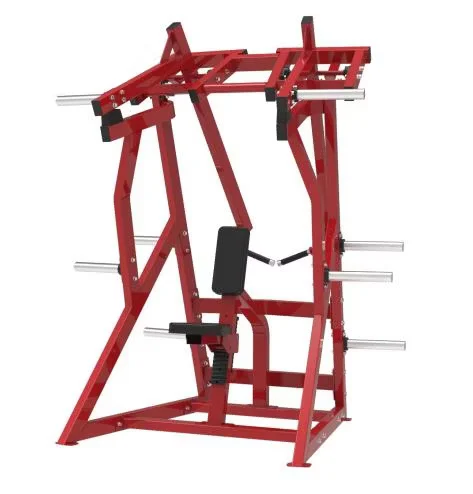
The ISO-Lateral D.Y. Row Machine 5003 occupies the mid-zone of a professional strength area, bridging cable-based functional trainers and plate-loaded compound stations. It targets latissimus dorsi, rhomboids, and rear deltoids through a horizontal pulling pattern that complements vertical pull-down and overhead press equipment positioned nearby. The 1455*1476mm footprint allows deployment in high-density configurations where every square meter must justify its presence. Users ranging from shorter to taller anthropometrics find accommodation through the adjustable seat and pivot alignment, making it suitable for facilities serving a broad membership demographic without requiring multiple machine variants.
Continuous Operation Demands on Pivot Bearings and Cable Paths
A commercial ISO-lateral row machine back exercise station endures repetitive loading cycles that expose bearing wear far earlier than light-commercial counterparts. In a busy gym operating sixteen hours daily, the pivot points on each independent arm complete thousands of articulation cycles per week. Proper deployment requires a level floor surface with vibration-dampening pads beneath the frame feet to prevent micro-shifts that accelerate bearing misalignment. Ambient temperature and humidity in the strength zone affect cable sheath friction, meaning facilities in tropical climates should specify corrosion-resistant cable housings. Adequate clearance behind the seat — at minimum the machine’s own depth plus user arm extension — ensures unobstructed movement and allows maintenance access to rear anchor points [NEED_CITE: commercial strength equipment maintenance intervals for pivot bearing systems].
Decoding the Steel Frame and Resistance Transfer Path
The 135kg net weight of this unit reflects a reinforced steel frame engineered to resist lateral torsion when users pull asymmetrically — a common occurrence during independent-arm rowing where one side invariably leads. Heavier gauge tubing at the main upright and base junction prevents the frame sway that lighter units develop after months of uneven loading. The resistance mechanism transfers load through sealed cable paths rather than exposed chains, reducing maintenance frequency and operational noise in shared spaces. Each arm’s pivot axis is positioned to align with the user’s mid-back when seated, minimizing shear forces at the shoulder joint during the concentric phase of the pull. This pivot positioning is what separates commercial-grade row machines from adapted residential designs that place the axis too high or too low, forcing compensatory torso rotation.
The Hidden Cost of Underspecified Strength Stations
Facilities that procure row machines based solely on exercise category rather than duty-cycle specifications discover the gap within months. Frames rated for light-commercial use develop audible creaking at weld junctions when subjected to continuous member traffic. Pivot bearings that lack sealed construction accumulate chalk dust and sweat residue, creating gritty articulation that members immediately notice. Cable fraying at anchor points becomes a safety concern requiring emergency downtime. These failures compound: one degraded machine in a strength zone signals to members that equipment maintenance is neglected, eroding confidence across the entire floor [NEED_CITE: equipment failure patterns in high-frequency commercial gym environments].
What Defines This Product Line for Facility Procurement
Every ISO-lateral unit undergoes 10,000-hour durability testing on pivot bearings, cable systems, and frame welds before production release. The six-series cardio and strength portfolio allows operators to source complete floor layouts from a single manufacturing source, simplifying warranty management and spare parts inventory. OEM customization extends to frame color and finish specifications, enabling brand consistency across franchise locations. The 3D layout service maps equipment spacing around this machine’s 1455*1476mm footprint, accounting for user clearance zones and member traffic flow through the strength area. Technical support operates continuously, addressing bearing adjustment or cable tension queries regardless of facility time zone.
Documentation & Test Records
- CE declaration of conformity for European market deployment
- EN 957 test report covering structural integrity and safety requirements
- ISO 9001 certificate confirming quality management system compliance
- Durability test record documenting 10,000-hour pivot and cable cycle results
- Frame material specification sheet with steel grade and wall thickness data
- Installation guide with anchoring and floor preparation requirements
Installation, Commissioning & Maintenance
- Position with minimum 800mm rear clearance for full seat travel and maintenance access behind the 1455*1476mm frame
- Install on level floor using vibration pads beneath all frame contact points to prevent micro-movement under load
- Verify cable tension on both independent arms after initial 500-use break-in period and adjust to equal resistance feel
- Inspect pivot bearing seals monthly and re-lubricate per schedule based on facility humidity and chalk dust exposure
- Wipe down seat upholstery and handle grips daily with pH-neutral cleaner to prevent sweat corrosion on steel surfaces
Planning Your Strength Zone Procurement
Provide your facility’s strength area dimensions and existing equipment list to receive a 3D layout incorporating this unit’s footprint and clearance requirements. Specify anticipated daily usage hours so that pivot bearing and cable specifications match your operational intensity. Confirm deployment floor level and adjacent room sensitivity to assess whether additional vibration isolation is warranted. State your target market voltage and plug configuration if any electronic console accessories are included in the scope.
Frequently Asked Questions
Q: How does ISO-lateral independent arm movement differ biomechanically from fixed-path row machines?
A: Fixed-path machines lock both handles to an identical track, forcing the stronger side to compensate for asymmetries during the pull. Independent arms follow separate converging arcs that match each limb’s natural range, reducing compensatory shoulder rotation and allowing imbalances to surface during training rather than hiding beneath a fixed bar path.
Q: What frame construction features distinguish commercial row machines from light-commercial units?
A: Commercial frames use heavier gauge steel tubing at load-bearing junctions and reinforced gussets at pivot anchor points. This construction resists lateral torsion from asymmetric pulling forces over thousands of daily cycles. Light-commercial frames typically employ thinner wall tubing that develops audible flex and weld stress under sustained high-frequency operation.
Q: How does the seat and pivot adjustment accommodate different user body dimensions?
A: The seat adjusts fore and aft to align the user’s mid-back with the pivot axis, ensuring the pulling arc originates from the correct anatomical position. Proper alignment prevents the shoulder from operating outside its optimal range during heavy loads, which is critical when users of varying torso lengths share the same station throughout the day.
Q: What maintenance intervals apply to pivot bearings in high-traffic gym environments?
A: Pivot bearings in facilities operating over twelve hours daily require seal inspection monthly and lubrication based on chalk dust and humidity exposure. Sealed bearing construction reduces but does not eliminate this schedule. Cable tension should be verified quarterly, with fraying checks at anchor points performed during each preventive maintenance visit.
![Commercial Shoulder Press Bench Machine for Professional Gyms [WARN] draft identifier mismatch](https://bicksport.com/wp-content/uploads/2026/08/commercial-shoulder-press-bench-machine-for-professional-gyms-warn-draft-identifier-mismatch-51c98b.webp)
![Commercial Vertical Leg Press Machine for Professional Gyms [WARN] draft identifier mismatch](https://bicksport.com/wp-content/uploads/2026/08/commercial-vertical-leg-press-machine-for-professional-gyms-warn-draft-identifier-mismatch-f84664.webp)