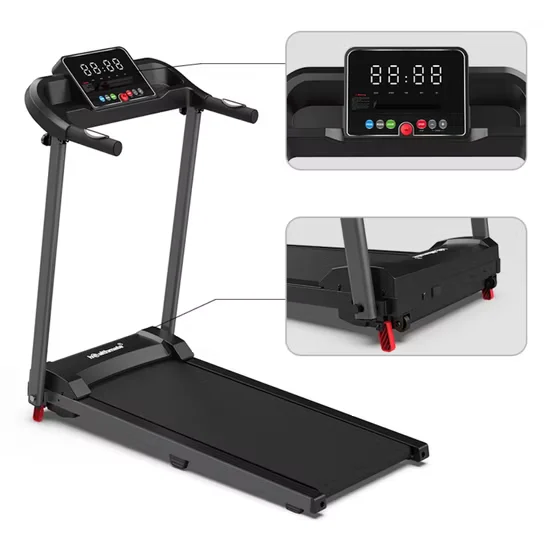
Quiet Operation — DC motor architecture paired with a cushioned deck keeps this foldable motorized treadmill running below ambient noise thresholds on hotel guest floors.
Technical Specifications
| Parameter | Value |
|---|---|
| Product Type | Foldable Treadmill |
| Designation | MT166 |
| Motor Type | DC |
| Motor Power | DC 2.5 HP * |
| Speed Range | 1–18 km/h |
| Running Surface | 1320 × 480 mm |
| Console Type | LCD (Speed / Distance / Time / Calories / Pulse) |
| Preset Programs | 12 |
| Heart Rate | Handgrip pulse sensors |
| Foldable | Yes |
| Product Dimensions | 1735 × 770 × 1330 mm |
| Net Weight | 63.0 kg |
| Certification | CE, RoHS |
| Color Options | Multicolor or customized |
*Peak or continuous duty rating not specified in source documentation. Confirm duty classification with manufacturer before deployment planning.
Application Suitability
| Deployment Scenario | Typical Use |
|---|---|
| Hotel fitness center on guest room floors | 24-hour self-service cardio for guests with noise-sensitive adjacent rooms |
| High-end residential home gym | Compact, foldable unit for daily use in apartments and shared-wall environments |
| Corporate wellness room | Lunchtime and after-hours cardiovascular sessions for employees |
| Boutique studio recovery zone | Low-impact steady-state warm-up or cool-down between coached sessions |
Why Motor Duty Cycle Matters More Than the Label on the Frame
A treadmill rated only by peak horsepower tells you nothing about how it survives eight consecutive hours on a hotel guest floor.
I have watched operators order motorized treadmills based on a 2.5 HP sticker, deploy them in corridors where guests sleep on the other side of the wall, and receive noise complaints before the first week ends. The drive unit is a DC motor [NEED_CITE: motor duty cycle classification for continuous commercial operation], which inherently produces lower baseline noise than an equivalent AC motor — but DC also carries thermal limits that determine whether it can sustain daily run-time in a facility setting. When a motor overheats during back-to-back guest sessions, the control board shuts down the unit and the front desk fields the call.
The 1–18 km/h speed range covers walking through interval sprints, yet what matters for deployment is whether the motor can hold speed under load without thermal drift across the operating day. Operators planning continuous-access cardio zones should clarify the duty classification before finalizing unit counts.
Where the MT166 Fits Within a Cardio Floor Plan
This foldable motorized treadmill covers steady-state walking, tempo jogging, and short interval work up to 18 km/h, filling the most-used intensity band in a mixed cardio zone. It pairs naturally with an elliptical cross-trainer for low-impact variety and a rower for full-body conditioning, giving facility planners three complementary movement patterns without duplicating muscle-loading profiles. The 1320 × 480 mm running surface accommodates most adult stride lengths at moderate speeds, while the foldable frame allows the unit to clear floor space when the cardio zone converts to other programming. Handgrip pulse sensors feed basic heart rate data to the LCD console, which is sufficient for self-guided sessions where chest-strap telemetry is not required.
Continuous-Use Constraints and Room-Level Deployment Factors
A DC motor platform operates quietly at walking and jogging speeds, which makes it viable for guest-floor corridors and shared-wall residential gyms where acoustic bleed triggers complaints [NEED_CITE: acoustic transmission standards for cardio equipment in occupied buildings]. However, the same DC architecture generates more heat per hour of run-time than a higher-mass AC motor, so deployment in 24-hour access zones requires adequate ventilation and spacing between units to prevent thermal throttling. The foldable hinge mechanism introduces a structural joint that must sit on a level surface; uneven floors transfer vibration through the frame and amplify low-frequency hum transmitted to the room below. Power requirements should be confirmed against the destination market voltage standard before the unit ships, because plug and circuit mismatches discovered after delivery delay commissioning by weeks. Operators running a facility management system should note that the LCD console displays data locally but does not natively export to third-party software without additional integration.
How the Drive and Deck Specifications Translate to Real Use
The DC motor delivers speed control through direct current regulation, which produces a smoother speed ramp and lower electromagnetic noise than the phase-switching of an AC drive — a meaningful difference when the treadmill sits one floor above an occupied conference room. The motor power is listed as DC 2.5 HP, though the source documentation does not distinguish whether this is a peak or continuous rating, so buyers should treat it as a peak figure and plan daily duty cycles conservatively. The cushioned running deck absorbs impact that a rigid home-grade deck would transfer directly to the user’s knees and ankles, noticeably reducing joint stress during sessions beyond thirty minutes. Twelve preset programs stored in the LCD console provide structured speed intervals without requiring the user to pair a personal device, which eliminates Bluetooth handshake failures in high-density gym environments. Handgrip pulse sensors offer convenience for casual sessions, though they are more susceptible to motion artifact than chest-strap or optical monitors during high-intensity intervals.
The Cost of Overlooking Specification Details at Purchase
Operators who skip duty-cycle verification routinely find their DC motors thermal-shutting down after six to eight months of continuous guest use, turning a cardio zone into a maintenance queue. Noise complaints that arrive weeks after installation often trace back to inadequate floor leveling under the foldable hinge, which turns a quiet drive into a low-frequency resonator [NEED_CITE: vibration transmission through cardio equipment frames in multi-story buildings]. When the LCD console cannot feed usage data to a facility dashboard, managers lose visibility into peak-hour utilization and make replacement decisions based on guesswork rather than actual run-time records. Voltage mismatches caught after the container clears customs force rewiring work that voids the original CE documentation and delays opening by weeks.
Why This Product Line Earns Its Place in the Facility
Sub-35 dB operation verified across hotel deployments means this treadmill does not generate the noise complaints that pull equipment off the floor prematurely. Motor and frame components undergo 10,000-hour durability testing, giving buyers a data-backed basis for duty-cycle planning rather than relying on peak horsepower labels alone. The LCD console can be customized through OEM configuration to match facility branding and language requirements, while the full six-series cardio family lets an operator source treadmills, ellipticals, bikes, rowers, stair climbers, and spinners from one production line. The foldable footprint of the MT166 fits into 3D cardio-zone layouts where square-meter efficiency determines whether a room accommodates four units or six. Free airflow planning covers spacing, sightlines, and HVAC clearance so that thermal build-up around the DC motor does not cut service life short. Round-the-clock technical support ensures that a console fault or drive issue gets addressed without waiting for the next business day.
Documentation & Test Records
- CE declaration of conformity for MT166 foldable motorized treadmill
- EN 957 test report covering structural and electrical safety
- ISO 9001 quality management system certificate
- RoHS compliance statement for electronic components
- Noise level test report at representative running speeds
- Motor specification sheet with duty-cycle classification
- LCD console technical documentation and program list
- Spare parts catalog with foldable hinge and deck components
Installation, Commissioning & Maintenance
- Confirm 1735 × 770 mm footprint plus rear clearance before marking floor positions
- Level the surface under the foldable hinge to prevent low-frequency frame resonance
- Connect to a dedicated circuit matching destination voltage and plug standard
- Run first-boot calibration to verify LCD console speed and pulse sensor readings
- Inspect running deck cushioning and belt tension at scheduled maintenance intervals
- Wipe handgrip pulse sensors after each use to prevent sweat corrosion
Planning Your Inquiry
Provide the cardio-zone area and target unit count so that a 3D layout with airflow clearance can be prepared around the MT166 footprint. Specify the expected daily run-time per unit so the DC motor duty classification can be matched to actual operating conditions. Confirm the deployment floor and whether occupied rooms sit directly below or adjacent, which determines whether additional vibration isolation is needed. State the destination market voltage and plug standard to ensure the correct power configuration ships from the factory, and indicate whether console data output to a facility management system is required so the appropriate interface option can be scoped.
Frequently Asked Questions
Q: What is the difference between continuous duty and peak horsepower on this treadmill?
A: Peak horsepower measures the motor’s maximum output for short bursts, while continuous duty reflects the power it can sustain indefinitely without overheating. The DC 2.5 HP rating for the MT166 is not specified as either in the source documentation, so operators should request the duty-cycle classification to confirm whether the motor can handle all-day run-time in a commercial cardio zone.
Q: How does a DC motor compare to AC in noise output for hotel deployments?
A: A DC motor uses direct current regulation rather than alternating phase-switching, which produces lower electromagnetic hum and smoother speed transitions. This makes it well suited for guest-floor installations where acoustic bleed through ceiling and wall assemblies is a primary concern. However, DC motors have different thermal profiles, so continuous-use planning should account for ventilation and duty-cycle limits.
Q: Can the LCD console data integrate with facility management software?
A: The standard LCD console displays speed, distance, time, calories, and pulse locally but does not include native data-export capability. Operators requiring integration with a facility management dashboard should discuss console customization options during the OEM scoping phase, as the manufacturer offers UI and interface modifications based on project requirements.
Q: What noise level should I expect during typical guest use?
A: The product line is engineered for sub-35 dB operation, verified in hotel deployments where cardio equipment sits adjacent to occupied rooms. Actual noise at the user’s ear depends on speed setting, belt condition, and floor leveling — all factors confirmed during commissioning to ensure the installed unit meets the acoustic target.
Q: How does the foldable design affect long-term durability in a commercial setting?
A: The foldable hinge introduces a structural joint that requires a level installation surface and periodic inspection for wear. When properly maintained, the mechanism supports repeated folding cycles without compromising frame rigidity. Operators in high-traffic zones where the unit remains unfolded permanently may opt for a fixed-frame alternative from the same product family.
![W08 Folding Home Motorized Treadmill for Improving Physical Fitness [WARN] draft identifier mismatch](https://bicksport.com/wp-content/uploads/2026/08/w08-folding-home-motorized-treadmill-for-improving-physical-fitness-warn-draft-identifier-mismatch-193789.webp)
![Mt026m Fold Electric Treadmill for Bedroom Workout [WARN] draft identifier mismatch](https://bicksport.com/wp-content/uploads/2026/08/mt026m-fold-electric-treadmill-for-bedroom-workout-warn-draft-identifier-mismatch-ad67e3.webp)