
![HSM Fashion Manual Incline Household Treadmill MT23B for Home Use [WARN] draft identifier mismatch](https://bicksport.com/wp-content/uploads/2026/08/hsm-fashion-manual-incline-household-treadmill-mt23b-for-home-use-warn-draft-identifier-mismatch-dfc649.webp)
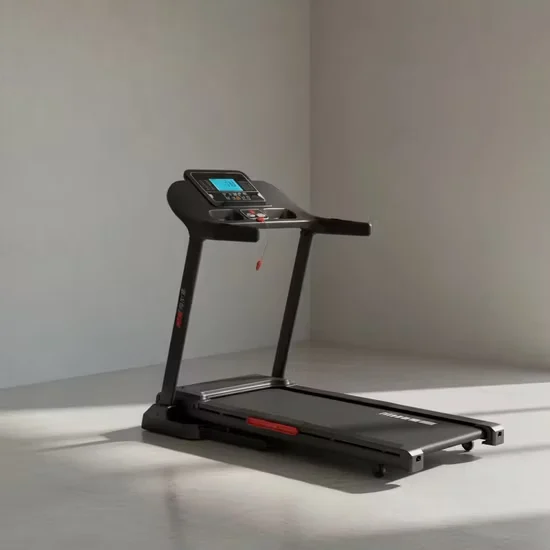
Quiet Operation Engineering — DC motor paired with a manual incline frame eliminates motorized lift noise, keeping household treadmill use compatible with multi-story residential floors.
Technical Specifications
| Parameter | Value |
|---|---|
| Designation | MT23B |
| Product Type | Foldable Treadmill |
| Motor Type | DC |
| Motor Power | 1.5/DC2.0 HP ¹ |
| Speed Range | 1–12 km/h |
| Incline | Manual |
| Running Surface | 1200 × 420 mm |
| Console Type | LCD (Speed / Distance / Time / Calories / Pulse) |
| Programs | 12 |
| Heart Rate | Handgrip pulse sensors |
| Foldable | Yes |
| Product Dimensions | 1490 × 720 × 1100 mm (unfolded) |
| Net Weight | 37 kg |
| Max User Weight | — |
| Certification | CE, RoHS |
¹ Peak or continuous duty rating not specified in source documentation. Confirm with supplier before specifying for sustained daily run-times.
Application Suitability
| Deployment Scenario | Typical Use |
|---|---|
| High-end residential home gym | Daily walking and light jogging in apartments or condominiums |
| Compact living spaces | Foldable storage when floor area must be reclaimed after sessions |
| Corporate wellness room | Moderate-duration cardio for employees during breaks |
| Hotel guest floor fitness alcove | Quiet walking programs in shared residential-style suites |
Why Noise Complaints Reach the Front Desk Before Maintenance Does
A DC motor running at household duty cycles avoids the low-frequency hum that travels through floor slabs.
When a treadmill sits above an occupied bedroom or beside a shared wall, the noise signature matters more than peak speed. A foldable treadmill DC motor manual incline household unit like the MT23B relies on a direct-current motor that operates at lower RPM ranges than comparable AC units, producing less structure-borne vibration. [NEED_CITE: structure-borne noise transmission in multi-story residential cardio deployments] The manual incline mechanism removes an additional motorized lift — one fewer vibration source transferring energy into the floor pan. For facility managers and homeowners alike, the first signal of a wrong equipment choice is rarely a maintenance ticket; it is a complaint from the neighbor below.
Where the MT23B Fits in a Compact Cardio Layout
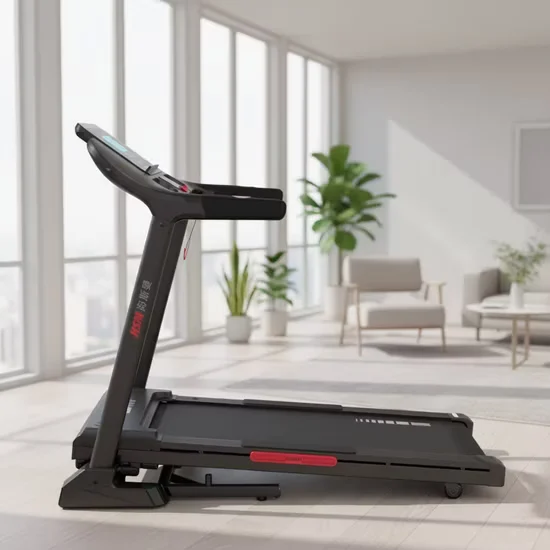
This foldable treadmill occupies a specific slot in a mixed-equipment aerobic zone: moderate-intensity steady-state walking and light jogging for users who need a low-footprint machine. It complements stationary bikes and ellipticals by covering the walking-to-jogging speed envelope without demanding the floor area of a full-commercial treadmill. The 1200 × 420 mm running surface suits users of average stride length performing sessions at 1–12 km/h. In a home gym or corporate wellness room, the foldable treadmill DC motor manual incline household configuration lets the unit stand upright against a wall between sessions, recovering usable floor space. The handgrip pulse sensors provide basic heart rate feedback without requiring a chest strap, keeping the setup simple for walk-in users who want quick biometric readouts.
Continuous Run-Time and Deployment Environment Considerations
A DC motor rated at 1.5/DC2.0 HP suits daily sessions of moderate duration in a residential or light-use setting. Facilities planning continuous back-to-back usage across multiple users should verify whether the stated horsepower reflects continuous duty or peak output before finalizing an order. [NEED_CITE: motor duty cycle classification for continuous commercial operation] Deployment on upper floors demands attention to vibration isolation — a rubber mat beneath the 1490 × 720 mm footprint helps decouple the frame from the slab. The manual incline adjustment requires the user to set the angle before stepping on, which eliminates the draw spike that a motorized lift would add to the circuit. Standard single-phase household power feeds the unit, but voltage and plug configuration must match the destination market before the container ships. Adequate clearance behind the running deck allows heat dissipation from the motor housing during extended sessions.
Reading Between the DC Motor and Manual Incline Specifications
The MT23B uses a DC motor, which in treadmill engineering generally means quieter operation at lower speeds compared to an AC motor of equivalent horsepower — the commutator design produces less electromagnetic hum at the RPMs typical of walking and jogging. However, DC motors carry thermal limits under sustained load; the 1.5/DC2.0 HP figure must be interpreted carefully, as peak output ratings describe short bursts rather than the continuous thermal capacity needed for hour-long sessions. The manual incline mechanism relies on a physical pin or adjustment foot at the rear of the deck, removing an incline motor and its associated control board from the failure-point list. This simplicity trades automated gradient changes for mechanical reliability. The LCD console displays speed, distance, time, calories, and pulse — a straightforward five-window readout without Bluetooth or app connectivity, which means no firmware updates and no data stranded in proprietary ecosystems. Handgrip pulse sensors offer convenient spot-checks, though they are inherently less stable than chest-strap telemetry during high-cadence intervals.
The Hidden Cost of Overlooking Specification Gaps
Deploying a household-duty treadmill in a setting that demands commercial run-times produces a predictable failure arc: the motor overheats during back-to-back user sessions, the thermal cutoff trips repeatedly, and the control board eventually fails outside warranty coverage. Noise complaints compound the problem — a unit that sounded acceptable in a showroom generates structure-borne resonance once installed on a suspended timber floor. When the running surface dimensions or deck cushioning do not match the user profile, joint discomfort drives members toward competing facilities. [NEED_CITE: member attrition linked to cardio equipment comfort and noise] Data isolation from a basic LCD console means usage patterns remain invisible to facility managers planning maintenance schedules or justifying equipment refresh cycles.
Why This Product Line Was Built Around Verified Durability
Every unit that leaves the Shandong assembly line passes through a 10,000-hour continuous operation test on motors, frames, and sealed bearings before release — a standard established after early field failures with under-specified cushioning layers. The MT23B benefits from this protocol: the DC motor and manual incline frame are validated against the same endurance benchmarks applied across the full six-series cardio range. OEM customization extends to console UI, color, and logo, so a residential developer or hotel group can align the visual identity without engineering a separate SKU. The free 3D cardio-zone layout service accounts for the MT23B’s 1490 × 720 mm footprint and fold-up clearance, mapping airflow paths and sightlines so the unit is positioned where users actually see it. Documentation packages ship with each order, and 24/7 technical support covers commissioning questions that arise after the container is opened.
Documentation & Test Records
- CE declaration of conformity covering MT23B electrical safety requirements
- EN 957 test report for stationary training equipment mechanical integrity
- ISO 9001 certificate for manufacturing quality management processes
- RoHS compliance documentation for restricted substance limits
- Noise level test record at defined speed and load conditions
- Motor specification sheet with thermal and duty-cycle data
Installation, Commissioning & Maintenance
- Maintain minimum clearance around the 1490 × 720 mm unfolded footprint for safe mounting and dismounting
- Place on a level surface with a vibration-damping mat to isolate the 37 kg frame from floor resonance
- Confirm voltage and plug type match local supply before connecting the DC motor circuit
- Run the belt at low speed for initial tracking alignment and tension verification
- Inspect running belt tension and deck lubrication at intervals defined in the commissioning guide
- Wipe the LCD console and handgrip sensors after each session to prevent sweat corrosion
Equipment Selection and Inquiry Scope
Provide the aerobic zone dimensions and planned equipment count to receive a 3D layout incorporating the MT23B’s footprint and fold-up clearance. Specify average daily run-time per unit so the DC motor duty rating can be validated against actual usage patterns. Confirm the deployment floor level and adjacent occupied spaces to determine whether supplementary vibration isolation is required. State the destination market voltage and plug standard, and indicate whether console data export to a facility management system is needed so the appropriate configuration is scoped before production.
Frequently Asked Questions
Q: What is the difference between continuous duty and peak horsepower in treadmill motors?
A: Peak horsepower measures the maximum output a motor can sustain for a few seconds during acceleration or incline load. Continuous duty horsepower reflects the thermal capacity to run indefinitely at that output without overheating. When a specification lists both values or leaves the distinction unstated, request the continuous duty rating from the supplier to confirm suitability for your expected session lengths.
Q: How does a DC motor compare to AC for home treadmill use?
A: DC motors typically operate more quietly at walking and jogging speeds because they run at lower RPM with less electromagnetic hum. They are lighter and suit foldable frames well. AC motors handle heavier continuous loads and dominate commercial settings. For household sessions under an hour, a properly rated DC motor provides adequate performance with a lower noise signature.
Q: Does manual incline affect workout effectiveness compared to motorized incline?
A: Manual incline still increases metabolic demand by raising the deck angle, engaging posterior chain muscles during walking and jogging. The trade-off is that adjustments require stopping and physically changing the pin or foot position, which interrupts interval programming. Users seeking automated gradient changes during a single session should evaluate motorized incline models instead.
Q: What noise level can be expected from a foldable household treadmill?
A: Actual noise depends on belt condition, deck lubrication, user weight, and floor structure. A DC motor with proper belt drive and a cushioned deck generally produces less structure-borne vibration than an equivalent AC unit. Request a noise level test report from the supplier and pair the treadmill with a rubber isolation mat to minimize transmission to floors below.

![MT296 Motorized Treadmill for Outdoor Running Alternative [WARN] draft identifier mismatch](https://bicksport.com/wp-content/uploads/2026/08/mt296-motorized-treadmill-for-outdoor-running-alternative-warn-draft-identifier-mismatch-6bbcfe.webp)