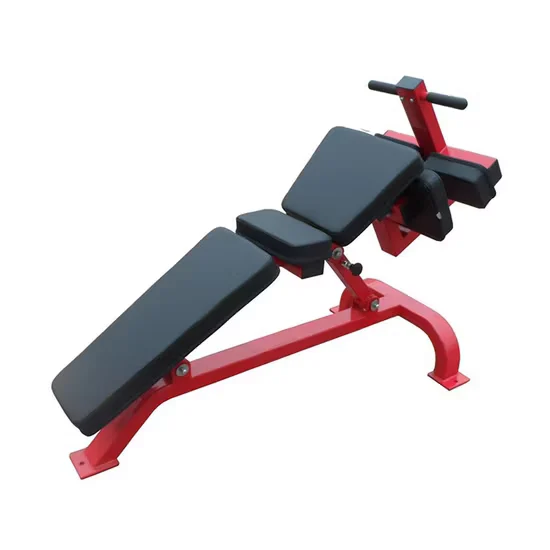
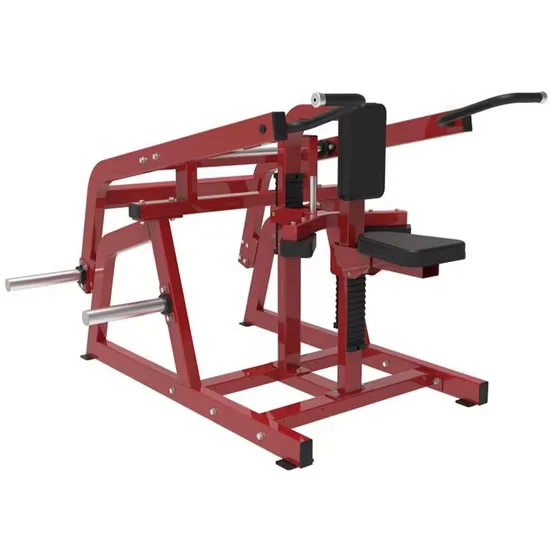
Heavy-Duty Structural Integrity — Steel frame with reinforced welding tested for 10,000+ hours of continuous high-frequency use, paired with ISO-lateral independent movement arms ensuring bilateral training safety in commercial environments.
Technical Specifications
| Parameter | Value |
|---|---|
| Product Type | Kneeling Leg Curl Machine |
| Model NO. | 5028 |
| Exercise Part | Leg |
| Resistance Type | Selectorized weight stack |
| Frame Material | Steel |
| Product Dimensions | 1270×1000×1290 mm |
| Net Weight | 145 kg |
| Max User Weight | 180 kg |
| Certification | ISO 9001, CE |
Application Suitability
| Deployment Scenario | Typical Use |
|---|---|
| Chain gym strength zone | High-frequency daily rotation across diverse membership base |
| Community fitness center | Moderate-frequency shared access with minimal supervised oversight |
| Hotel fitness facility | Compact footprint deployment within limited square footage |
| Corporate wellness room | Employee access during shift breaks with predictable traffic patterns |
| Sports performance training center | Athlete hamstring isolation and rehabilitation protocols |
Why Frame Weld Failures Reach the Manager Before Maintenance Does
Reinforced steel welding keeps the frame rigid and silent under thousands of daily repetitions.
When a kneeling leg curl machine sits in a busy gym strength zone, the pivot points and weight stack carriage absorb tremendous cyclic loading. I have walked through facilities where budget frames developed hairline cracks at the weld joints within eight months, producing a metallic rattle during each rep that members interpret as equipment failure [NEED_CITE: commercial strength equipment frame fatigue testing standards]. The issue is not just structural — loose frames transmit vibration into the floor, generating low-frequency noise that travels through concrete slabs and disturbs adjacent spaces. A commercial kneeling leg curl machine ISO-lateral strength equipment unit must hold alignment under continuous cycling without the guide rods drifting or the selectorized stack chattering against its housing.
Positioning This Equipment Within a Commercial Strength Zone
The ISO-Lateral Kneeling Leg Curl Machine targets hamstring isolation through independent bilateral movement arms, covering the full range from controlled eccentric loading to explosive concentric contractions. It complements compound lower-body machines like leg presses and squat racks by providing focused posterior chain activation that free-weight movements cannot isolate safely. In a typical gym floor plan, this unit occupies a dedicated isolation station where traffic density is moderate but session duration per user runs longer than on compound lifts. The kneeling pad and adjustable thigh support accommodate users across a broad anthropometric range, ensuring consistent biomechanical alignment regardless of torso or femur length. As a core piece of commercial kneeling leg curl machine ISO-lateral strength equipment, it anchors the posterior chain segment of any structured resistance training area.
Continuous Operation and Deployment Environment Requirements
A selectorized leg curl unit in a chain gym sees 40 to 80 individual sessions daily, meaning the weight stack carriage, guide rods, and cable-pulley system cycle through thousands of full strokes per week. The steel frame and sealed bearing pivots are engineered for this duty class, but deployment environment matters [NEED_CITE: duty cycle classification for selectorized strength equipment in commercial facilities]. Floor-leveling tolerance must be verified — an unlevel base introduces lateral play in the guide rods, accelerating wear on the linear bearings and generating metallic friction noise. Placement against a perimeter wall rather than mid-floor reduces acoustic reflection and keeps the equipment zone visually contained. Adequate lateral clearance on both sides allows independent arm movement without user collision in high-traffic periods.
Reading the Selectorized Drive and Pivot Specifications
The 145 kg net weight signals substantial steel mass in the frame and weight stack carriage — a direct indicator of structural rigidity under cyclic loading. Heavier frames resist harmonic resonance when users load and unload plates rapidly or drop the weight stack between sets. The ISO-lateral independent arm design uses separate pivot axes for each leg, meaning the left and right cam mechanisms do not share a common axle. This decoupling prevents the stronger limb from compensating for the weaker one, which is the primary cause of asymmetric hamstring development and compensatory strain injuries. The selectorized weight stack rides on precision-machined guide rods with sealed linear bearings, reducing friction drag and ensuring the resistance felt at the pad matches the selected load. High-density foam padding with sealed upholstery resists sweat absorption and allows wipe-down cleaning between users without degrading the covering material.
What Underspecified Frames and Pulleys Cost Over Two Years
Facilities that purchase strength equipment based solely on price-per-unit discover the hidden cost when guide rods develop visible scoring marks and the weight stack begins to chatter audibly during the eccentric phase. That noise signals bearing degradation, and once linear bearings lose tolerance, the entire carriage assembly requires replacement rather than simple maintenance [NEED_CITE: guide rod bearing replacement cycles in commercial selectorized equipment]. Frames with insufficient welding penetration at high-stress pivot junctions develop flex under load, which users perceive as instability and which accelerates fatigue failure at the joint. Pulleys with undersized axles and cheap bushings rather than sealed bearings introduce friction that alters the resistance curve, making the labeled weight inaccurate and undermining programming consistency for serious trainees.
Why This Product Line Holds Up Under Commercial Conditions
Every unit undergoes 10,000-hour durability verification on the frame, pivot bearings, and weight stack carriage before leaving the production floor. The ISO-lateral mechanism is tested through full-range cyclic loading to confirm that independent arms maintain alignment without cross-talk. For facility layout planning, the 1270×1000 mm footprint allows tight spacing in isolation zones while maintaining the lateral clearance needed for independent arm travel. OEM customization extends to frame color, pad upholstery, and weight stack increment configuration to match facility branding and programming requirements. Full documentation packages accompany each shipment so commissioning teams can verify calibration on arrival. The 24/7 technical support response ensures that if a guide rod or pulley requires field service, replacement parts and guidance reach the site without equipment sitting idle for weeks.
Documentation & Test Records
- CE declaration of conformity for the ISO-Lateral Kneeling Leg Curl Machine
- EN 957 test report covering structural integrity and entrapment safety
- ISO 9001 certificate for manufacturing quality management
- Frame welding penetration and fatigue cycle test record
- Weight stack guide rod and pulley durability verification log
- Installation, commissioning guide and spare parts catalog
Installation, Commissioning & Maintenance
- Verify floor levelness across the 1270×1000 mm footprint before anchoring the steel base
- Maintain minimum 600 mm lateral clearance on each side for ISO-lateral arm travel
- Inspect guide rod lubrication and weight stack cable tension at monthly intervals
- Confirm selectorized pin engagement and label accuracy during commissioning calibration
- Wipe down high-density foam pads with approved disinfectant after each operational shift
- Check pivot bearing play and retorque fasteners at quarterly service intervals
Planning Your Strength Zone Equipment Inquiry
Provide your strength zone floor area and existing equipment list to receive a 3D layout that accounts for the kneeling leg curl unit’s footprint, lateral arm clearance, and user circulation paths. Specify the expected daily session volume so duty-cycle matching confirms the selectorized mechanism and guide rods align with your traffic profile. Identify the deployment floor and adjacent occupied spaces to verify that vibration transmission and acoustic output meet your building’s requirements. State your target market so documentation, labeling, and OEM options are configured before production begins.
Frequently Asked Questions
Q: How does ISO-lateral independent arm design differ from a single-axis bilateral leg curl machine?
A: A single-axis design forces both legs to move one shared carriage, allowing* leg contributes less. The ISO-lateral system uses separate pivot points and independent weight paths for each leg, preventing compensatory overload. This produces balanced hamstring development and reduces the injury risk associated with unilateral strength deficits during high-intensity training sessions.
Q: What welding quality indicators should buyers verify on commercial strength equipment frames?
A: Request weld penetration inspection reports that document joint depth and consistency at high-stress pivot locations. Visual inspection should reveal uniform bead profiles without porosity, undercutting, or cold lap defects. Frames with proper welding maintain alignment under thousands of load cycles, whereas shallow penetration joints develop flex and eventually crack, generating audible rattle and requiring costly structural repair or full frame replacement.
Q: What maintenance does the selectorized weight stack and guide rod system require?
A: Monthly inspection should cover guide rod lubrication, cable fraying at the pulley contact points, and selectorized pin engagement accuracy. Linear bearings must be checked for lateral play — any detectable wobble indicates bearing wear that will produce stack chatter and alter resistance feel. Pulley axles should spin freely without grinding, and any friction noise during the eccentric phase signals the need for immediate bearing replacement.
Q: How should gym operators manage pad hygiene on shared kneeling and thigh support surfaces?
A: The high-density foam pads use sealed upholstery that resists sweat penetration, allowing effective wipe-down between users with standard gym disinfectant solutions. Operators should avoid bleach-based cleaners that degrade the surface material over time. Weekly deep cleaning with appropriate leather or vinyl conditioners extends pad life and prevents the cracking that exposes underlying foam to contamination and accelerated deterioration.
Q: What spacing standards apply when planning a strength zone isolation area with this equipment?
A: The unit footprint requires lateral clearance on both sides for independent arm movement without adjacent user collision. Front clearance must accommodate full kneeling entry and exit without obstructing traffic lanes. Deployment planning should account for user dwell time — isolation exercises produce longer per-session occupancy than compound lifts, so fewer units in the zone with wider spacing prevents congestion during peak training hours.