
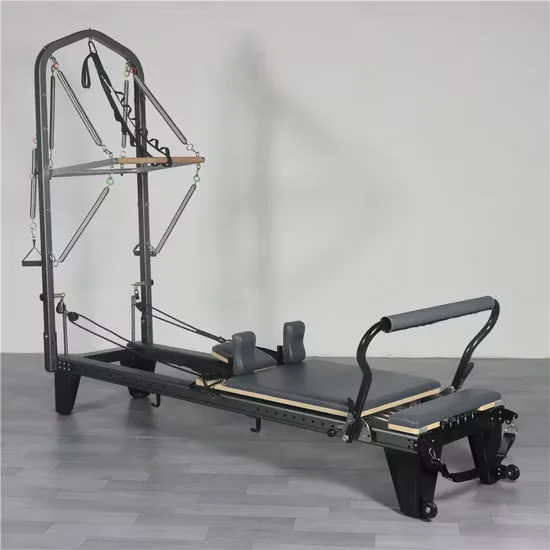
Sub-35dB Operation — Sealed bearings and precision-machined rails verified across hotel deployments where cardio zones share walls with occupied rooms.
Technical Specifications
| Parameter | Value |
|---|---|
| Designation | SRY-11 |
| Product Dimensions | 2390 × 900 × 1960 mm |
| Net Weight | 120 kg |
| Frame Material | Full Aluminum Alloy |
| Resistance Type | Spring-Based Progressive |
| Accessory Options | Long Box / Jump Board / Platform |
| Color | Black |
| Certification | ISO 9001, CE |
| Warranty | 3 Years |
| Logo | Customized Is Allowed |
| Max User Weight | 180 kg |
Application Suitability
| Deployment Scenario | Typical Use |
|---|---|
| Pilates studio and boutique fitness center | Reformer group classes with Tower-assisted Cadillac movements |
| Hotel fitness center on guest room floors | 24/7 self-service access requiring whisper-quiet rail operation |
| Corporate wellness room | Lunch-hour Pilates sessions with quick accessory changeovers |
| High-end residential home gym | Private training combining Reformer and Tower modalities |
| Rehabilitation and physical therapy clinic | Progressive spring-resistance protocols with controlled range of motion |
Why Rail Noise Becomes a Studio Problem Before You Notice It
Full-aluminum framing eliminates the resonance points that steel and wood develop after repeated loading cycles.
Pilates reformers in busy studios run six to eight group classes a day, and the first sign of wear is not visual — it is acoustic. Steel frames transmit spring vibration through the floor, and wooden carriages begin to rattle in their tracks as humidity cycles swell and shrink the material. Members notice before instructors do, and complaints move from whispered feedback to cancellation requests [NEED_CITE: acoustic transmission standards for group fitness environments]. A commercial aluminum Pilates reformer with tower addresses this at the structural level: aluminum does not warp, corrode, or resonate at the frequencies generated by spring-loaded carriage travel.
Where the SRY-11 Fits in a Dedicated Reformer Zone
The SRY-11 covers the full spectrum of classical and contemporary Pilates repertoire when configured with its Tower, Jump Board, Long Box, and Platform accessories. In a studio layout, it pairs naturally with mat stations and small apparatus zones, reducing the need for a separate Cadillac or half-Cadillac footprint. It suits deployment densities where instructors circulate between six and twelve units during group classes, and accommodates users across a broad range of body sizes up to 180 kg. Spring tension can be adjusted mid-class to match individual strength levels, and the Tower adds vertical resistance vectors for standing and kneeling work that a standalone reformer cannot deliver.
Continuous Class Scheduling and Floor-Level Deployment
Studios running back-to-back classes from early morning through evening place cumulative load on every moving part. The sealed bearings and aluminum rail surface maintain consistent carriage glide without the mid-day lubrication breaks that exposed steel tracks require. Floor placement matters: rooms above occupied spaces benefit from the vibration-damping characteristics of the aluminum frame paired with appropriate floor mats. The 2390 × 900 mm footprint allows adequate lateral spacing for instructor passage when units are arranged in rows [NEED_CITE: recommended spacing standards for group Pilates equipment layout]. Overhead lighting and ventilation should account for the 1960 mm Tower height to avoid shadowing and ensure air circulation during high-exertion Jump Board sequences.
Reading the Spring and Rail Specifications
The progressive spring-resistance system delivers load that increases proportionally with carriage travel, which mirrors how muscles engage through a full range of motion. Multiple spring weights allow instructors to dial resistance from rehabilitation-level assistance to advanced athletic loading without mechanical changeovers between users. The precision-machined aluminum rail paired with sealed bearings provides low-friction reciprocating motion — the same engineering principle used in linear guide systems where surface flatness directly determines operational smoothness and long-term wear. Unlike steel rails that require periodic re-greasing, sealed bearings in an aluminum track resist dust and sweat contamination common in high-traffic studio environments [NEED_CITE: sealed bearing lifecycle expectations in fitness equipment applications]. The full-aluminum construction also resists corrosion from humidity and cleaning chemicals, maintaining dimensional stability across seasonal climate shifts.
What Spec-Down Decisions Cost a Studio Over Two Years
Choosing reformers with mixed-material frames or unsealed track systems often surfaces problems around month eight: carriage wobble introduces lateral noise, spring anchor points fatigue unevenly, and wooden carriage platforms crack under Jump Board impact. Studios then face selective unit replacement — pulling one or two machines from rotation while sourcing compatible parts, which fragments class scheduling and erodes member confidence. Aluminum framing with sealed bearings avoids this degradation curve, but only if the rail hardness, spring fatigue rating, and accessory mounting tolerances have been validated under commercial-frequency testing [NEED_CITE: spring fatigue lifecycle testing standards for commercial Pilates equipment].
Why This Product Line Holds Up Under Studio Conditions
Every unit undergoes rail-flatness verification and spring-cycle endurance testing before leaving the production floor, mirroring the 10,000-hour durability protocols applied across the full cardio range. The Tower system mounts directly to the aluminum frame without adapter brackets, maintaining structural rigidity during dynamic movements like Jump Board plyometrics. OEM customization extends to Logo placement and color specification, allowing studios to maintain brand consistency across their equipment fleet. The 120 kg unit weight is manageable for layout reconfigurations without sacrificing frame mass needed for stability during standing Tower work. Facilities sourcing multiple cardio and Pilates disciplines benefit from unified documentation standards, OEM processes, and 24/7 technical support across every product category.
Documentation & Test Records
- CE declaration of conformity covering full unit and accessory assembly
- EN 957 test report validating structural load and safety margins
- ISO 9001 certificate for manufacturing process control
- Spring fatigue lifecycle and resistance decay test record
- Rail flatness and sealed bearing durability verification report
- OEM customization specification and accessory compatibility guide
Installation, Commissioning & Maintenance
- Position with minimum 600 mm lateral clearance for instructor access on the SRY-11 footprint
- Level the aluminum frame on a solid subfloor to prevent carriage drift during use
- Verify Tower mounting bolt torque after the first 50 hours of operation
- Inspect sealed bearings and rail surfaces quarterly for debris contamination
- Check spring anchor points and tension calibration during semi-annual service intervals
- Use pH-neutral cleaners on aluminum surfaces to protect the finish from sweat corrosion
Equipment Selection and Facility Planning
Share your studio floor plan and target class capacity to receive a 3D layout with spacing and airflow recommendations specific to the SRY-11 dimensions. Specify your daily class schedule so we can match spring-duty cycles to your operating intensity. Confirm whether units will be placed on floors above occupied rooms so acoustic isolation requirements can be addressed. State your target market for any region-specific labeling or documentation needs, and indicate whether accessory packages should be standardized or varied across units.
Frequently Asked Questions
Q: How does an aluminum frame compare to steel over years of studio use?
A: Aluminum maintains dimensional stability without rust or warping, which keeps rail flatness consistent through humidity cycles and daily cleaning. Steel frames can develop resonance points and corrosion at weld joints under high-frequency use, leading to carriage noise and uneven glide that requires mid-lifecycle reconditioning or replacement.
Q: What training dimensions does the Tower add to a standard reformer?
A: The Tower introduces vertical spring-resistance vectors for standing, kneeling, and supine exercises that replicate core Cadillac movements. Combined with the Jump Board and Long Box, a single unit covers reformer, mat, and tower-based repertoire, reducing the equipment footprint needed for a full classical Pilates program.
Q: How often do sealed bearings in the rail system need maintenance?
A: Sealed bearings resist sweat and dust ingress, typically requiring only visual inspection and surface cleaning during quarterly service rounds. Unlike open bearings that demand regular lubrication, sealed units maintain consistent glide without scheduled re-greasing, though any lateral play or audible irregularity warrants immediate bearing assessment.
Q: When should springs be replaced on a commercially deployed reformer?
A: Springs in daily studio use should be evaluated for tension consistency during semi-annual service checks. Visible elongation, uneven coil spacing, or measurable resistance decay indicate fatigue. Replacing springs as a matched set rather than individually preserves balanced loading across the carriage.
Q: What should facility buyers verify before ordering multiple reformer units?
A: Confirm aluminum alloy grade and surface treatment specifications, review rail durability test documentation, and validate spring fatigue ratings against your projected class volume. Also verify Tower structural testing, accessory mounting compatibility, and OEM customization scope including Logo placement and color options.


![Senrui Fitness Aluminum Alloy Reformer with Tower Pilates Machine [WARN] draft identifier mismatch](https://bicksport.com/wp-content/uploads/2026/08/senrui-fitness-aluminum-alloy-reformer-with-tower-pilates-machine-warn-draft-identifier-mismatch-e52269.webp)