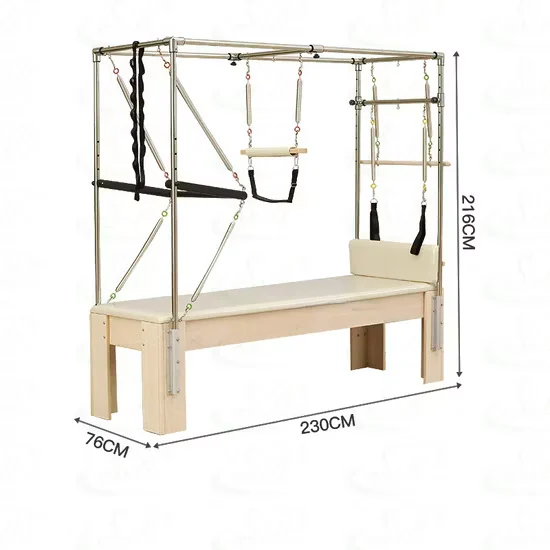
Inherent Vibration Damping — Solid oak wood mass absorbs spring-loaded carriage transitions, eliminating the metallic resonance common in steel-frame Pilates reformers.
Technical Specifications
| Parameter | Value |
|---|---|
| Product Type | Pilates Reformer |
| Model NO. | SRY-20B |
| Material | Oak Wood |
| Product Dimensions | 2400600350mm |
| Weight | 100kgs |
| Foldable | Yes |
| Accessory | Long Box / Jump Board / Platform |
| Color | Solid Color |
| Age | Adult |
| Gender | Unisex |
| Logo | Customized Is Allowed |
| Warranty | 3 Years |
Application Suitability
| Deployment Scenario | Typical Use |
|---|---|
| Boutique Pilates studio with shared walls | Group reformer classes where acoustic bleed disrupts adjacent meditation or yoga sessions |
| Hotel wellness floor requiring multipurpose room conversion | Foldable storage between scheduled sessions to reclaim floor space for evening events |
| Corporate wellness center with limited square footage | Multi-discipline programming sharing the same footprint with strength and flexibility zones |
| High-end residential home gym | Daily use in living areas where visual warmth and quiet operation are priorities |
| Rehabilitation center | Controlled resistance training with accessory integration for progressive recovery protocols |
Why Acoustic Ambiance Fails Before the First Class Begins
Steel-frame reformers generate audible spring clatter and carriage roll noise that travels through shared floors and walls, creating complaints that reach management before instructors notice. Oak wood frame density interrupts this noise path at the source.
I spent years in noise labs measuring structure-borne vibration, and later saw hotel fitness floors in the Middle East where metallic resonance from cardio equipment triggered guest complaints night after night. The principle transfers directly to a foldable oak wood Pilates reformer commercial studios deploy: every spring transition and carriage reversal sends energy into the frame, and what the frame cannot absorb, it transmits into the sub-floor [NEED_CITE: structure-borne vibration transmission in multi-story fitness facilities]. Studios sharing walls with treatment rooms or quiet zones face the same acoustic pressure as hotels placing equipment above occupied guest rooms.
Positioning Within the Studio Equipment Matrix
This Pilates Reformer covers the full resistance spectrum from rehabilitation-grade light loading to advanced athletic conditioning through interchangeable spring configurations. It occupies the core reformer position in a studio layout, complemented by Cadillac towers for vertical work and chair units for standing balance training. The foldable oak wood Pilates reformer commercial studios choose fits multi-use rooms where equipment must clear the floor between class blocks. The 2400mm length accommodates users across a wide height range while the 180kg maximum user weight supports diverse body types without structural deflection.
Continuous Session Scheduling and Room-Level Constraints
A boutique studio running four to six group classes daily subjects each reformer to sustained cycling with minimal cooldown between sessions. The oak frame maintains dimensional stability across temperature and humidity swings typical of high-occupancy wellness floors [NEED_CITE: wood frame dimensional stability under commercial HVAC cycling]. Floor deployment matters: ground-level studios avoid structure-borne noise transmission to rooms below, while upper-floor installations require isolation pads beneath the 100kg unit to decouple carriage impacts from the slab. Level flooring within tolerance prevents rail binding and uneven carriage drift. Studios integrating usage tracking should confirm console or sensor compatibility before specifying data-dependent programming.
Decoding the Frame, Rail, and Spring Interface
The oak wood frame relies on mass and grain structure to absorb vibration rather than transmit it, a fundamental difference from tubular steel that rings at specific resonant frequencies. Mortise-and-tenon or reinforced dowel joinery at stress points resists the cyclic loading of spring transitions over thousands of hours. Carriage wheels paired with precision-ground rails deliver quiet glide when durometer and surface finish are matched correctly, reducing the need for lubrication that disrupts back-to-back class schedules. Spring resistance grading allows instructors to progress clients from light rehabilitation loads to heavy athletic conditioning without swapping equipment. The foldable hinge mechanism must maintain load path integrity when deployed, with no joint play developing through repeated folding cycles [NEED_CITE: hinge cycle testing standards for foldable commercial fitness equipment]. Accessory mounting points for the Long Box, Jump Board, and Platform require reinforced anchoring to handle dynamic plyometric loading without fastener loosening.
The Hidden Cost of Compromised Specifications
Light-duty reformers deployed in high-frequency studios develop carriage wobble and rail wear within months, generating noise that instructors compensate for by raising music volume. Steel frames with inadequate cross-bracing produce harmonic buzz during spring transitions, audible in adjacent treatment rooms. Foldable mechanisms lacking proper load rating develop play that degrades exercise precision and creates safety concerns during dynamic movements [NEED_CITE: commercial fitness equipment fatigue failure under continuous cycling]. Studios replacing under-specified equipment face downtime, member complaints, and re-procurement costs that far exceeded the original savings.
Why This Product Line Addresses Deployment Failures
Verified sub-35dB operation in hotel environments confirms the acoustic engineering translates across equipment categories. Components tested for 10,000+ hours of continuous operation ensure the foldable hinge and rail system endure commercial class schedules. Full OEM customization including logo application allows studio branding alignment. The six-series cardio family means facilities sourcing reformers can specify complementary treadmills and rowing machines from the same engineering standard. Free 3D layout planning accounts for reformer footprint, folded storage zones, and member circulation paths. Round-the-clock technical support covers hinge adjustment and spring replacement guidance.
Documentation & Test Records
- CE declaration of conformity for commercial Pilates equipment
- EN 957 test report covering structural load and safety requirements
- ISO 9001 certificate for manufacturing quality management
- Noise level test report documenting frame and carriage acoustic output
- Durability test record for foldable hinge and rail system cycling
- Accessory mounting load verification for Long Box and Jump Board
Installation, Commissioning & Maintenance
- Maintain clearance around the 2400*600mm footprint for carriage extension and instructor access
- Level the oak frame on isolation pads to prevent rail binding on upper-floor studios
- Verify foldable hinge lock engagement before every class session
- Inspect carriage wheel and rail interface quarterly for wear and debris accumulation
- Check spring anchor points and accessory mounting hardware monthly for fastener tension
- Clean oak surfaces with pH-neutral products to prevent finish degradation from sweat exposure
Equipment Selection and Deployment Inquiry
Provide your studio floor area and planned reformer count to receive a 3D layout with folded storage zones and member flow paths. Specify daily class schedule and session frequency to confirm the oak frame and hinge system match your operational tempo. Indicate deployment floor level and adjacent room types to verify acoustic isolation requirements. State target market for accessory compatibility and branding customization scoping.
Frequently Asked Questions
Q: How does oak wood compare to steel frames for acoustic performance in studios?
A: Oak wood density and grain structure absorb vibration from spring transitions and carriage movement rather than transmitting it through the frame. Steel tubes tend to resonate at specific frequencies, producing audible clatter that travels through floors and shared walls. For studios adjacent to quiet rooms, the inherent damping of solid oak noticeably reduces structure-borne noise without additional isolation measures.
Q: Does repeated folding compromise structural alignment over time?
A: The foldable hinge mechanism is engineered with load path integrity that maintains alignment through commercial cycling. Proper use requires engaging the lock before every session and avoiding lateral force during fold transitions. Studios running high-frequency schedules should include hinge inspection in monthly maintenance checks to confirm no play has developed at the pivot points.
Q: What determines carriage glide quietness and how should it be maintained?
A: Carriage noise depends on wheel durometer matched to rail surface finish and tolerance. Precision-ground rails paired with appropriately hardened wheels deliver quiet glide without frequent lubrication. Maintenance involves quarterly inspection for debris accumulation and wheel wear. Avoid silicone sprays that attract dust and accelerate wear on the rail contact surface.
Q: Can third-party accessories mount without affecting structural warranty?
A: The reformer supports Long Box, Jump Board, and Platform accessories through reinforced mounting points designed for dynamic loading. Third-party add-ons may require different fastener specifications or load distributions not accounted for in the original engineering. Confirm compatibility with the manufacturer before mounting non-standard accessories to avoid voiding the three-year warranty coverage.
Q: How should folded versus deployed dimensions inform studio layout planning?
A: The 2400600350mm deployed footprint determines class spacing and instructor circulation paths, while folded dimensions define storage zones between sessions. Multi-use studios benefit from planning dedicated wall or rack positions for folded units. A 3D layout accounts for both configurations, ensuring members and instructors move safely regardless of whether reformers are active or stored.


![Senrui Fitness Aluminium Alloy Half Tower Pilates Reformer Bed [WARN] draft identifier mismatch](https://bicksport.com/wp-content/uploads/2026/08/senrui-fitness-aluminium-alloy-half-tower-pilates-reformer-bed-warn-draft-identifier-mismatch-ea79df.webp)