
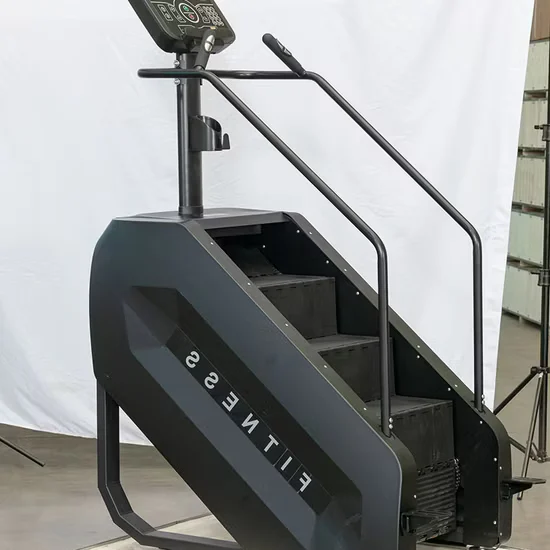
Commercial Duty Cycle Engineering — Motor-driven stair climber validated for continuous operation, addressing premature failure patterns observed when undersized motors face eight-hour daily facility run-times.
Technical Specifications
| Parameter | Value |
|---|---|
| Designation | SQ1017 |
| Product Type | Stair Climber |
| Function | Electric |
| Drive Type | Motor Drive |
| Running Velocity | 15 steps/min – 164 steps/min |
| Step Area | 560 x 235 x 220 mm |
| Material | Steel Pipe + PP Plastic |
| Console Display (OSD) | Time, Climb, Calories, Steps, Heart Rate |
| Mains Input | AC220V±10% / AC110V±10% |
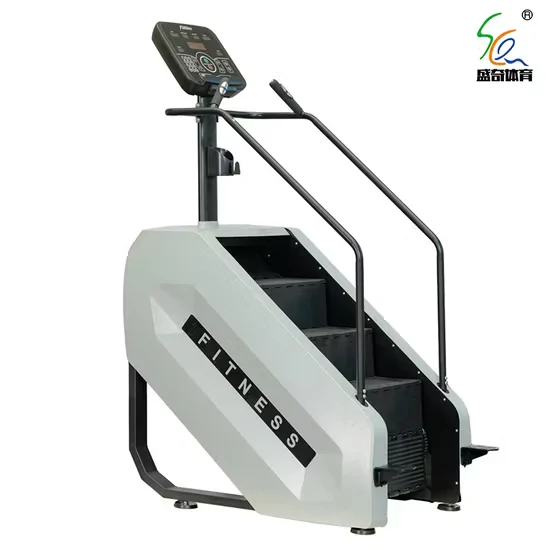
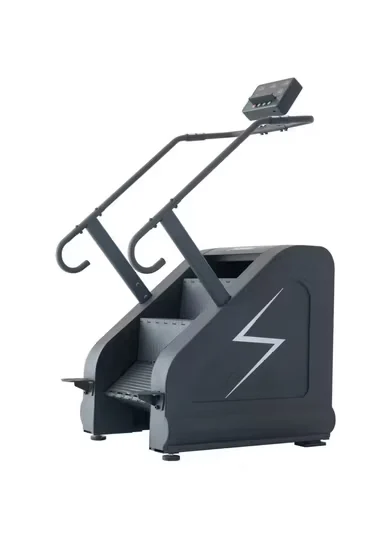
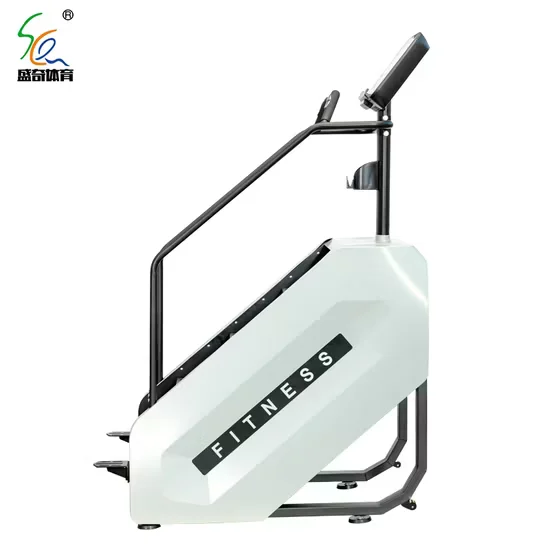
| Product Dimensions | 1450 x 820 x 2080 mm |
| Net Weight | 148 kg |
| Folded | Unfolded |
| Color | Black |
| Certification | CE |
| Customized | Yes (color, logo, specifications) |
Application Suitability
| Deployment Scenario | Typical Use |
|---|---|
| Hotel fitness center on guest room floors | 24-hour guest access with noise-sensitive adjacency to occupied rooms |
| Chain gym cardio zone | High-frequency member traffic during peak operating hours |
| Corporate wellness room | Employee use across staggered break schedules throughout the workday |
| High-end residential home gym | Private daily use with extended session durations |
| Sports performance training center | Athlete conditioning programs requiring precise step velocity control |
Why Motors Burn Out Before the Warranty Expires
Continuous duty rating, not peak horsepower, determines whether a commercial stair climber motor driven gym deployment survives its first year.
Light-commercial stair climbers specified for intermittent home duty cycles routinely fail within months when subjected to continuous public facility run-times. The motor windings overheat during back-to-back user sessions, insulation degrades, and the unit goes offline — generating maintenance tickets, member complaints, and replacement costs that dwarf the original equipment savings. I watched this pattern repeat with undersized motors burning out under sustained facility loads before we committed to testing every drive system against 10,000-hour continuous operation benchmarks [NEED_CITE: motor duty cycle classification for continuous commercial operation].
Step Velocity Range and Training Zone Coverage
This unit covers a step velocity range from 15 to 164 steps per minute, accommodating warm-up progression through high-intensity interval protocols without abrupt resistance jumps. In a mixed cardio zone, it pairs with steady-state machines like ellipticals and rowing ergometers to provide vertical load variety. The motor-driven system delivers consistent step cadence regardless of user weight within the rated capacity, making it suitable for deployment in high-throughput zones where members cycle through equipment in rapid succession. The commercial stair climber motor driven gym configuration fits a footprint of 1450 x 820 mm, requiring standard lateral clearance for safe mounting and dismounting.
Continuous Operation and Facility Environment Demands
Facilities running cardio equipment across twelve or more daily hours demand motors rated for sustained thermal load, not intermittent duty. This motor drive system is engineered for continuous operation aligned with extended durability testing protocols. The steel pipe and PP plastic construction dissipates heat through the open frame geometry, but deployment still requires adequate airflow around the motor housing — particularly when units are positioned against walls or in enclosed alcoves. Dual voltage compatibility (AC220V±10% / AC110V±10%) eliminates power standard mismatches that surface only after equipment arrives at international deployment sites. Floor leveling and vibration isolation pads remain essential to prevent resonant transfer to adjacent occupied spaces [NEED_CITE: EN 957 requirements for commercial cardio equipment].
Electric Drive System and Console Data Architecture
The motor drive system maintains step velocity through electronic speed control rather than user-generated momentum, delivering consistent cadence across the full 15–164 steps/min range. The console tracks Time, Climb, Calories, Steps, and Heart Rate through an OSD interface, providing real-time workout metrics visible during use. Heart rate data is captured via contact sensors on the handlebar grips, which offer reasonable accuracy for general intensity monitoring during continuous climbing sessions. The step area dimensions of 560 x 235 x 220 mm accommodate a wide range of user foot sizes while maintaining secure foot placement during high-cadence intervals. Motor-driven operation requires continuous electrical input, making dedicated circuit allocation a planning consideration during facility electrical design.
What Specification Compromises Cost in Practice
Undersized motors installed in commercial facilities fail prematurely, generating service calls and member frustration that compounds across the equipment lifecycle. Noise from inadequately isolated drive systems triggers complaints from adjacent hotel guest rooms or residential units, sometimes forcing entire cardio zones to relocate. Console systems that cannot export usage data leave facility operators blind to equipment utilization patterns, making replacement planning reactive rather than evidence-based. Voltage mismatches discovered post-shipment delay deployment timelines and incur rewiring costs that could have been eliminated during specification review [NEED_CITE: commercial facility cardio equipment failure modes].
Why This Product Line Addresses Facility Procurement Pain Points
Every unit undergoes continuous operation testing aligned with 10,000-hour durability benchmarks, verifying motor, frame, and bearing performance under sustained load. The dual voltage input eliminates the most common international deployment mismatch before production begins. The console OSD architecture provides real-time metric display while maintaining compatibility pathways for facility management data integration. OEM customization extends to color, logo, and specification adjustments at flexible minimum order quantities. The 1450 x 820 mm footprint allows standard commercial cardio zone spacing, and free 3D layout planning addresses sightline and airflow considerations before equipment ships. Technical support operates on a 24/7 response model to minimize facility downtime.
Documentation & Test Records
- CE declaration of conformity for this stair climber model
- EN 957 test report covering structural and performance requirements
- ISO 9001 certificate for the manufacturing quality system
- Noise level test report documenting operational acoustic output
- Durability test record validating continuous motor and frame performance
- Motor specification sheet detailing continuous duty parameters
- Console technical documentation with OSD interface specifications
- Installation and commissioning guide with spare parts list
Installation, Commissioning & Maintenance
- Maintain minimum clearance of 500 mm on all sides around the 1450 x 820 mm footprint for safe mounting
- Install vibration isolation pads beneath the 148 kg unit to prevent resonant transfer to adjacent floors
- Connect to a dedicated circuit matching the specified AC220V±10% or AC110V±10% input requirement
- Calibrate step velocity sensor during first power-on to verify 15–164 steps/min range accuracy
- Inspect motor drive belt tension and step mechanism lubrication at scheduled maintenance intervals
- Wipe console OSD display and handlebar heart rate sensors after each use to prevent sweat corrosion
Equipment Selection and Specification Matching
Provide your cardio zone square footage and equipment count to receive a 3D layout with airflow planning specific to this stair climber’s footprint. Specify your average daily operating hours so we can confirm motor duty cycle alignment with your facility’s usage intensity. Identify the deployment floor and adjacent occupied spaces to verify noise transmission requirements match the unit’s acoustic profile. Confirm your target market voltage standard so the correct power input configuration ships from the production line. Indicate whether console data output needs to interface with your existing facility management software.
Frequently Asked Questions
Q: What is the difference between motor-driven and self-powered stair climbers for commercial use?
A: Motor-driven stair climbers use an electric motor to control step velocity, maintaining consistent cadence regardless of user effort level. Self-powered units rely entirely on user-generated force to drive the mechanism, which creates variable speed and higher joint loading at low cadences. For commercial facilities where members expect predictable resistance and smooth acceleration from warm-up through interval work, motor-driven systems deliver more consistent user experience across the full 15 to 164 steps per minute range.
Q: How does the electric drive system maintain quiet operation during continuous facility use?
A: The motor drive system operates through controlled electromagnetic force rather than mechanical friction mechanisms that generate audible wear signatures over time. The steel pipe frame construction provides structural rigidity that prevents resonant vibration amplification during sustained operation. Proper installation with vibration isolation pads and floor leveling further reduces acoustic transfer to adjacent occupied spaces, which is critical for hotel fitness centers positioned on guest room floors.
Q: Can the console data sync with facility management software or member apps?
A: The console OSD tracks Time, Climb, Calories, Steps, and Heart Rate for real-time display during workouts. The data architecture is designed with integration pathways, but specific facility management software compatibility depends on the API protocols your system requires. We provide console technical documentation detailing the available data output specifications so your IT team can evaluate integration feasibility before placing an order.
Q: What voltage and plug standards are supported for international deployment?
A: This unit accepts AC220V±10% or AC110V±10% input, covering the primary voltage standards across most international markets. However, plug type varies by region and must be specified before production to avoid post-shipment rewiring. We confirm your target deployment country’s voltage and plug standard during the quotation stage so the correct configuration ships directly from the factory.
Q: How does the 10,000-hour durability testing translate to real-world facility uptime?
A: The durability testing protocol subjects the motor, frame, and drive components to continuous operation cycles that simulate high-frequency commercial facility use. This testing identifies failure modes before production, allowing design adjustments that prevent premature burnout under sustained daily run-times. Facilities deploying equipment for twelve or more hours daily benefit from components validated against continuous load rather than intermittent home-use duty cycles.
![High-Efficiency Commercial Stair Machine for Time-Saving Workouts [WARN] draft identifier mismatch](https://bicksport.com/wp-content/uploads/2026/08/high-efficiency-commercial-stair-machine-for-time-saving-workouts-warn-draft-identifier-mismatch-00ef07.webp)