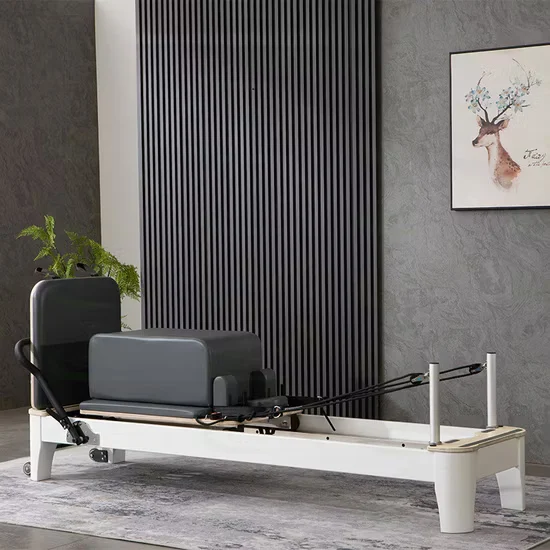
Solid Maple Vibration Dampening — The 100kg solid maple wood frame absorbs carriage resonance naturally, keeping floor-transmitted noise out of occupied rooms below.
Technical Specifications
| Parameter | Value |
|---|---|
| Designation | SRY-02 |
| Product Type | Wood Pilates Reformer |
| Frame Material | Solid Maple Wood |
| Color | Solid Color |
| User Profile | Adult, Unisex |
| Accessories | Long Box / Jump Board / Platform |
| Product Dimensions | 2460730680mm |
| Net Weight | 100kgs |
| Warranty Time | 3 Years |
| Production Capacity | 80 Pieces/Month |
| HS Code | 9506911900 |
| Logo Customization | Customized Is Allowed |
Application Suitability
| Deployment Scenario | Typical Use |
|---|---|
| Boutique Pilates studio with shared walls | Group reformer classes requiring low noise transfer between adjacent rooms |
| High-end residential home gym on upper floors | Private practice sessions where carriage noise must not reach living spaces below |
| Rehabilitation and physiotherapy clinic | Controlled resistance progression for patient recovery in quiet clinical environments |
| Hotel fitness center on guest room floors | 24-hour self-service access without mechanical noise disturbing guests in adjacent rooms |
Why Studio Owners Replace Budget Reformers Within the First Year
Spring rattle and carriage vibration generate complaints long before the frame shows structural wear.
Many commercial Pilates studios start with budget reformers that look acceptable during showroom demos but reveal their acoustic shortcomings once installed in multi-unit layouts. The metallic clanking from loosely toleranced spring housings and thin carriage wheels transfers through hardwood floors and shared walls, disrupting concentration during classes and triggering noise complaints from neighboring tenants [NEED_CITE: acoustic transfer characteristics of spring-based resistance systems in multi-unit fitness deployments]. I have seen studio operators in leased commercial spaces face lease penalties because the reformer vibration traveled through floor joists into the office below. This custom wood Pilates reformer maple commercial studio unit addresses that problem at the frame level — solid maple absorbs harmonic vibration rather than amplifying it the way steel or composite frames do.
Positioning Within a Studio Cardio and Mind-Body Zone
This custom wood Pilates reformer maple commercial studio reformer covers the full spectrum of Pilates programming from foundational mat-equivalent movements through advanced spring-loaded resistance work. In a mixed-use studio layout, it pairs naturally with mat stations for warm-up sequences and with tower or chair units for progressive overload sessions. The 2460*730mm footprint allows deployment in rooms where instructors need clear sightlines across multiple stations simultaneously. The unisex adult design accommodates the broadest possible member range without requiring separate equipment tiers, while the Long Box, Jump Board, and Platform accessories eliminate the need for supplementary apparatus in most class formats.
Floor Loading and Acoustic Deployment Requirements
The 100kg net weight provides inherent stability during dynamic jump board and standing work without requiring bolt-down installation, which protects floor finishes in leased spaces where permanent modifications are prohibited. However, that same mass means floor load calculations must account for concentrated point loading when multiple custom wood Pilates reformer maple commercial studio units are arranged in group class configurations [NEED_CITE: floor load capacity requirements for concentrated fitness equipment placement]. In upper-floor residential and hotel deployments, the solid maple frame naturally attenuates carriage vibration before it reaches the floor surface, but proper leveling on uneven subfloors remains essential to prevent the carriage from drifting and generating secondary noise. Adequate ventilation around each station prevents spring housing moisture accumulation in humid climates.
Spring Tension Mechanics and Carriage Glide Engineering
Solid maple wood differs fundamentally from steel or aluminum framing in its vibration absorption profile — the natural fiber structure dissipates harmonic energy from carriage transitions rather than reflecting it back into the room as audible resonance. The spring-based resistance system requires periodic tension verification because metal fatigue in extension springs gradually alters the force curve, making resistance feel inconsistent to experienced practitioners who rely on predictable load progression. Carriage wheel material directly affects both glide smoothness and noise generation — harder wheels roll freely but transmit more vibration through the rails, while softer compounds absorb vibration at the cost of increased rolling resistance. The 100kg unit weight ensures the frame remains stationary during explosive jump board work without shifting on smooth floor surfaces.
What Happens When Frame Specifications Are Compromised
Reformers built with composite or laminated wood frames often develop micro-fractures at stress concentration points within months of continuous commercial use, leading to carriage wobble and inconsistent rail alignment that experienced instructors detect immediately. Lightweight frames under 80kg shift during dynamic movements, forcing users to compensate for equipment instability rather than focusing on controlled movement patterns [NEED_CITE: structural fatigue patterns in commercial Pilates equipment under continuous scheduling]. Studios that selected reformers based primarily on price point report higher member attrition rates because inconsistent spring tension and noisy carriage operation undermine the premium experience that justifies Pilates class pricing. Voltage or environmental mismatches are less relevant for purely mechanical equipment, but humidity-induced wood warping in poorly climate-controlled spaces creates the same operational disruptions.
Why This Product Line Supports Mixed Deployment Scenarios
The sub-35dB acoustic engineering principles developed for commercial cardio equipment apply directly to reformer deployment in noise-sensitive environments — the solid maple frame selection and carriage tolerance specifications reflect the same priority on preventing noise complaints before they reach facility management. The 10,000-hour durability testing protocols used on cardio motors inform the spring cycle testing and rail wear validation performed on each reformer unit before shipment. The complete accessory ecosystem — Long Box, Jump Board, and Platform — means a studio can source full-spectrum programming equipment from a single product line rather than managing multiple vendor relationships. The free 3D layout and airflow planning service accounts for reformer station spacing, instructor sightlines, and ventilation requirements specific to Pilates environments where heat buildup affects practitioner comfort during extended sessions [NEED_CITE: commercial Pilates studio layout spacing and airflow requirements].
Documentation & Test Records
- CE declaration of conformity for Pilates resistance equipment
- EN 957 test report covering structural load and spring tension safety
- ISO 9001 certificate for manufacturing quality management
- Maple wood frame grade and finish specification documentation
- Spring tension range and progression calibration sheet
- Carriage wheel material specification and glide noise test record
Installation, Commissioning & Maintenance
- Allocate minimum 600mm clearance around the 2460730680mm frame for safe movement and instructor access
- Level the solid maple frame on uneven subfloors using adjustable foot pads to prevent carriage drift
- Verify spring tension calibration across all resistance levels during initial commissioning
- Inspect carriage wheel condition and rail lubrication at monthly intervals under commercial scheduling
- Clean maple wood surfaces with pH-neutral products to prevent finish degradation from sweat contact
- Document spring replacement cycles for warranty compliance under the 3-year coverage period
Equipment Selection and Deployment Planning
Provide your studio floor plan and intended reformer count to receive a 3D layout that accounts for instructor sightlines, member flow between stations, and ventilation requirements specific to group class environments. Specify whether deployment is on a ground floor or upper level so that floor load calculations and acoustic isolation measures can be confirmed before equipment selection. Identify the target market and end-user profile so that spring tension calibration and accessory configuration align with the programming you intend to offer. State whether logo customization or specific wood finish requirements apply to your order.
Frequently Asked Questions
Q: How does maple wood compare to birch or beech for reformer frame durability?
A: Maple has a tighter grain structure and higher density than birch or beech, which translates to superior vibration absorption and resistance to surface denting from repeated accessory mounting. In commercial studio environments where reformers see continuous daily use, maple frames maintain rail alignment and carriage glide consistency longer than softer hardwood alternatives, reducing the frequency of maintenance interventions required to keep equipment operating smoothly.
Q: How should spring tension be calibrated for different user levels in a group class setting?
A: Springs should be organized by color-coded resistance levels and verified against a tension gauge during commissioning to ensure consistent force curves across identical units. For mixed-level classes, instructors typically assign lighter springs to beginners and progressively heavier configurations to advanced practitioners, but the actual tension progression must be documented so that users transitioning between reformers experience predictable resistance rather than unexpected load variations.
Q: What is the expected carriage wheel replacement cycle under commercial studio scheduling?
A: Carriage wheel lifespan depends on usage frequency, user weight distribution, and rail maintenance practices, but commercial studios running multiple daily classes typically inspect wheels monthly and plan replacement when surface wear creates audible friction or visible flat spots. Keeping rails clean and properly lubricated extends wheel life significantly, while neglecting rail maintenance accelerates wheel degradation and generates noise complaints from practitioners.
Q: How much floor space should be allocated between reformer stations in a group class layout?
A: Minimum spacing between reformer stations should account for the full 2460mm frame length plus extension when accessories like the Long Box or Jump Board are in use, plus lateral clearance for instructor access and participant movement. Studios running synchronized group classes need additional width between units so that practitioners performing wide-stance or extended-limb movements do not contact neighboring equipment during sessions.
![Pilates Reformer with Tower Aluminium Fitness Training Equipment [WARN] draft identifier mismatch](https://bicksport.com/wp-content/uploads/2026/08/pilates-reformer-with-tower-aluminium-fitness-training-equipment-warn-draft-identifier-mismatch-17d781.webp)