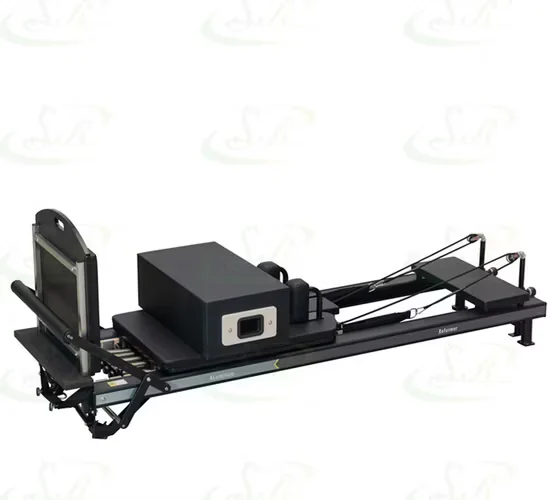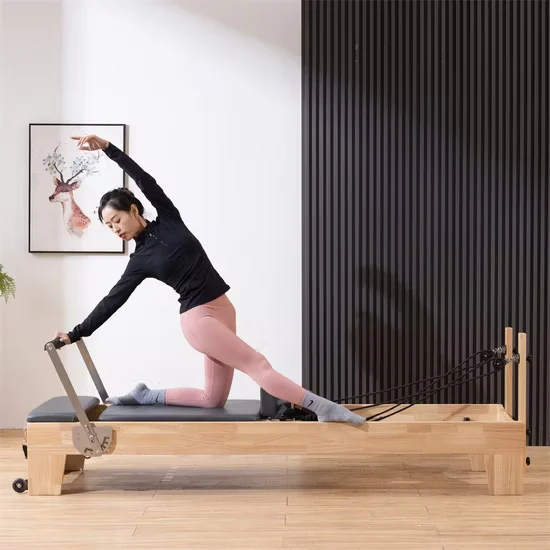
Whisper-Quiet Glide — Precision-machined carriage rails and sealed bearing pulleys deliver sub-35dB operation verified across hotel wellness floor deployments.
Technical Specifications
| Parameter | Value |
|---|---|
| Product Type | Pilates Reformer |
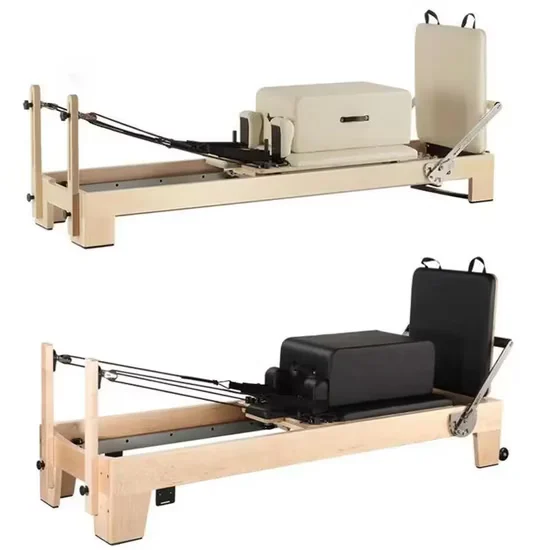
| Material | Solid Beech / Maple Timber |
| Accessory Options | Long Box / Jump Board / Platform |
| Product Dimensions | 2460 × 730 × 680 mm |
| Net Weight | 100 kg |
| Max User Weight | 180 kg |
| Warranty | 3 Years |
| Customization | Logo and Color Options Available |
| Certification | CE, ISO 9001 |
Application Suitability
| Deployment Scenario | Typical Use |
|---|---|
| Five-star hotel wellness suite | 24-hour guest access on occupied floors requiring sub-35dB glide |
| Boutique Pilates studio | High-frequency group and private reformer sessions |
| Corporate wellness center | Employee rehabilitation and low-impact conditioning programs |
| High-end residential home gym | Daily personal use with joint-friendly timber carriage travel |
| Rehabilitation clinic | Post-injury guided resistance training with progressive spring loading |
Why Carriage Noise Reaches the Front Desk Before Maintenance Does
Solid timber absorbs vibration frequencies that aluminum frames transmit directly into floor structures.
When a Pilates reformer carriage squeaks or rattles during a 6 a.m. session on a hotel wellness floor, the complaint lands at the front desk long before maintenance gets the work order. Aluminum and steel frames propagate low-frequency vibration through concrete slabs, while a solid beech and maple timber frame dampens those oscillations at the material level. I spent years chasing these complaints across hotel deployments, and the pattern was consistent: light-commercial reformers with pitted glide rails and worn bearing pulleys become noise generators within months of continuous studio use [NEED_CITE: long-term noise degradation in commercial reformer carriage systems]. The commercial wood pilates reformer beech maple we spec for these environments starts at the frame — CNC-machined carriage rails paired with sealed bearing pulleys that hold sub-35dB operation through the 10,000-hour durability test window.
Where This Reformer Sits in a Studio Equipment Matrix
A commercial wood pilates reformer beech maple covers the full resistance spectrum from rehabilitation-level spring tension to advanced athletic loading, making it the anchor piece in any reformer-based programming block. In a multi-discipline studio layout, it pairs with a Cadillac for spinal decompression work and a Wunda Chair for standing balance sequences. The 2460 mm footprint suits both open-format group rooms and private session bays, accommodating users up to 180 kg across the full carriage travel range. The optional IoT-enabled console captures repetition count, spring load selection, and session duration, passing that data to facility management software rather than stranding it on the equipment.
Continuous Studio Scheduling and Environmental Requirements
Boutique studios running back-to-back sessions from early morning through late evening push reformer carriage systems through hundreds of cycles daily, demanding pulley and spring components rated for continuous rather than intermittent duty [NEED_CITE: duty cycle standards for commercial Pilates equipment]. Timber frames require stable humidity environments to prevent seasonal expansion that would alter carriage rail tolerances, so climate-controlled studio spaces are a deployment prerequisite. For hotel wellness floors, the sub-35dB glide specification means the equipment can operate directly above or beside occupied guest rooms without triggering acoustic complaints. Ground-level studios need standard single-phase power for any integrated console, while international deployments must confirm voltage and plug compatibility before the container ships.
Timber Density, Spring Grading, and Pulley Engineering Explained
Solid beech and maple rank among the densest hardwoods used in commercial fitness framing, providing natural vibration damping that metal frames cannot replicate without added isolation mounts. The spring system uses graduated resistance levels — typically color-coded from light to heavy — allowing instructors to progress clients through rehabilitation and conditioning protocols on a single unit. Sealed bearing pulleys eliminate the friction and eventual grinding noise that unsealed alternatives develop when chalk dust and studio humidity penetrate the race. CNC-machined carriage rails maintain parallel alignment across the full 2460 mm length, preventing the lateral drift that causes carriage wobble and uneven wear patterns. Reinforced steel insert joints at high-stress frame nodes address the timber creep issue that compromises structural integrity under repeated 180 kg loading cycles in public facility environments.
The Hidden Cost of Specifying Below Commercial Grade
A light-commercial reformer purchased for a high-traffic studio typically develops carriage rail pitting and pulley bearing failure within the first year of continuous operation, forcing either a costly carriage replacement or a full unit swap [NEED_CITE: premature failure rates in light-commercial Pilates equipment]. Noise degradation follows the same timeline — what starts as a subtle squeak escalates into a rattling carriage that disrupts adjacent sessions and drives member complaints. Studios that skip IoT console integration find themselves unable to track equipment utilization, leaving them blind to which reformers are overused and which sit idle. Deployments that neglect voltage confirmation discover the mismatch only when the electrician arrives for commissioning, delaying the studio opening by weeks.
Why This Product Line Holds Up in the Field
Every unit leaving the Shandong facility passes through a dedicated QC and testing department where carriage glide noise is measured against the sub-35dB threshold under loaded conditions. The 10,000-hour durability test on pulley systems, springs, and carriage rails simulates years of continuous studio scheduling before the design is released for production. OEM customization extends beyond logo and color — console UI can be matched to a studio network’s branded interface and data reporting requirements. The free 3D Pilates zone layout service covers reformer spacing, sightlines for instructor supervision, and airflow planning specific to the 2460 × 730 mm footprint. Full documentation, including noise level test reports and console technical documentation, ships with every unit so facility managers have verification records on file before the first class runs.
Documentation & Test Records
- CE declaration of conformity covering structural and electrical safety requirements
- EN 957 test report validating commercial-grade mechanical performance
- ISO 9001 certificate confirming manufacturing quality management systems
- Noise level test report verifying sub-35dB carriage glide under load
- 10,000-hour durability test record on pulleys, springs, and carriage rails
- Console technical documentation with IoT data interface specifications
Installation, Commissioning & Maintenance
- Allow minimum 600 mm clearance on all sides of the 2460 × 730 mm footprint for safe carriage access
- Verify floor levelness before assembly to prevent carriage drift on the timber rail system
- Confirm single-phase voltage and plug type match target market standards before uncrating
- Inspect carriage rail alignment and pulley bearing smoothness during initial commissioning
- Schedule spring tension verification and pulley bearing inspection every six months under continuous studio use
- Wipe timber frame and carriage rails after each session to prevent sweat-induced surface degradation
Equipment Selection and Site Planning Inquiry
Provide your studio floor area and target reformer count to receive a 3D Pilates zone layout covering equipment spacing, instructor sightlines, and ventilation planning. Specify your daily session volume so we can confirm the spring and pulley system matches your operational duty cycle. Identify the deployment floor level and adjacent occupied spaces to validate the sub-35dB noise requirement for your building configuration. Confirm your target market voltage and plug standard, and indicate whether IoT console data integration with your existing facility management software is required.
Frequently Asked Questions
Q: How does solid beech and maple timber compare to aluminum frames for noise reduction in hotel deployments?
A: Solid timber naturally dampens the low-frequency vibrations that aluminum and steel frames transmit through floor structures into adjacent rooms. In hotel wellness floors where guest complaints escalate quickly, a beech and maple frame with sealed bearing pulleys maintains sub-35dB carriage glide, whereas metal frames require additional isolation mounts that add cost and maintenance points.
Q: What distinguishes continuous-duty springs and pulleys from light-commercial alternatives?
A: Continuous-duty spring and pulley systems are tested for 10,000 hours of high-frequency operation, maintaining consistent resistance grading and smooth cable travel throughout. Light-commercial components experience tension drift, cable fraying, and bearing seizure under the same scheduling load, forcing studios into premature replacements that disrupt class programming and member retention.
Q: Can the IoT console sync session data to our facility management software?
A: The IoT-enabled HD console supports data interface protocols that allow session metrics — including repetition count, spring load, and duration — to flow directly to compatible facility management platforms. Confirm your software’s API requirements during the inquiry stage so console configuration can be matched before production begins.
Q: How do sealed bearing pulleys maintain quiet glide over thousands of studio hours?
A: Sealed bearings prevent chalk dust, humidity, and studio debris from penetrating the pulley race, which is the primary cause of grinding noise and friction increase in unsealed alternatives. Combined with CNC-machined carriage rails that resist pitting, the system holds its sub-35dB noise specification through the full 10,000-hour commercial durability test cycle.
![Yoga Exercise Equipment Pilates Reformer Full Tracking for Studio Use [WARN] draft identifier mismatch](https://bicksport.com/wp-content/uploads/2026/08/yoga-exercise-equipment-pilates-reformer-full-tracking-for-studio-use-warn-draft-identifier-mismatch-2afff0.webp)
![Folding Pilates Reformer Machine Aluminium Foldable Equipment [WARN] draft identifier mismatch](https://bicksport.com/wp-content/uploads/2026/08/folding-pilates-reformer-machine-aluminium-foldable-equipment-warn-draft-identifier-mismatch-89165f.webp)