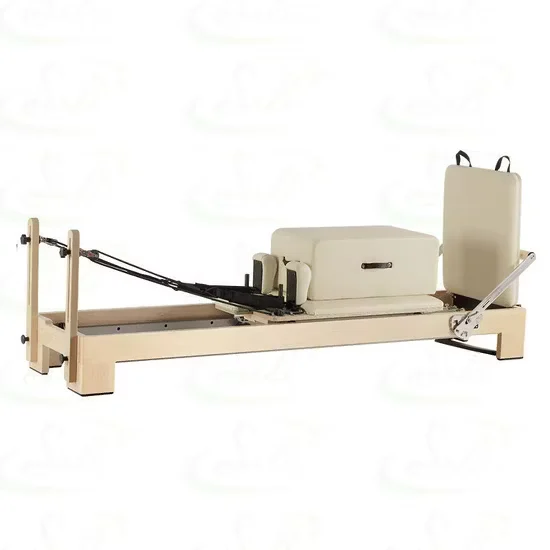
Smooth Carriage Travel — Aluminium extrusion rails and sealed pulley assemblies keep the reformer carriage gliding quietly under continuous studio scheduling.
Technical Specifications
| Parameter | Value |
|---|---|
| Designation | SRY-12 |
| Product Type | Pilates Reformer |
| Frame Material | Aluminium |
| Color | White |
| Accessory | Long Box / Jump Board / Platform |
| Product Dimensions | 2570 × 730 × 270 mm |
| Net Weight | 90 kg |
| Logo | Customized Is Allowed |
| Production Capacity | 80 Pieces/Month |
| Warranty | 3 Years |
Application Suitability
| Deployment Scenario | Typical Use |
|---|---|
| Boutique Pilates studio | Group reformer classes and private sessions |
| Five-star hotel wellness floor | Guest-accessible Pilates suite and spa adjacency |
| High-end residential fitness room | Low-noise reformer training in shared buildings |
| Corporate wellness center | Employee recovery and mobility programming |
Why Carriage Noise Undermines Studio Retention Before Instructors Notice
Aluminium extrusion rails paired with sealed pulleys prevent the metallic rattle that drives members toward competing studios.
Pilates studios occupying upper floors of mixed-use commercial buildings routinely receive noise complaints from the offices or residences below. The source is rarely the springs themselves; it is the carriage contacting the rail at transition points during footwork sequences and jump board intervals. Over months of high-frequency class scheduling, steel-on-steel contact surfaces develop wear patterns that amplify vibration into the floor slab. Facility operators often discover the issue only after members cancel memberships citing an uncomfortable training environment [NEED_CITE: acoustic transmission through floor slabs in multi-tenant fitness facilities]. A commercial aluminium Pilates reformer equipment specification addresses this at the structural level by damping resonance before it reaches the building structure.
Where This Reformer Fits in a Mixed-Discipline Cardio and Mobility Zone
The SRY-12 covers the full spectrum of reformer programming from rehabilitative spring progressions through advanced jump board plyometrics. In a facility that already stocks treadmills and ellipticals, this commercial aluminium Pilates reformer equipment occupies the low-impact, high-control training niche that retains members who avoid high-velocity cardio. It pairs naturally with mat zones and stretch areas, allowing instructors to route clients through a mobility circuit without changing rooms. The 2570 mm footprint requires clearance on three sides for instructor access during group classes, and the aluminium frame weight allows repositioning when the studio reconfigures for different class formats.
Continuous Scheduling and the Acoustic Demands of Upper-Floor Deployment
A studio running six group classes daily places the carriage in near-constant motion across eight or more operating hours. Each class cycles through dozens of spring-loaded transitions, and the cumulative vibration energy transfers through the frame legs into the subfloor. Upper-floor deployments above occupied hotel rooms or office spaces require isolation pads beneath each foot and verification that the floor slab can absorb low-frequency resonance. The aluminium frame naturally dampens higher frequencies compared to welded steel, but facility planners should still confirm ceiling clearance, HVAC airflow across the carriage travel path, and proximity to noise-sensitive adjacent rooms before finalizing the layout [NEED_CITE: vibration isolation requirements for upper-floor fitness equipment].
What the Frame and Accessory Specs Actually Mean for Class Programming
The aluminium frame delivers rigidity without the mass of welded steel, keeping net weight at 90 kg so two staff members can reposition the unit for studio reconfigurations. The long box extends the carriage surface for supine and seated work, the jump board converts the foot end into a plyometric platform, and the platform attachment creates a stable standing surface for balance sequences. These three accessories allow a single reformer to support beginner through advanced class tiers without requiring additional equipment. The three-year warranty signals that the manufacturer expects the frame, rail, and pulley assembly to endure the duty cycle of a commercial studio schedule rather than a home-user pattern.
The Hidden Cost of Compromising on Rail Material and Pulley Seals
Studios that source reformers with unsealed pulley bearings typically face carriage roughness complaints within the first year of heavy scheduling. The bearings ingest chalk dust, sweat aerosol, and lint from studio flooring, creating grinding friction that transfers into the rail and eventually the floor. Replacing pulleys across a fleet of ten or more reformers mid-contract is disruptive and expensive, and members notice the inconsistency between units during partner classes. Facilities that selected reformers without verifying the accessory ecosystem also discover that third-party jump boards and boxes do not align with the carriage mounting points, forcing programming compromises or unsafe adapter solutions [NEED_CITE: accessory mounting compatibility across reformer frame geometries].
Why This Product Line Was Engineered for Studio Environments
The SRY-12 was validated through continuous carriage-cycle testing that simulates the transition frequency of back-to-back group classes. The aluminium extrusion process produces a rail profile that maintains dimensional tolerance across temperature fluctuations common in studios with large window walls. The accessory mounting points are machined into the frame rather than bolted on as afterthoughts, ensuring the long box and jump board register flush with the carriage surface. Customizable logo placement allows multi-location studio networks to maintain brand consistency across every unit. The 80-piece monthly production capacity supports phased rollout for facilities expanding from a pilot studio to a regional chain without lead-time bottlenecks.
Documentation & Test Records
- CE declaration of conformity covering the complete SRY-12 assembly
- EN 957 test report validating structural and mechanical safety requirements
- ISO 9001 certificate documenting manufacturing process control
- Noise level test report measuring carriage travel acoustic output
- Durability test record logging continuous carriage cycle performance
- Accessory fit and load verification for long box, jump board, and platform
Installation, Commissioning & Maintenance
- Maintain 600 mm clearance on both sides and 900 mm at each end for instructor circulation around the 2570 × 730 mm footprint
- Place isolation pads beneath all frame feet to decouple aluminium resonance from the floor slab
- Verify floor levelness within 3 mm across the footprint to prevent carriage drift during supine exercises
- Inspect pulley seals and rail surface every 90 days under commercial scheduling and clean with non-solvent wipe
- Confirm accessory mounting pins engage fully before each jump board and platform class segment
- Wipe aluminium frame with pH-neutral cleaner after each class to prevent sweat-induced surface oxidation
Planning Your Studio Layout and Equipment Specification
Provide your Pilates zone dimensions and intended class capacity so we can generate a 3D layout showing reformer spacing, instructor sightlines, and airflow pathways. Confirm whether the deployment floor sits above occupied rooms so we can specify isolation requirements and noise thresholds. State your target market so we can verify accessory documentation and labeling compliance. Indicate whether you need customized console or branding integration across a multi-location rollout.
Frequently Asked Questions
Q: What advantages does an aluminium frame offer over welded steel for a Pilates reformer?
A: Aluminium reduces overall unit weight to 90 kg, allowing two staff members to reposition the reformer for studio reconfigurations. The extrusion process produces a rail profile that dampens high-frequency resonance, keeping carriage travel quiet in multi-tenant buildings. Aluminium also resists corrosion from sweat aerosol without requiring painted coatings that chip over time.
Q: How should I evaluate carriage rail smoothness before committing to a fleet purchase?
A: Request a noise level test report documenting carriage travel decibel output under loaded conditions. Run the carriage through full extension and return cycles at the speed your instructors cue transitions, listening for clicking or grinding at mid-rail. Confirm the pulley bearings are sealed against chalk dust and sweat aerosol ingress that accelerates wear.
Q: What exercises do the long box, jump board, and platform accessories enable?
A: The long box extends the carriage surface for seated and supine pulling sequences and spinal articulation work. The jump board converts the foot end into a plyometric surface for cardiovascular intervals within a reformer class. The platform creates a stable standing zone for balance and proprioception exercises that would otherwise require a separate apparatus.
Q: How does spring resistance progression affect beginner and advanced class compatibility?
A: A reformer with multiple spring attachment points allows instructors to scale resistance from rehabilitative loads through advanced athletic programming on the same unit. Confirm the spring set includes at least four tension levels so a single reformer can serve mixed-ability group classes without requiring equipment swaps between sessions.
Q: What does the three-year warranty cover under commercial studio deployment?
A: The warranty covers structural frame integrity, rail dimensional tolerance, and pulley assembly function under the duty cycle expected in a commercial Pilates studio. It does not cover consumable springs, upholstery wear, or damage from unapproved accessory adapters. Confirm the specific exclusion list and the claim submission process before finalizing your purchase order.
![Commercial Pilates Reformer Machine Aluminum Frame for Studio Use[WARN] draft identifier mismatch](https://bicksport.com/wp-content/uploads/2026/08/commercial-pilates-reformer-machine-aluminum-frame-for-studio-usewarn-draft-identifier-mismatch-458bf2.webp)