
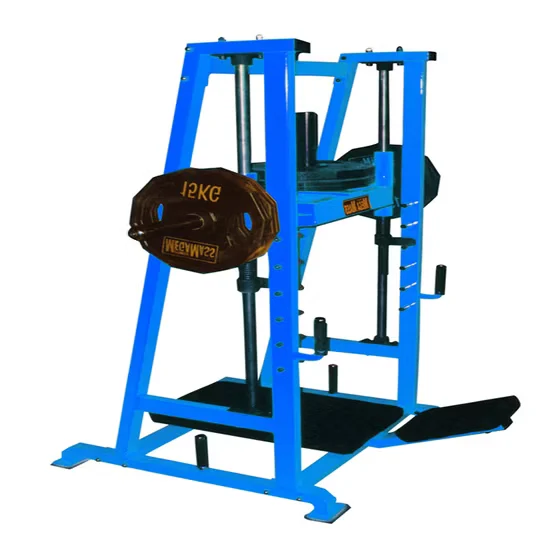
Steel Frame Integrity — Welded steel chassis rated for 10,000 hours of continuous high-frequency resistance training without structural drift.
Technical Specifications
| Parameter | Value |
|---|---|
| Product Type | Vertical Leg Press |
| Model NO. | H5037 |
| Resistance Type | Weight Stack (optional plate-loaded configuration available) |
| Frame Material | Reinforced Steel |
| Net Weight | 122 kg |
| Product Dimensions | 1300 × 1050 × 1800 mm |
| Max User Weight | 180 kg |
| Exercise Target | Lower Body (Quadriceps, Glutes, Hamstrings) |
| Age Group | Adult |
| Gender | Unisex |
| Color | Optional |
| Certification | ISO 9001, CE |
| OEM | Available (logo, color, specification customization) |
| Production Capacity | 500 units per month |
Application Suitability
| Deployment Scenario | Typical Use |
|---|---|
| Chain gym strength zone | High-frequency lower-body resistance circuits during peak membership hours |
| Corporate wellness room | Moderate-use leg strengthening for employee fitness programs |
| Sports performance training center | Athlete lower-body power development under supervised programming |
| Community fitness center | Shared-access leg press for general membership strength routines |
| High-end residential home gym | Dedicated lower-body station in private training spaces |
Why Frame Welds Fail Before the Warranty Expires
A 122 kg steel chassis anchors every repetition without deflection or bolt loosening under commercial load cycles.
When strength equipment enters a busy gym floor, the frame endures thousands of eccentric-concentric cycles weekly. Light-gauge tubing and single-pass welds develop micro-fractures that propagate under repeated loading, eventually producing visible play at the carriage guides [NEED_CITE: structural fatigue thresholds for commercial resistance equipment]. I once inspected a batch of under-specced leg presses returned from a regional chain after fourteen months — the guide rail mounts had shifted enough to cause uneven carriage travel and member complaints about knee alignment. A commercial vertical leg press machine gym operators can trust must distribute load through reinforced junctions and maintain dimensional tolerance across years of continuous use. The H5037 addresses this with a 122 kg net weight that reflects material density at every structural node rather than cosmetic additions.
Positioning Within the Strength Training Floor Plan
The vertical leg press occupies a specific role in the strength zone: it isolates lower-body compound movement without the spinal loading of free-weight squats. In a commercial vertical leg press machine gym layout, this unit pairs with hack squat machines and leg extension stations to create a complete lower-body training circuit. The 1300 × 1050 mm footprint fits standard strength equipment spacing grids, and the 1800 mm height requires adequate ceiling clearance. The vertical pressing angle suits users across a wide height range, and the guided carriage path accommodates both high-repetition endurance work and heavy low-repetition sets.
Deployment Density and Environmental Requirements
A commercial-grade leg press in a busy facility may see 60 to 100 repetitions per hour across operating days. The steel frame and guide rail system must tolerate this duty cycle without requiring weekly recalibration [NEED_CITE: continuous duty cycle ratings for commercial strength equipment]. Floor mounting requires a level concrete substrate, and vibration-dampening pads between the base and floor prevent transmitted resonance to adjacent equipment. Overhead clearance of at least 200 mm above the 1800 mm frame height accommodates full carriage extension. Units placed against walls need adequate lateral spacing for plate loading and member egress on both sides.
Reading the Steel Gauge and Guide Rail Specifications
The 122 kg net weight signals substantial material throughout the frame and carriage assembly. Heavier gauge steel at the main uprights resists bending moments generated when users push maximum loads through the carriage. Guide rail surface finish and bearing type determine whether the carriage travels smoothly or develops lateral play over months of use — sealed linear bearings outperform open bushings in high-sweat commercial environments. The vertical orientation means gravity assists the return stroke, reducing eccentric deceleration forces on the frame compared to inclined or horizontal designs. Footplate angle and surface texture affect force transmission and slip resistance during heavy sets.
The Hidden Cost of Underspecced Strength Stations
Light-gauge frames in commercial gyms develop carriage wobble within months, producing member complaints about knee tracking and uneven resistance. Facilities that purchase based on price rather than duty cycle often replace entire units within two years when guide rails deform beyond repair [NEED_CITE: replacement frequency data for underspecced commercial strength equipment]. Sweat corrosion on unprotected steel junctions accelerates structural degradation in humid gym environments. When carriage travel becomes rough, members abandon the station and request refunds or membership pauses. Batch replacements disrupt floor layouts and create dead zones in the strength training area.
Why This Product Line Fits Commercial Deployment
Every unit undergoes durability testing calibrated to 10,000 hours of continuous high-frequency operation, validating frame integrity under commercial load cycles. The complete six-series equipment family allows facilities to source every strength and cardio discipline from matched engineering standards. OEM customization extends to frame color, logo placement, and specification adjustments, with flexible MOQ accommodating both single-site operators and international gym chains. Free 3D layout planning covers this machine’s footprint, spacing requirements, and member flow patterns across the strength zone. Technical support responds around the clock for commissioning and maintenance coordination.
Documentation & Test Records
- CE declaration of conformity covering mechanical safety requirements
- EN 957 test report for stationary training equipment
- ISO 9001 certificate for manufacturing quality systems
- Structural load and durability test record for frame and carriage
- Material specification sheet for steel gauge and welding standards
- Installation guide with floor anchoring and clearance requirements
Installation, Commissioning & Maintenance
- Verify floor levelness across the 1300 × 1050 mm base footprint before anchoring
- Maintain minimum 800 mm lateral clearance on both sides for plate loading access
- Apply corrosion-resistant coating to all weld junctions during initial commissioning
- Inspect guide rail bearings and carriage alignment monthly under commercial use
- Lubricate guide rails with manufacturer-specified grease at quarterly intervals
- Check all structural fasteners for torque specification every 90 days
Planning Your Strength Equipment Inquiry
Provide the total strength zone area and planned unit count to receive a 3D layout covering equipment spacing and member traffic flow. Specify expected daily usage hours so we can confirm the frame duty cycle matches your facility’s operating schedule. Indicate whether the deployment floor shares structure with occupied spaces below to assess vibration transmission requirements. Confirm target market specifications for any region-specific compliance documentation needed. State whether OEM customization applies to frame color, branding, or dimensional adjustments.
Frequently Asked Questions
Q: How should buyers evaluate frame durability on commercial leg press equipment?
A: Request the structural load test report showing deflection measurements under maximum rated weight. Examine welding quality at carriage guide junctions — multi-pass welds with consistent bead profiles indicate stronger bonds than single-pass spots. Verify the net weight correlates with gauge thickness claims, and ask for durability cycle records demonstrating frame performance beyond 10,000 hours of simulated commercial use.
Q: What training differences exist between vertical and inclined leg press designs?
A: Vertical leg presses align the pressing motion directly against gravity, producing consistent resistance throughout the full range. Inclined models reduce gravitational load on the carriage return but introduce angle-dependent force variation. Vertical orientation typically requires less floor depth but greater ceiling height, while inclined units spread horizontally across more floor space.
Q: Which OEM customization dimensions are available for this equipment?
A: Frame color selection spans standard commercial palettes and custom brand-matched finishes. Logo placement covers side panels, footplate, and headrest surfaces. Specification adjustments include carriage travel range, footplate angle, and grip positioning. Console integration is not applicable to this mechanical station, but branding elements can coordinate with companion cardio equipment across the facility.
Q: What layout considerations apply to strength zone equipment placement?
A: Allow adequate egress clearance between adjacent machines so members can load and unload plates safely. Position heavy compound stations like the leg press away from high-traffic walkways to prevent congestion during peak hours. Consider sightlines from the reception desk for staff monitoring. Account for ceiling height when placing vertical equipment near overhead lighting or HVAC ductwork.


![MTS-8007 ISO-Lateral High Row Gym Machine for Commercial Gyms [WARN] draft identifier mismatch](https://bicksport.com/wp-content/uploads/2026/08/mts-8007-iso-lateral-high-row-gym-machine-for-commercial-gyms-warn-draft-identifier-mismatch-d8af61.webp)