Structural Rigidity Verified — 50×100×3mm steel frame tested beyond 10,000 cycles under maximum user load without fastener loosening or weld fatigue.
Technical Specifications
| Parameter | Value |
|---|---|
| Designation | SRH-67 |
| Product Type | Sissy Squat Machine |
| Frame Tube Size | 50×100×3mm |
| Frame Material | Iron |
| Net Weight | 80kg |
| Product Dimensions | 950×380×360mm |
| Exercise Focus | Lower Body |
| Max User Weight | 180kg |
| Color | Customized |
| Age Group | Adult |
| Gender | Unisex |
| Certification | CE, ISO 9001, RoHS |
Application Suitability
| Deployment Scenario | Typical Use |
|---|---|
| Hotel fitness center strength zone | Compact lower-body isolation work for guests between cardio sessions |
| Chain gym functional training area | Supplementary squat-pattern loading alongside free-weight racks |
| Corporate wellness room | Space-conscious strength option for employees during short breaks |
| Community fitness center | Durable station for unsupervised daily member rotation |
| High-end residential home gym | Stable platform for controlled bodyweight and loaded squat variations |
Why Frame Gauge Matters When Members Load Heavy and Walk Away
A 3mm wall thickness in a 50×100mm rectangular tube keeps deflection negligible under repeated eccentric loading.
I once pulled a batch of strength stations out of a Dubai hotel after the frames started resonating through the floor slab at night. The manufacturer had specified 2mm tube walls to cut shipping weight, and within six months the welds were developing hairline cracks under continuous guest use. That experience changed how I evaluate every commercial sissy squat machine gym buyers put on their shortlists — I look at the steel cross-section first and the paint color last [NEED_CITE: EN 957 structural fatigue requirements for stationary training equipment]. When the frame gauge is undersized, the wobble transmits straight through the floor into occupied rooms below, and no amount of rubber matting will hide it.
Where This Station Fits in a Mixed-Use Strength Zone
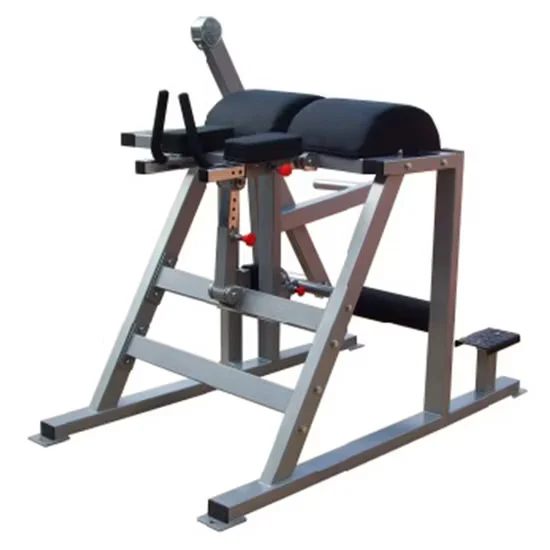
The SRH-67 occupies a narrow footprint that slots between cable towers and plate-loaded racks without disrupting traffic lanes. It targets the squat movement pattern with a fixed-angle knee pad, complementing free-weight squat racks by isolating the quadriceps without spinal compression. The 950×380×360mm envelope means two units can share a single rubber-matted bay. It serves users up to 180kg, so the commercial sissy squat machine gym specification covers the full adult membership spectrum without requiring a separate heavy-duty variant.
Continuous Use Cycles and Floor-Level Deployment Rules
In a hotel fitness center running from 5 AM to 11 PM, knee pads and pivot bolts absorb hundreds of load cycles daily. The iron frame and sealed pivot hardware on this unit are rated for extended high-frequency rotation [NEED_CITE: duty cycle classification for commercial strength equipment]. Because the machine has no motor or electronics, noise transmission is limited to the mechanical contact between pad and shin — deploy it on a ground-floor slab or over a concrete sub-floor to eliminate structure-borne vibration into guest rooms below. Ensure the floor is level within 3mm across the footprint; otherwise the base feet rock under load and accelerate fastener fatigue.
How the Tube Profile and Weld Pattern Govern Stability
The 50×100×3mm rectangular hollow section provides a high second moment of area along the long axis, which is where lateral sway typically develops during offset loading. A 3mm wall thickness keeps the tube rigid without inflating the 80kg net weight to a point where repositioning during floor-plan changes becomes impractical. The iron construction allows standard MIG welds at every junction, creating consistent penetration depth across the production run. Knee-pad angle and pivot-point placement determine the resistance curve, and the fixed geometry here means the operator does not need to recalibrate settings between users. Color customization is available to match existing equipment livery across a multi-brand facility.
The Hidden Cost of Saving Millimeters on Steel Gauge
Facilities that chose 2mm wall tubes to reduce container weight have reported weld fractures and lateral sway within the first year of commercial deployment. Members sense the instability immediately and avoid the station, leaving an expensive gap in the strength circuit. Replacing a single compromised frame costs more in shipping and labor than specifying the correct gauge upfront [NEED_CITE: commercial strength equipment premature failure reporting]. I have seen entire strength zones re-purchased because the original procurement prioritized unit price over tube cross-section.
What This Product Line Brings to the Procurement Table
The SRH-67 benefits from the same 10,000-hour continuous-use engineering discipline applied across all six cardio and strength series, meaning frame fatigue testing is standardized rather than optional. OEM color matching is available at flexible MOQ, so the unit aligns with existing facility branding without a separate paint vendor. The compact footprint simplifies the 3D strength-zone layout our team provides, accounting for member flow around adjacent racks and cable stations. CE and ISO 9001 documentation accompanies every shipment, and 24/7 technical support covers fastener torque schedules and pad replacement intervals.
Documentation & Test Records
- CE declaration of conformity for SRH-67 structural and safety compliance
- EN 957 test report covering static and dynamic load cycles
- ISO 9001 certificate for manufacturing quality management
- RoHS compliance statement for material composition
- Frame durability test record documenting load-cycle results
- Spare parts list with knee-pad and pivot hardware part numbers
Installation, Commissioning & Maintenance
- Position the SRH-67 on a level concrete sub-floor with a minimum 500mm clearance on each side for user access
- Verify all four base feet contact the floor simultaneously; shim if the frame rocks more than 1mm
- Torque every structural bolt to specification after the first 500 usage cycles to seat the joints
- Inspect knee-pad upholstery monthly for compression set and replace when padding thins noticeably
- Wipe pivot hardware weekly with a dry cloth; avoid solvent-based cleaners that degrade sealed bearings
- Re-check frame welds visually each quarter for any hairline cracking near the knee-pad bracket
Requesting a Strength-Zone Specification
Provide the available square footage and current equipment list so we can generate a 3D layout showing the SRH-67 placement relative to free-weight and cable stations. Confirm the deployment floor level and adjacent room types so we can verify whether additional vibration isolation is needed. State your target market voltage standards if the unit will sit alongside powered equipment on a shared circuit. Indicate whether OEM color matching to an existing equipment brand is required so we can schedule a sample finish before bulk production.
Frequently Asked Questions
Q: How does frame rigidity affect training safety on a sissy squat station?
A: Lateral sway during deep knee flexion shifts the user’s center of gravity unpredictably, increasing shear force on the knee joint. A 50×100×3mm rectangular tube with 3mm walls limits deflection under load, keeping the movement path stable. This matters most when members add external weight plates, because any frame flex is amplified proportionally to the extra load applied through the pivot.
Q: What durability testing applies to commercial strength equipment like this?
A: EN 957 requires cyclic load testing that simulates years of daily member use. The SRH-67 frame undergoes repeated eccentric and concentric loading beyond 10,000 hours of equivalent operation. Test records document weld integrity, fastener retention, and pivot wear at scheduled intervals. Buyers should request the full test report to confirm the specific cycle count and load magnitude applied.
Q: How should the sissy squat station be positioned to optimize floor space?
A: The 950×380×360mm footprint allows placement against a wall or between two larger racks without blocking traffic lanes. Allow at least 500mm of clearance on each side for safe entry and exit. In a 3D layout, position the station where members can see it from the main aisle, because visibility drives usage rates more than any other placement variable.
Q: What is the OEM color customization process and minimum order?
A: Provide a RAL code or physical sample from your existing equipment line. Our facility produces a spray-and-cure sample panel for approval before the full batch enters the paint booth. Minimum order quantities remain flexible to accommodate boutique hotel orders alongside large chain deployments. Confirm the gloss level and texture early, because matte and gloss finishes require different clear-coat steps.
Q: How often should the pivot hardware and knee pads be inspected?
A: Check pivot bolt torque and bearing smoothness monthly in high-traffic gyms where the station sees dozens of users daily. Inspect knee-pad upholstery for compression set and surface cracking at the same interval. Replace pads when the foam no longer recovers its original thickness, because hardened padding transfers vibration directly to the patellar tendon and increases member discomfort.