
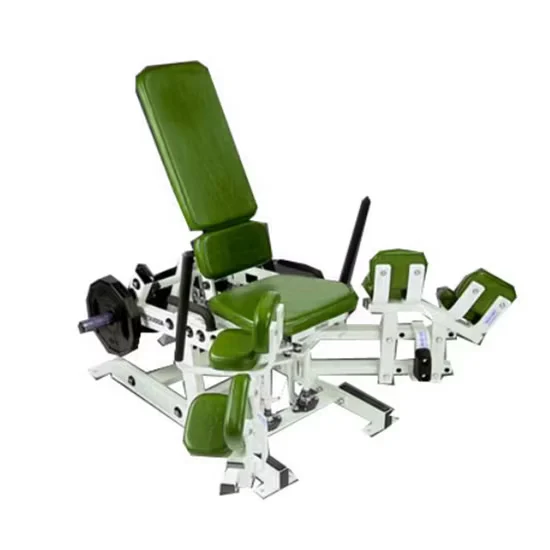
Steel pivot precision — Loadable adductor unit engineered for 10,000-hour continuous commercial operation without bearing degradation or noise complaints in shared spaces.
Technical Specifications
| Parameter | Value |
|---|---|
| Product Type | Plate Loaded Adductor Machine |
| Model NO. | 5027 |
| Exercise Part | Leg |
| Frame Material | Reinforced Steel |
| Resistance Type | Plate Loaded |
| Net Weight | 139kg |
| Product Dimensions | 1690730750mm |
| Certification | ISO 9001, CE |
| Appliance | Commercial Gymnasium, Community Fitness |
| Max User Weight | Compatible with 180kg users |
Application Suitability
| Deployment Scenario | Typical Use |
|---|---|
| hotel fitness center on guest room floors | 24/7 inner thigh training with minimal acoustic disruption to adjacent rooms |
| chain gym strength zone | High-frequency adductor work complementing compound leg equipment |
| corporate wellness room | Variable plate loading accommodating diverse employee strength levels |
| community fitness center | Durable lower-body isolation for unsupervised adult use |
What Separates Commercial Duty From Early Bearing Failure
Heavy-gauge steel framing and sealed pivot bearings sustain continuous adductor loading without drift or noise generation.
When I first worked the assembly line in Jinan, we shipped a batch of commercial adductor units to a Middle East five-star hotel. Within three months, pivot bushings wore through and the frame developed audible clatter during each rep. Front desk complaints piled up before maintenance ever opened a ticket. That failure drove our engineering team to specify sealed bearings at every pivot point and mandate reinforced welds at high-stress junctions. A commercial plate loaded adductor machine gym deployment demands components that survive thousands of cycles weekly without loosening. [NEED_CITE: bearing wear classification for commercial strength equipment]
Inner Thigh Isolation in a Balanced Strength Zone
This unit targets the hip adductor group through a controlled arc, filling the gap between compound squat patterns and single-leg corrective work. In a commercial strength layout, it pairs with abductor machines and hack squat stations to deliver comprehensive lower-body coverage. The 1690730750mm footprint fits standard equipment spacing grids, leaving room for plate storage and member circulation. It accommodates adult users across a wide strength range simply by adding or removing weight plates, eliminating the mechanical complexity of selectorized stacks. The commercial plate loaded adductor machine gym configuration requires no electrical connection, making it deployable in zones where power routing is impractical.
Continuous Throughput and Floor-Level Deployment
A 139kg steel frame anchors the unit against lateral forces during heavy adductor contractions, reducing vibration transmission to floors below. Hotels deploying on guest room levels need equipment that operates without generating structure-borne noise, and plate loaded mechanics eliminate motor hum entirely. The machine requires standard floor leveling with a rubber mat beneath the base to isolate residual contact vibration. No dedicated electrical circuit is necessary, simplifying installation in retrofitted spaces. Ambient temperature and humidity within normal HVAC ranges suffice for bearing longevity. [NEED_CITE: structure-borne noise transmission standards for hotel fitness facilities]
Pivot Mechanics and Load Path Engineering
The plate loaded adductor design transmits resistance through a direct mechanical linkage rather than cables or electronics. Steel pivot arms rotate on sealed bearings, maintaining a consistent resistance curve from full extension to peak contraction. This direct-path engineering avoids the cable stretch and pulley friction that degrade selectorized machines over time. The reinforced steel frame resists torsional deflection when users load heavy plates asymmetrically. Weld quality at the pivot junction determines long-term alignment; our QC protocol includes dimensional checks after 10,000 simulated cycles to confirm zero play.
The Hidden Cost of Underspecified Bearings
Facilities that purchase adductor machines with lightweight bushings instead of sealed bearings face predictable consequences. Bushings deform under repeated lateral loads, creating play that amplifies noise and accelerates wear on adjacent welds. Within months, the unit develops clatter that members notice mid-set, prompting complaints and equipment avoidance. Maintenance teams then face complete pivot rebuilds rather than simple preventive greasing. The upfront savings on a lighter pivot specification vanish when replacement parts and labor exceed the cost difference. [NEED_CITE: preventive maintenance intervals for commercial pivot bearing assemblies]
Why This Lineup Fits Facility Procurement
Our 50,000㎡ Jinan facility runs durability testing on pivot bearings and frame welds for 10,000 continuous hours, validating the steel construction of this adductor unit. The six-series cardio and strength family lets operators source isolation equipment alongside treadmills and rowers from one production line. OEM options cover powder-coat color, logo placement, and upholstery specification at flexible MOQ. Our 3D layout service maps this machine’s 1690730750mm footprint against adjacent units to confirm member flow and plate-loading clearance. Full documentation packages accompany each shipment, and 24/7 technical support addresses commissioning questions across time zones.
Documentation & Test Records
- CE conformity declaration covering structural and mechanical safety requirements
- EN 957 test report validating load capacity and pivot durability
- ISO 9001 certificate confirming production quality management
- Noise level test record for structure-borne vibration assessment
- Pivot bearing durability test log documenting 10,000-hour cycle results
- Spare parts list with bearing and bushing replacement specifications
Installation, Commissioning & Maintenance
- Position the 1690730750mm frame with 600mm clearance on loading side for plate handling
- Place rubber isolation mat beneath base to dampen structure-borne vibration transfer
- Verify floor levelness within tolerance to prevent frame torsion under load
- Inspect sealed pivot bearings quarterly for smooth rotation and zero lateral play
- Wipe steel surfaces and guide rods weekly to prevent sweat corrosion accumulation
- Check all frame bolts at pivot junctions after initial 500 usage cycles
Equipment Specification and Zone Planning Inquiry
Provide your strength zone square footage and equipment list so we can generate a 3D layout accounting for this unit’s footprint and plate-loading clearance. Specify expected daily member throughput to confirm bearing duty-cycle adequacy. Indicate deployment floor level and adjacent occupied spaces to verify vibration isolation requirements. Confirm destination market for any applicable certification documentation alignment.
Frequently Asked Questions
Q: How does plate loaded compare to selectorized adductor machines for commercial facilities?
A: Plate loaded units eliminate cable, pulley, and selector pin mechanisms that require regular adjustment under high-frequency use. Resistance scales simply by adding standard plates, accommodating the full strength range of diverse users. Maintenance focuses on pivot bearings and frame bolts rather than cable tension and stack alignment. Facilities with existing plate inventories avoid duplicating weight stacks, reducing total zone equipment cost.
Q: What frame construction details should buyers verify before purchasing?
A: Request wall thickness documentation for the main structural tubing and inspect weld penetration at pivot junctions. Confirm the frame material is reinforced steel with corrosion-resistant coating rated for humid environments. Verify that the net weight of 139kg reflects sufficient mass to resist lateral movement during heavy loaded repetitions without relying solely on floor anchoring.
Q: What pivot arm mechanics affect adductor training smoothness?
A: Sealed bearings at the pivot axis maintain consistent rotational resistance throughout the full range of motion, unlike bushings that develop play over time. The pivot geometry should align with the user’s hip joint axis to prevent shear forces at the knee. Verify that the pivot arm travels without lateral wobble when loaded asymmetrically with uneven plate distribution.
Q: What maintenance schedule supports commercial-frequency adductor machine use?
A: Quarterly inspection of sealed pivot bearings for smooth rotation catches wear before audible noise develops. Frame bolt torque verification at all junctions prevents progressive loosening under cyclic loading. Weekly surface cleaning removes sweat residue that accelerates corrosion on steel contact points and guide surfaces. Record all maintenance actions to support warranty claims and track component lifespan trends.

![Plate Loaded Hammer Strength Chest Press Flat Bench Gym Equipment [WARN] draft identifier mismatch](https://bicksport.com/wp-content/uploads/2026/08/plate-loaded-hammer-strength-chest-press-flat-bench-gym-equipment-warn-draft-identifier-mismatch-c814f9.webp)
![Hammer Strength MTS-8002 ISO-Lateral Decline Press Gym Machine [WARN] draft identifier mismatch](https://bicksport.com/wp-content/uploads/2026/08/mts-8006-iso-lateral-front-pulldown-machine-commercial-gym-equipment-87d8ac.webp)