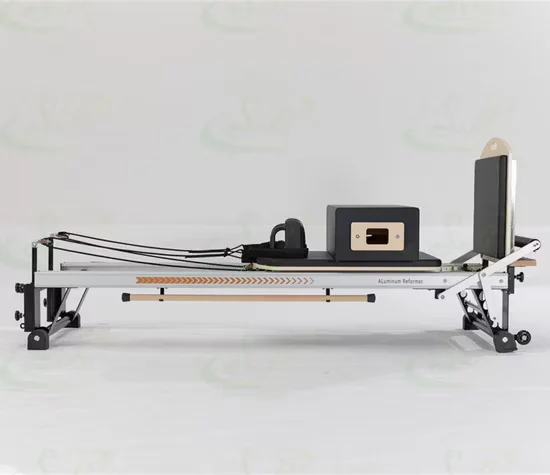
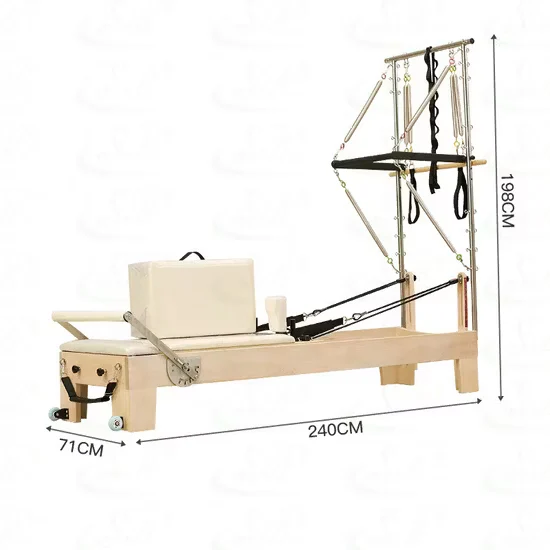
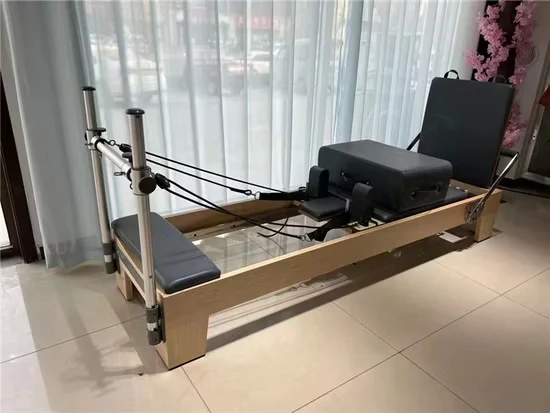
Structural Rigidity — Reinforced steel frame and half trapeze tower tested for continuous studio-frequency stretching and suspension loading.
Technical Specifications
| Parameter | Value |
|---|---|
| Designation | SRY-06 |
| Product Type | Pilates Reformer with Tower |
| Product Dimensions | 2460 × 730 × 1900 mm |
| Net Weight | 150 kg |
| Accessory | Long Box / Jump Board / Platform |
| Color | Solid Color (options available) |
| Logo Customization | Available |
| Target User | Adult, Unisex |
| Warranty | 3 Years |
Application Suitability
| Deployment Scenario | Typical Use |
|---|---|
| Professional Pilates studio | Group reformer classes with tower-assisted flexibility and strength sequences |
| Comprehensive gym functional training zone | Supplementary core and mobility work alongside cardio and resistance stations |
| Rehabilitation and physiotherapy center | Controlled resistance progression for post-injury recovery and posture correction |
| High-end residential home gym | Private full-body Pilates practice with multi-attachment versatility |
Why Spring Fatigue and Rail Stiction End Up Costing Studios More Than the Equipment Itself
A reformer that skips resistance levels mid-hundred ruins the class, not just the session.
When a commercial Pilates reformer with half trapeze tower enters a studio running six back-to-back classes daily, the rail and spring system faces cumulative loading that home-grade units never encounter. Studios I have serviced reported members canceling memberships after experiencing jarring transitions during supine leg work — the carriage stuttered on worn glide surfaces and springs lost tension consistency after months of stretch cycles. [NEED_CITE: spring fatigue testing standards for commercial Pilates equipment] The cost is never just the replacement spring. It is the member who walks out and does not come back.
Positioning This Reformer Within a Studio Equipment Layout
The SRY-06 covers full-range reformer work plus tower-based standing and kneeling exercises, bridging mat-to-apparatus progressions in a single footprint. In a studio configuring four to eight units for group classes, this commercial Pilates reformer with half trapeze tower pairs with dedicated Cadillac or Wunda Chair stations for advanced programming without overlapping movement patterns. The 2460 mm length accommodates tall users while the 730 mm width maintains sightlines across the room for instructor correction. It supports unisex adult users across varying strength levels through multi-spring resistance staging.
Continuous Scheduling and the Studio Environment It Demands
A reformer running five or more classes per day accumulates thousands of carriage cycles weekly, making rail smoothness and spring calibration non-negotiable maintenance items. The 150 kg net weight anchors the frame against lateral forces during jump board plyometrics and tower-assisted pulling, but floor leveling remains critical — an uneven base introduces carriage drift that compounds over sessions. Studios installing on upper floors should verify structural load ratings for multiple units plus dynamic user weight. Adequate clearance around the 1900 mm tower height prevents interference with overhead lighting and HVAC ductwork. [NEED_CITE: floor load requirements for grouped commercial Pilates apparatus] Ambient humidity control matters: excessive moisture accelerates spring corrosion and degrades grip surfaces on the long box and platform.
What the Rail, Spring, and Tower Specs Actually Mean for Daily Operation
The carriage glide system determines whether transitions between exercises feel controlled or erratic, and commercial-grade rails must maintain tolerance across temperature and humidity fluctuations common in group class environments. Spring resistance staging provides progressive loading from rehabilitation-level tension through advanced athletic work, but the anchoring points and attachment hardware must resist deformation under repeated hook-and-release cycles. The half trapeze tower extends exercise variety into standing balance work, overhead reaching patterns, and assisted stretching that a standalone reformer cannot deliver — its structural rigidity under lateral pull is the safety-critical specification. Long box, jump board, and platform attachments each introduce different load vectors onto the frame, so attachment interfaces must seat precisely without play or rattle during dynamic movements.
What Happens When Studios Compromise on Apparatus Specs
Studios that purchased light-duty reformers for commercial scheduling found carriage wheels developing flat spots within months, creating vibration through every exercise and forcing mid-semester replacements. Spring sets without documented fatigue testing lose calibration at different rates, meaning the same color-coded spring delivers different resistance on adjacent machines — instructors cannot cue consistently across a group class. Towers with insufficient frame rigidity sway during hanging exercises, alarming users and forcing instructors to remove advanced movements from programming. [NEED_CITE: carriage wheel durability under commercial frequency use] Attachment hardware that lacks standardized sizing means a jump board from one production batch does not fit the next, stranding studios with incompatible accessory inventories.
Why This Product Line Addresses the Failures I Have Diagnosed
Every unit undergoes rail smoothness verification and spring calibration before shipping, because I have seen what inconsistent resistance does to class flow and member trust. The 10,000-hour durability testing protocol covers spring attachment points, carriage bearings, and tower joints — the exact failure points from field service records. Our facility sources all six cardio and Pilates disciplines from one manufacturing line, so studios expanding from reformer into functional cardio can coordinate delivery and warranty through a single supply chain. The free 3D layout planning accounts for this unit’s 2460 × 730 mm footprint plus instructor walkway clearance and airflow between stations. OEM customization extends to color matching across a multi-unit order, keeping studio aesthetics consistent. Technical support responds around the clock when a spring needs replacement guidance before morning classes.
Documentation & Test Records
- CE declaration of conformity for SRY-06 Pilates apparatus
- EN 957 test report covering structural load and stability
- ISO 9001 certificate for manufacturing quality management
- Spring fatigue and resistance calibration test record
- Rail glide smoothness and carriage bearing durability report
- Installation guide with attachment interface torque specifications
Installation, Commissioning & Maintenance
- Maintain minimum 600 mm clearance on all sides of the 2460 × 730 mm footprint for safe instructor access.
- Level the floor surface before assembly to prevent carriage drift during loaded movements.
- Verify ceiling clearance exceeds 1900 mm tower height plus user overhead reach.
- Inspect spring attachment hooks and tower hardware torque after the first 50 hours of use.
- Lubricate rail glide surfaces at intervals matching studio class frequency and ambient humidity.
- Wipe down upholstery and attachment surfaces after each class to prevent sweat corrosion on hardware.
How to Scope Your Studio Reformer Order
Provide your studio floor area and intended unit count so we can generate a 3D layout with instructor sightlines and member flow paths. Specify daily class frequency to confirm spring and rail duty-cycle suitability. Indicate deployment floor level and adjacent room usage to address noise transmission during jump board work. State whether you need color matching across multiple units or logo placement on the frame.
Frequently Asked Questions
Q: What separates a commercial Pilates reformer from a home-grade unit?
A: Commercial units use heavier frame gauges, higher-cycle spring sets, and rail systems rated for thousands of weekly carriage passes. Home reformers prioritize cost and compact storage over sustained load tolerance. A studio running group classes needs equipment that maintains calibration and structural integrity across continuous daily scheduling.
Q: How should the rail system be maintained in a busy studio?
A: Rail surfaces require periodic cleaning and lubrication at intervals determined by class frequency and ambient humidity. Carriage wheels should be inspected for flat spots or bearing play. Studios scheduling five or more classes daily typically need more frequent attention than those running two or three sessions.
Q: How do spring resistance levels match different training needs?
A: Multi-spring configurations allow instructors to stage resistance from light rehabilitation loading through advanced athletic work. Each spring provides a defined tension curve, and combining springs creates progressive options. Consistent calibration across machines in a group studio ensures instructors can cue the same resistance level on every unit.
Q: What is the safe loading range for tower-assisted exercises?
A: The half trapeze tower must withstand lateral and overhead forces generated during standing and hanging movements. Frame rigidity and joint hardware torque determine safe working loads. Studios should verify structural test documentation before programming advanced suspension exercises for heavier users.
Q: How do attachments like the jump board and long box expand programming?
A: The long box enables seated and supine exercises with extended range of motion. The jump board introduces plyometric cardiovascular intervals on the reformer carriage. The platform adds stability work. Together they let a single unit serve multiple class formats without requiring dedicated apparatus for each discipline.