
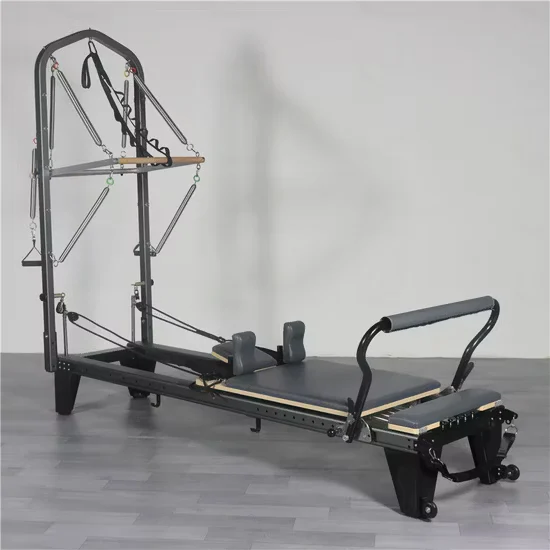
Sub-35dB Whisper-Quiet Operation — Full-aluminium alloy frame and sealed bearing carriage eliminate wood-resonance noise, keeping hotel guest floors free from reformer-generated complaints.
Technical Specifications
| Parameter | Value |
|---|---|
| Designation | SRY-11 |
| Product Type | Pilates Reformer |
| Frame Material | Full Aluminium Alloy |
| Resistance Type | Commercial-grade Spring System |
| Carriage System | Sealed Bearing Rail Track |
| Noise Level | Sub-35dB |
| Accessories | Long Box / Jump Board / Platform |
| Product Dimensions | 2390 × 900 × 1960 mm |
| Net Weight | 120 kg |
| Maximum User Weight | 180 kg |
| Console | IoT-enabled (optional) |
| Color | Black (additional options available) |
| Logo | Customized allowed |
| Warranty | 3 Years |
| Certification | ISO 9001, CE, EN 957 |
| Durability Test | 10,000-hour continuous high-frequency operation |
| User Demographic | Adult, Unisex |
Application Suitability
| Deployment Scenario | Typical Use |
|---|---|
| Five-star hotel fitness center on guest room floors | Silent Pilates sessions without disturbing adjacent rooms during 24-hour access windows |
| Chain Pilates studio and boutique fitness center | High-frequency class scheduling with IoT data tracking for member retention analytics |
| Corporate wellness room | Full-body conditioning for employees during midday breaks with minimal noise bleed to office areas |
| High-end residential fitness space | Multi-generational use with aluminium frame durability resisting humidity and temperature fluctuation |
| Sports rehabilitation center | Controlled spring resistance progression for post-injury recovery protocols under therapist supervision |
Why Traditional Reformers Trigger Noise Complaints in Hotel Deployments
Aluminium alloy construction eliminates the low-frequency resonance that wooden frames transmit through floor slabs.
I spent years troubleshooting cardio zones where wooden reformers generated carriage rattle and spring twang that traveled through concrete decks into occupied rooms below. Front desk teams log these complaints before maintenance ever gets involved, and by the time a technician arrives the guest has already checked out. A commercial pilates reformer aluminium alloy with tower solves this at the structural level — the metal frame dampens vibration rather than amplifying it, and sealed bearings on the carriage rail remove the metal-on-metal scraping that aging wooden tracks produce. [NEED_CITE: structural vibration transmission of aluminium versus wood in fitness equipment deployment]
Positioning Within the Commercial Cardio and Mind-Body Zone
This reformer covers the full spectrum from foundational mat-style Pilates movements through advanced jump board plyometrics, occupying the low-impact, high-control segment of any facility’s equipment mix. It complements high-intensity cardio machines by offering members an active recovery modality and pairs naturally with mat zones for group class flow. The 2390 × 900 mm footprint requires roughly 4 square meters per unit including clearance for Long Box and Platform accessories. Maximum user weight of 180 kg accommodates the broadest commercial demographic, and the tower attachment extends exercise variety without demanding a second dedicated station. A commercial pilates reformer aluminium alloy with tower is typically deployed at 1.5-meter intervals to allow instructor circulation during group sessions.
Continuous Operation and Environmental Requirements for Studio Deployment
Studios running four to six group classes daily push carriage bearings and spring sets through thousands of cycles per week, making sealed track systems essential for preventing mid-week maintenance shutdowns. The sub-35dB noise output allows installation on suspended floor assemblies common in hotel properties without supplemental acoustic underlayment. Cross-ventilation or HVAC supply within 3 meters of the reformer zone prevents sweat accumulation on aluminium surfaces, which can accelerate cosmetic oxidation over time. [NEED_CITE: environmental humidity thresholds for aluminium alloy fitness equipment longevity] IoT console integration requires a local network access point within range, and facilities planning member usage dashboards should confirm API compatibility with their existing management platform before deployment.
Spring Resistance and Carriage Engineering Under Commercial Load
Commercial-grade spring sets maintain linear resistance curves far longer than consumer alternatives, which lose tension unpredictably and create inconsistent loading between identical reformers in a studio row. The sealed bearing carriage on the SRY-11 rides on a precision-machined aluminium rail, eliminating the wood-warping that causes track misalignment in humid environments. Spring tension is adjustable across multiple attachment points, allowing instructors to scale resistance for rehabilitation clients and athletic conditioning within the same session. The tower attachment adds vertical spring vectors for standing and kneeling work, expanding the exercise library without additional floor equipment. Aluminium’s thermal stability means the frame does not expand or contract seasonally, preserving carriage alignment year-round.
The Hidden Cost of Specifying Consumer-Grade Reformers for Commercial Floors
Facilities that purchase residential or light-commercial reformers for hotel or studio use typically see carriage bearing failure within the first year, followed by spring sag that forces instructors to modify class programming around equipment limitations. Wooden frames absorb ambient moisture and develop micro-fractures at bolt joints, generating creaks that migrate through floor assemblies and trigger guest complaints in hotel settings. [NEED_CITE: lifecycle cost comparison of commercial versus residential Pilates reformers in high-frequency facilities] The absence of data connectivity on basic models leaves operators unable to track equipment utilization, making it impossible to justify expansion or identify underused stations. Voltage and plug mismatches affect powered accessories and IoT consoles, occasionally discovered only after shipment arrives at the destination country.
Why This Product Line Addresses Deployment Gaps
Every SRY-11 unit undergoes 10,000-hour durability testing on springs and carriage bearings before shipping, matching the duty-cycle verification applied across the full cardio range. Sub-35dB operation has been validated in hotel deployments where equipment sits directly above occupied guest rooms. The IoT console option integrates with facility management software to surface utilization data, and OEM customization extends to logo application and console UI configuration. Our team provides 3D layout planning that accounts for reformer spacing, instructor sightlines, and HVAC airflow patterns — the same service applied to cardio zones across the six-series equipment family. 24/7 technical support covers spring replacement guidance and carriage track alignment without requiring on-site service calls for routine issues.
Documentation & Test Records
- CE declaration of conformity covering the SRY-11 aluminium frame and spring assembly
- EN 957 test report validating structural load capacity and safety requirements
- ISO 9001 certificate for manufacturing quality management systems
- Sub-35dB noise level test report from controlled acoustic measurement
- 10,000-hour spring and bearing durability test record
- IoT console technical documentation with API and data interface specifications
Installation, Commissioning & Maintenance
- Maintain minimum 1.5-meter lateral clearance and 2-meter rear clearance for full carriage travel with Long Box attached
- Level the aluminium frame on vibration-damping pads to prevent rail misalignment under cyclic loading
- Confirm IoT console network requirements and pair with facility management system before member onboarding
- Inspect sealed bearing carriage track and spring tension monthly under high-frequency studio schedules
- Wipe aluminium surfaces with pH-neutral cleaner after each session to prevent sweat-induced oxidation
- Verify spring attachment points and tower hardware torque quarterly per commissioning guide specifications
Equipment Selection and Facility Planning Inquiry
Provide your studio floor area and planned reformer count to receive a 3D layout with spacing, sightline, and airflow recommendations. Specify daily class volume and average session duration so we can confirm spring and bearing duty-cycle adequacy. Indicate deployment floor level and adjacent room types to verify noise isolation requirements. State your target market voltage and plug standard for any powered console accessories. Confirm whether IoT data integration with your existing member management platform is required for utilization tracking.
Frequently Asked Questions
Q: What advantages does an aluminium alloy frame offer over traditional wooden reformers in noise-sensitive environments?
A: Aluminium eliminates the low-frequency resonance that wooden frames amplify and transmit through floor structures. The metal frame maintains dimensional stability regardless of humidity, preventing the joint creaking and rail warping that develop in wood over time. Combined with sealed bearing carriages, the aluminium construction holds operation below 35dB, making it suitable for hotel guest floors and shared residential buildings where noise complaints directly impact operations.
Q: How does commercial-grade spring resistance differ from residential spring systems in lifespan?
A: Commercial springs are engineered for 10,000 hours of continuous high-frequency use, maintaining linear resistance curves that instructors depend on for predictable class programming. Residential springs lose tension unpredictably under studio-class volume, creating inconsistency between identical units in the same room. The SRY-11 spring set is tested to match the durability standards applied across commercial cardio equipment in our product family.
Q: Can the IoT console integrate with existing facility management and member tracking systems?
A: The optional IoT console supports data export for utilization tracking and session analytics. Before shipment, we provide interface documentation so your IT team can confirm compatibility with your current member management software. This eliminates the data island problem where equipment usage remains invisible to operators, enabling evidence-based decisions about class scheduling and equipment expansion.
Q: What noise control measures are recommended when deploying reformers on hotel guest room floors?
A: The SRY-11 aluminium frame and sealed carriage inherently operate below 35dB, but we also recommend vibration-damping pads under each foot and minimum clearance from elevator shafts or mechanical rooms. Our 3D layout service maps equipment placement against occupied rooms on the floor below, identifying potential transmission paths before installation. This approach has resolved noise complaints in multiple five-star hotel deployments.
Q: How do modular accessories affect class programming flexibility and member retention?
A: The Long Box enables supine and seated positions for rehabilitation and beginner progressions. The Jump Board introduces plyometric conditioning for athletic members seeking higher intensity. The Platform extends the working surface for standing balance work. Together they allow a single reformer to serve the full member spectrum without requiring dedicated stations for each modality, improving per-unit revenue in studio environments.


