
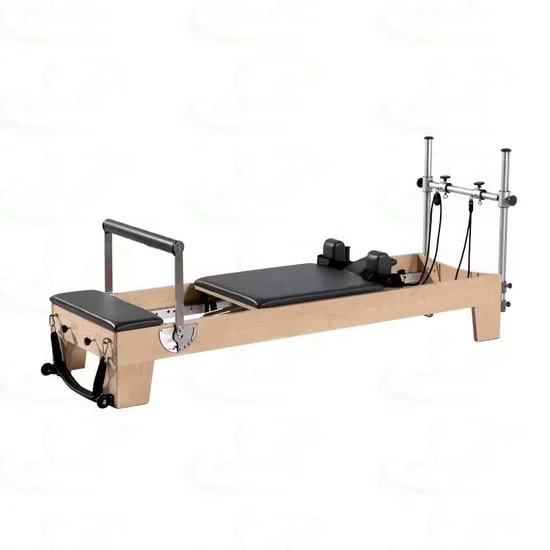
Acoustic Precision — Solid maple frame and precision rail system deliver smooth, quiet motion across high-frequency studio sessions.
Technical Specifications
| Parameter | Value |
|---|---|
| Product Type | Pilates Reformer |
| Model NO. | SRY-02 |
| Frame Material | Solid Maple Wood |
| Specification | 2460×730×680 mm |
| Net Weight | 100 kg |
| Accessories | Long Box / Jump Board / Platform |
| Color | Solid Color (customizable) |
| Logo | Customized Is Allowed |
| Warranty | 3 Years |
| Production Capacity | 80 Pieces/Month |
| HS Code | 9506911900 |
Application Suitability
| Deployment Scenario | Typical Use |
|---|---|
| Boutique Pilates studio | Daily group reformer classes across multiple time slots |
| Yoga and mindful movement center | Complement mat-based sessions with resistance-based flow |
| High-end residential home gym | Private training with minimal noise transfer to adjacent rooms |
| Rehabilitation and physiotherapy facility | Low-impact controlled resistance for guided recovery programs |
| Sports performance training center | Core stabilization and functional movement prep for athletes |
Why Studio Owners Replace Reformers Before the Frame Fails
The rail and carriage system wears out long before the wood does.
I spent years watching equipment cycle through hotel fitness centers and boutique studios. The complaints rarely arrive as structural failures. They come as noise: a carriage that rattles on the return stroke, a rail that develops uneven friction after months of sweat exposure, a spring housing that loses tension consistency across the resistance range. When a maple wood reformer Pilates machine commercial studio depends on runs twelve classes a day, those small degradations compound into member attrition before anyone notices the maintenance log [NEED_CITE: maintenance intervals for commercial Pilates reformer rail systems].
Where This Reformer Sits in a Studio Floor Plan
The SRY-02 occupies a dedicated footprint that pairs with mat zones and tower-based equipment rather than competing with them. It covers full-range supine, seated, and standing movement patterns across beginner through advanced intensity bands. In a commercial layout, this maple wood reformer Pilates machine commercial operators select typically anchors the center row, with jump board work requiring overhead clearance planning. The 180 kg user capacity accommodates the full adult demographic without frame deflection concerns.
Continuous Session Load and Studio Environment Requirements
A reformer in a group class environment cycles through carriage travel hundreds of times per day. The solid maple frame handles sustained load without the resonance that lighter composite frames develop over time. Floor leveling matters here: a 2460 mm length means even minor subfloor variation transfers into rail binding. Climate control affects wood movement, so studios in humid coastal markets should plan for seasonal humidity management. Sweat corrosion on the rail and spring attachments is the primary maintenance variable, making daily wipe-down protocols essential for longevity [NEED_CITE: environmental factors affecting wood frame equipment in commercial fitness].
What the Rail and Spring System Actually Delivers
The precision rail system governs carriage smoothness, which directly determines whether transitions between exercises feel controlled or jerky. Spring-based resistance offers a progressive load curve that differs fundamentally from weight stacks: tension increases through the range of motion rather than remaining constant. The included Long Box extends the platform for supine and seated positions, the Jump Board introduces plyometric loading, and the Platform modifier changes foot positioning for standing work. Each accessory changes the biomechanical demand without requiring a separate machine.
The Cost of Specifying Below Studio Demand
Lighter frames from residential-grade lines look identical in catalog photos. The difference surfaces in month four, when carriage wheels develop flat spots and the rail shows wear grooves that no amount of lubrication fixes. I have seen boutique studios replace an entire fleet because the original purchase prioritized unit cost over duty cycle matching. Spring tension drift across a set of reformers also creates an uneven class experience, where one station feels noticeably different from the next, undermining instructor credibility [NEED_CITE: spring tension consistency requirements for group Pilates instruction].
Why Operators Source This Line for Multi-Room Buildouts
The maple frame passes durability testing aligned with 10,000-hour continuous operation benchmarks used across our commercial cardio range. OEM customization covers logo engraving, color matching, and accessory bundling so each studio rollout maintains visual consistency. Our 3D layout planning accounts for reformer spacing, instructor sightlines, and ventilation flow between stations — the same methodology we apply to cardio zone design. The six-series product family means a facility expanding from reformer-only to include cardio can consolidate sourcing. Technical support runs 24/7 for commissioning and parts replacement.
Documentation & Test Records
- CE declaration of conformity for commercial fitness equipment
- EN 957 test report covering structural load and stability
- ISO 9001 certificate for manufacturing quality management
- Noise and vibration assessment for studio floor deployment
- Spring tension and rail durability test record
- Accessory compatibility and load verification sheet
Installation, Commissioning & Maintenance
- Confirm 2460×730 mm footprint with 600 mm clearance on all sides for instructor access
- Level the floor surface before placement; maple frame requires even load distribution across all feet
- Inspect rail alignment and carriage wheel seating before first class session
- Wipe rail and spring attachments after every class to prevent sweat corrosion buildup
- Check spring tension consistency across all five springs monthly and replace in matched sets
- Verify accessory mounting points for Long Box and Jump Board security before plyometric use
Planning Your Studio Equipment Inquiry
Provide your studio floor dimensions and planned class capacity to receive a 3D layout with station spacing and airflow recommendations. Specify your daily session volume so we can match spring and rail specifications to your duty cycle. Confirm whether your space shares walls or floors with occupied rooms to address vibration transfer. Indicate any brand identity requirements for logo engraving and color coordination across the equipment set.
Frequently Asked Questions
Q: What makes a solid maple frame preferable to metal for studio reformers?
A: Maple wood absorbs vibration rather than transmitting it, reducing noise transfer to adjacent floors and rooms. The material also provides natural damping during rapid carriage transitions, which metal frames cannot replicate without added isolation components. For studios operating group classes in multi-tenant buildings, this acoustic difference directly affects lease renewal conversations.
Q: How does the rail system affect long-term maintenance costs?
A: A precision-machined rail with matched carriage wheels maintains smooth travel through thousands of cycles without developing play or wobble. Lower-precision rails develop uneven wear patterns that require carriage replacement well before the frame reaches end of life. Investing in rail quality at purchase reduces the total cost of ownership across a three to five year deployment window.
Q: Which accessories should a new studio prioritize for group class programming?
A: The Long Box is essential for foundational repertoire including footwork variations and supine arm work. The Jump Board adds plyometric progressions for intermediate and advanced classes. The Platform modifier expands standing exercise options. Most studios deploy all three from launch, as instructors design class sequences assuming full accessory availability at each station.
Q: How should a commercial studio extend reformer service life?
A: Daily rail cleaning with a non-abrasive wipe prevents sweat salt buildup that accelerates wheel degradation. Spring tension checks should occur monthly with matched-set replacement when any spring shows measurable drift. Keeping studio humidity within a controlled range prevents wood expansion that can bind carriage travel. These three protocols account for most avoidable maintenance events.
Q: What is the typical customization and delivery process for a studio order?
A: After confirming station count and accessory requirements, we scope logo placement, color matching, and any specification adjustments. Production runs at approximately 80 units per month, so multi-station orders should account for lead time in facility opening schedules. We provide installation guides and commissioning support to ensure every unit is calibrated before the first member session.


