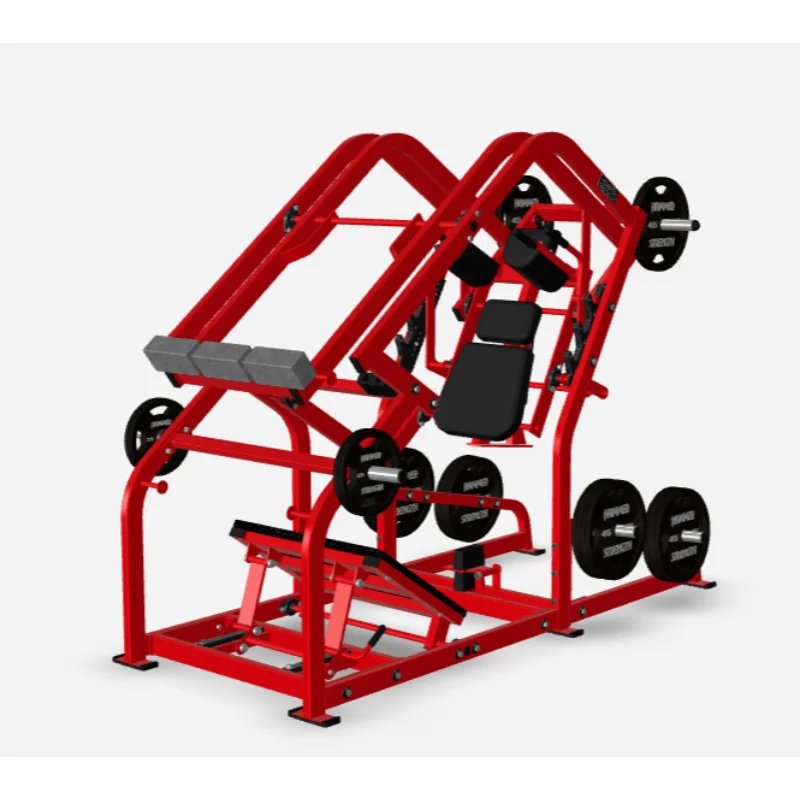
10,000-Hour Endurance Verified — Every bearing and guide rail on this plate-loaded linear leg press is tested for continuous high-frequency commercial cycles before leaving the factory.
Technical Specifications
| Parameter | Value |
|---|---|
| Product Type | Linear Leg Press |
| Power Source | Manual (Plate-Loaded) |
| Exercise Part | Leg |
| Material | Steel |
| Net Weight | 250 kg |
| Product Dimensions | 2375 × 1500 × 1475 mm |
| Foldable | Unfolded |
| Color Options | Optional |
| Customization | Available (Frame color, upholstery, branding) |
| OEM | Available |
| Certification | ISO 9001, CE |
Application Suitability
| Deployment Scenario | Typical Use |
|---|---|
| Chain gym strength zone | High-frequency daily loading by hundreds of members with minimal maintenance overhead |
| Hotel fitness center | Zero motor noise operation suitable for floors adjacent to guest rooms and quiet zones |
| Corporate wellness room | Compact heavy-duty strength training for time-constrained employees on lunch breaks |
| High-end residential home gym | Commercial-grade durability for serious lifters who want gym-quality loading at home |
| Sports performance training center | Max-load lower-body development for athletes requiring stable, repeatable pressing mechanics |
Why Plate-Loaded Silence Outperforms Motorized Alternatives in Strength Zones
Zero electronics means zero electrical failure points across the entire service life of the machine.
When a selectorized leg press gets installed in a hotel fitness center, the weight stack cable and selector pin mechanism generate clicking noise on every repetition — and that low-frequency clatter travels through concrete slabs just like cardio equipment does [NEED_CITE: structural vibration transmission from selectorized strength equipment]. Facility managers who outfit guest-room floors quickly learn that even strength equipment contributes to noise complaints at the front desk. The commercial linear leg pre*manual plate loading: no solenoids, no cable-and-pulley rattling, no electronic resistance motors humming under load. The 250 kg steel frame anchors itself against the floor without shifting or resonating, even when athletes press maximum loads through full range of motion.
Positioning This Linear Leg Press Within a Commercial Strength Zone
This machine covers high-load bilateral and unilateral lower-body pressing across beginner through elite athlete strength levels, complementing squat racks, hack squats, and leg extension machines in a comprehensive leg-training circuit. Its 2375 × 1500 × 1475 mm footprint demands dedicated floor space with clearance on the loading side for plate changes, making it best suited for the core strength zone rather than peripheral wellness areas. The reinforced steel frame and broad back pad accommodate users across a wide body-size range, and the linear sled path keeps resistance mechanics consistent whether someone is pressing 100 kg or 500 kg. In a chain gym or sports performance facility, this commercial linear leg press gym equipment anchors the lower-body section alongside hip thrust and calf raise stations for complete posterior and anterior chain coverage.
Deployment Environment and Floor-Level Installation Requirements
A machine this heavy demands a level, reinforced concrete subfloor capable of supporting concentrated dynamic loads without deflection — installers should verify slab rating before positioning the unit near upper-floor edges or suspended floor sections [NEED_CITE: structural load requirements for heavy plate-loaded gym equipment]. Because there are no motors or electronics, there is no voltage compatibility concern and no dedicated circuit requirement, which simplifies international deployment considerably. Rubber vibration-damping mats beneath the frame feet further isolate impact from floor-transmitted noise, an important step when the strength zone shares a floor with spa areas or conference rooms. Adequate clearance around the loading side ensures staff can move bumper plates safely without obstructing adjacent equipment traffic flow. The absence of a console or data cable also means zero integration overhead with facility management systems.
Guide Rail and Bearing Mechanics That Determine Long-Term Smoothness
The sled travels along linear guide rails rather than a pivot-arm arc, which keeps the pressing path consistent and eliminates the mechanical bind that plagues cheaper hinge-based designs at the bottom of the stroke. Sealed bearings inside the sled carriage are rated for over 10,000 hours of continuous commercial operation, preventing the grinding and lateral play that develop when unsealed bearings accumulate chalk dust and sweat corrosion. The 250 kg frame mass provides inertial stability so the unit does not rock or walk across the floor during heavy eccentric lowering phases. Plate-loaded resistance scales linearly with added mass — there is no magnetic drag curve or friction-compensation algorithm to calibrate, which is exactly why maintenance intervals on this commercial linear leg press gym equipment stretch to simple bearing inspections and rail wipe-downs rather than electronic diagnostic visits.
The Hidden Cost of Substituting Light-Commercial Frames in High-Traffic Facilities
When a facility purchases a lighter leg press to save on upfront equipment cost, the thinner steel tubing begins to flex under repeated heavy loads, and that flex concentrates stress at weld joints until hairline cracks appear [NEED_CITE: fatigue failure patterns in light-commercial strength equipment frames]. The guide rails on underspecified machines develop lateral play within months, producing metal-on-metal scraping sounds that members report to staff as equipment malfunction. Selectorized alternatives introduce cable fraying and weight-stack misalignment as recurring service calls, each one pulling maintenance technicians away from preventive work elsewhere in the facility. Procurement teams that approved the lighter unit end up authorizing a full replacement cycle before the original depreciation schedule completes, making the total cost of ownership higher than if the heavier commercial-grade frame had been specified from the outset.
Why This Plate-Loaded Line Meets Commercial Deployment Standards
Every frame in this series undergoes endurance cycling that simulates years of member traffic, validating weld integrity and rail alignment under sustained load. The zero-electronics architecture means this commercial linear leg press gym equipment ships without voltage-plug mismatches or console firmware compatibility issues — it arrives, gets bolted to the floor, and begins earning its keep immediately. The full product family across six cardio and strength categories lets a facility source from a single OEM partner, simplifying warranty management and spare-parts logistics. Customization covers frame color, upholstery material, and brand logo placement, so the unit visually integrates with any facility identity without delaying production timelines. The 3D layout service extends to strength zones as well, accounting for plate-storage clearance, member traffic flow, and sightline considerations that affect how often the station actually gets used.
Documentation & Test Records
- CE declaration of conformity covering structural and mechanical safety requirements
- EN 957 test report validating load rating and structural integrity
- ISO 9001 certificate confirming quality management across the manufacturing process
- Durability test record documenting 10,000-hour bearing and guide rail performance
- Weld inspection report detailing steel thickness and joint integrity at stress points
- Spare parts catalog with exploded assembly diagrams for bearing and rail replacement
Installation, Commissioning & Maintenance
- Maintain minimum 600 mm clearance on the plate-loading side for safe bumper-plate handling
- Position on level reinforced concrete with rubber isolation mats beneath all frame contact points
- No electrical circuit required; verify subfloor load rating for the 250 kg static weight plus dynamic loading
- Inspect sealed bearings and wipe guide rails monthly; re-lubricate per the service schedule
- Check all anchor bolts after the first 500 use cycles and retorque to specification
- Clean upholstery with non-solvent cleaner to preserve leather integrity under high-humidity gym conditions
Requesting a Site-Specific Strength Zone Layout
Provide the total strength-zone square footage and target member capacity to receive a 3D layout plan that accounts for plate-storage zones, member circulation paths, and safe clearance around each pressing station. Specify the deployment floor level and adjacent room types so the planning team can confirm vibration isolation requirements. Indicate whether frame color, upholstery, and branding customization are needed so the OEM scope is defined before the proforma invoice stage.
Frequently Asked Questions
Q: What distinguishes a plate-loaded linear leg press from a selectorized version for commercial use?
A: A plate-loaded design eliminates the cable, pulley, and weight-stack mechanism entirely, removing the components most prone to wear and service calls in high-traffic facilities. Resistance scales directly with added plates, giving athletes finer load increments and higher absolute capacity. Maintenance is limited to bearing inspection and rail cleaning rather than cable replacement and selector-pin calibration, which keeps the machine in service instead of in the repair queue.
Q: What steel thickness standards apply to commercial strength equipment frames?
A: Commercial-grade frames typically use steel tubing with wall thicknesses that withstand repeated dynamic loading without flex or fatigue cracking at weld points. The 250 kg frame mass on this unit reflects substantial material volume, ensuring structural rigidity under maximum user loads. Facilities should request the weld inspection report and steel specification sheet to verify that the frame meets EN 957 structural requirements for static and dynamic load testing.
Q: How do sealed bearings maintain smooth guide-rail operation over years of commercial use?
A: Sealed bearings prevent chalk dust, sweat, and humidity from penetrating the internal race, which is the primary cause of grinding and lateral play in unsealed alternatives. The 10,000-hour durability testing validates that these bearings maintain smooth linear travel through thousands of loaded press cycles. Monthly rail wipe-downs and periodic visual inspections are sufficient to extend bearing service life well beyond typical equipment depreciation timelines.
Q: What floor-space and clearance planning factors apply to deploying this leg press in a strength zone?
A: The 2375 × 1500 × 1475 mm footprint requires dedicated floor area with at least 600 mm of clearance on the plate-loading side for safe plate handling and member passage. Facilities should also consider sightline positioning so the station is visible from the entrance, which correlates with higher utilization rates. A 3D layout plan can optimize these spacing factors alongside adjacent squat rack and deadlift platform placements.
Q: What OEM customization options are available for matching a facility’s visual identity?
A: Frame powder-coat color, upholstery leather or vinyl material, and brand logo placement are all configurable to align with a facility’s design language. These customizations are scoped during the quotation phase, with flexible minimum order quantities that accommodate both single-unit boutique installations and multi-site chain deployments. The customization process does not alter the structural specifications or certification status of the base unit.