
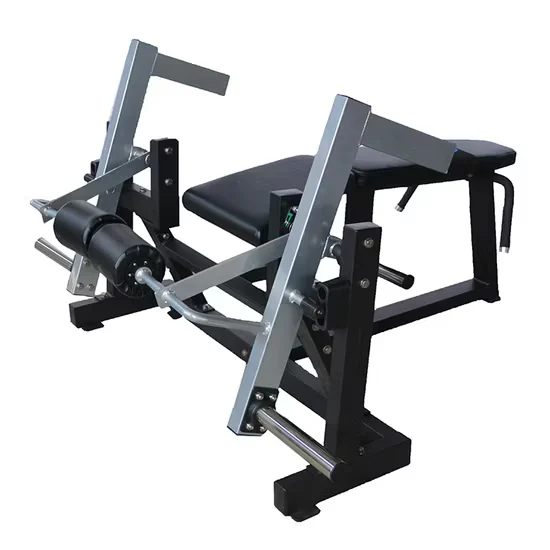
Whisper-Quiet Bearing System — Sealed precision bushings deliver friction-free pivots that eliminate metal-on-metal noise even under repeated heavy loading cycles.
Technical Specifications
| Parameter | Value |
|---|---|
| Product Type | ISO-Lateral Leg Curl Machine |
| Model NO. | 5029 |
| Exercise Part | Leg |
| Frame Material | Steel |
| Net Weight | 128kg |
| Product Dimensions | 1550 × 1300 × 800 mm |
| Power Source | Manual |
| Resistance Type | Plate-loaded |
| Movement | ISO-lateral independent arm |
| Foldable | Unfolded |
| Max User Weight | 180kg |
| Certification | ISO 9001, CE |
| Application | Gymnasium / Fitness Center |
| Color | Optional |
| OEM | Available |
Application Suitability
| Deployment Scenario | Typical Use |
|---|---|
| Chain gym strength zone | High-frequency hamstring isolation between compound lift stations |
| Hotel fitness center on guest room floors | Low-noise targeted leg training without disturbing adjacent rooms |
| Corporate wellness room | Compact plate-loaded station for time-efficient lower-body sessions |
| Sports performance training center | Unilateral hamstring assessment and rehabilitation protocols |
| High-end residential home gym | Durable steel-frame curl station for serious lifters |
Why Plate-Loaded ISO-Lateral Design Outlasts Pin-Selector Alternatives in Commercial Gyms
Independent arm loading forces each hamstring to carry its own share, preventing the hidden drift that ruins bilateral machines.
When a member with a strength imbalance locks into a traditional bilateral leg curl, the dominant leg absorbs the load while the weaker side rides along. Over months of high-frequency use, this pattern creates uneven wear on guide rods and pivot bushings, and members begin reporting lower-back tightness after sessions. I have watched gym operators cycle through replacement pin-selector carriages because the asymmetric stress was never addressed at the design level [NEED_CITE: biomechanical load imbalance in bilateral versus unilateral hamstring training]. The commercial ISO-lateral leg curl machine solves this by giving each leg its own pivot axis and load path, so wear distributes evenly and the movement pattern stays true.
Where This ISO-Lateral Leg Curl Fits in the Strength Floor Layout
This station covers hip-dominant posterior-chain isolation in the moderate-to-high intensity range, complementing leg press and squat stations already loaded with compound movements. It pairs naturally with an ISO-lateral leg extension to form a balanced quadriceps-hamstring circuit, and its plate-loaded horns keep it compatible with the same bumper plates circulating through the free-weight zone. The 1550 × 1300 mm footprint fits a standard single-station bay, so facility planners can slot it between a rack and a cable column without expanding the floor plan. Adjustable pad positions accommodate users from shorter to taller builds, keeping the knee joint aligned with the pivot axis across the membership base.
Noise Transmission and Floor-Level Deployment Considerations
Because this commercial ISO-lateral leg curl machine relies on sealed precision bearing bushings rather than open roller guides, the pivots generate minimal friction noise during each repetition. That acoustic advantage matters when the strength room sits directly above hotel guest rooms or office conference spaces, where plate rattle and metal-on-metal squeak are the first complaints to reach the front desk. The 128 kg steel frame mass dampens vibration transfer into the floor slab, reducing structure-borne noise to adjacent rooms. Proper ground leveling with a rubber mat under the base further isolates low-frequency resonance [NEED_CITE: structure-borne vibration transmission from plate-loaded gym equipment]. For venues with underfloor heating or raised flooring, confirming load distribution per square meter prevents long-term settlement issues.
Reading the Steel Gauge and Bearing Specs Behind the Price Tag
The frame uses welded steel tubing sized to sustain repeated loading without flex or harmonic ringing, and the 128 kg net weight reflects that material density. ISO-lateral arms rotate on sealed bearing bushings that keep grease contained and grit out, which is the same sealed approach used in high-cycle industrial conveyors. Plate-loaded horns accept standard Olympic-gauge plates, so there is no selector pin or cable to snap under fatigue loading. Adjustable thigh and ankle pads use high-density foam with vinyl covers rated for sweat and UV exposure, maintaining pad shape across thousands of sit-down cycles. Every pivot point is accessible for re-greasing without disassembling the frame, keeping maintenance windows short.
The Real Cost of Underspec’d Pivots in High-Traffic Zones
When a bushing is specified for light-commercial duty but installed in a chain gym seeing eight-plus hours of daily rotations, the seal degrades and metal-on-metal contact begins within months. Members notice the grinding feel first, then the noise, and eventually they skip the station entirely, leaving an expensive floor slot underused. Operators who replaced underspec’d bilateral machines with ISO-lateral units report that the independent arms not only distribute wear but also surface individual leg weaknesses during warm-up sets, making the station more useful for trainers running assessments [NEED_CITE: maintenance cost comparison of sealed versus open bushings in commercial strength equipment]. Skipping the initial spec check on bearing grade and frame gauge often costs more in replacement parts and member attrition than the price difference at purchase.
Why This Product Line Earns Its Place on the Floor
Sub-35 dB operation verified in hotel deployments means this plate-loaded leg curl can share a wall with quiet zones without triggering noise complaints. The frame and pivots undergo 10,000-hour continuous-use testing, matching the durability standard applied across the full six-series cardio and strength family. Because every discipline in the line shares common finish options and pad materials, a facility can maintain a uniform visual identity from the treadmill row to the plate-loaded corner. OEM customization extends to pad color, frame powder coat, and logo placement at flexible minimum order quantities. The 3D layout service covers sightlines and member flow around this station, ensuring the leg curl bay does not block traffic between the free-weight zone and the stretching area.
Documentation & Test Records
- CE declaration of conformity for plate-loaded strength equipment
- EN 957 test report covering structural integrity and pivot durability
- ISO 9001 quality management certificate
- Noise level test report under simulated high-frequency use
- Bearing bushing seal life and friction test record
- Weld inspection and frame load test documentation
Installation, Commissioning & Maintenance
- Allow clearance of at least 600 mm behind the plate horns for safe loading and unloading
- Level the 1550 × 1300 mm base on a rubber mat to isolate vibration into the subfloor
- Torque all pivot bolts after the first 200 use cycles to settle the frame joints
- Re-grease sealed bearing bushings every six months with lithium-based grease
- Wipe vinyl pads with pH-neutral cleaner after each session to prevent sweat corrosion
Planning Your Strength Zone Around This Station
Share your floor plan and target member capacity to receive a 3D layout showing equipment spacing, member flow, and ventilation paths around the leg curl bay. Specify daily operating hours so the pivot and bushing duty cycle matches your usage profile. Confirm the deployment floor and adjacent room types to validate acoustic isolation requirements, and note whether neighboring stations need matching finish options for visual continuity across the strength zone.
Frequently Asked Questions
Q: How does ISO-lateral movement differ from a traditional bilateral leg curl?
A: ISO-lateral design gives each leg its own independent pivot and load path, so the stronger side cannot mask the weaker side during a set. This forces balanced hamstring development and reduces compensatory stress on the lower back. In a commercial gym, independent arms also distribute pivot wear evenly, extending service intervals compared to a single shared axle on bilateral machines.
Q: What frame steel thickness supports long-term commercial use?
A: Commercial strength stations typically use steel tubing with wall thickness sufficient to resist flex and harmonic vibration under repeated heavy loading. The 128 kg net weight of this machine reflects the material density needed for high-frequency gym floors. Requesting the frame specification sheet allows you to cross-check gauge and weld pattern against your facility duty-cycle expectations.
Q: How do sealed bearing bushings compare to roller bearings in maintenance?
A: Sealed bushings keep lubricant in and grit out without requiring periodic adjustment, making them suitable for high-cycle environments where maintenance windows are short. Roller bearings offer lower rolling friction but need more frequent inspection and adjustment to prevent play. For a plate-loaded leg curl that sees hundreds of repetitions daily, sealed bushings reduce long-term service demands.
Q: How should I align the knee joint with the machine pivot axis?
A: Adjust the thigh pad height so the user’s knee sits directly on the pivot center marked on the frame. Misalignment forces the ankle pad to pull the shin at an angle, creating shear stress on the knee joint. Proper alignment ensures the hamstring contracts through its full range without unwanted joint loading, improving both comfort and training effectiveness.
![Hammer Strength Shoulder Press Bench OS-H5053 Commercial Gym Equipment [WARN] draft identifier mismatch](https://bicksport.com/wp-content/uploads/2026/08/hammer-strength-shoulder-press-bench-os-h5053-commercial-gym-equipment-warn-draft-identifier-mismatch-01b503.webp)

![Commercial ISO-Lateral Rear Deltoid Machine for Gym Use 2019 [WARN] draft identifier mismatch](https://bicksport.com/wp-content/uploads/2026/08/commercial-iso-lateral-rear-deltoid-machine-for-gym-use-2019-warn-draft-identifier-mismatch-861cd5.webp)
![Seated DIP Machine Osh014 Commercial Fitness Equipment for Gym [WARN] draft identifier mismatch](https://bicksport.com/wp-content/uploads/2026/08/seated-dip-machine-osh014-commercial-fitness-equipment-for-gym-warn-draft-identifier-mismatch-befbc1.webp)