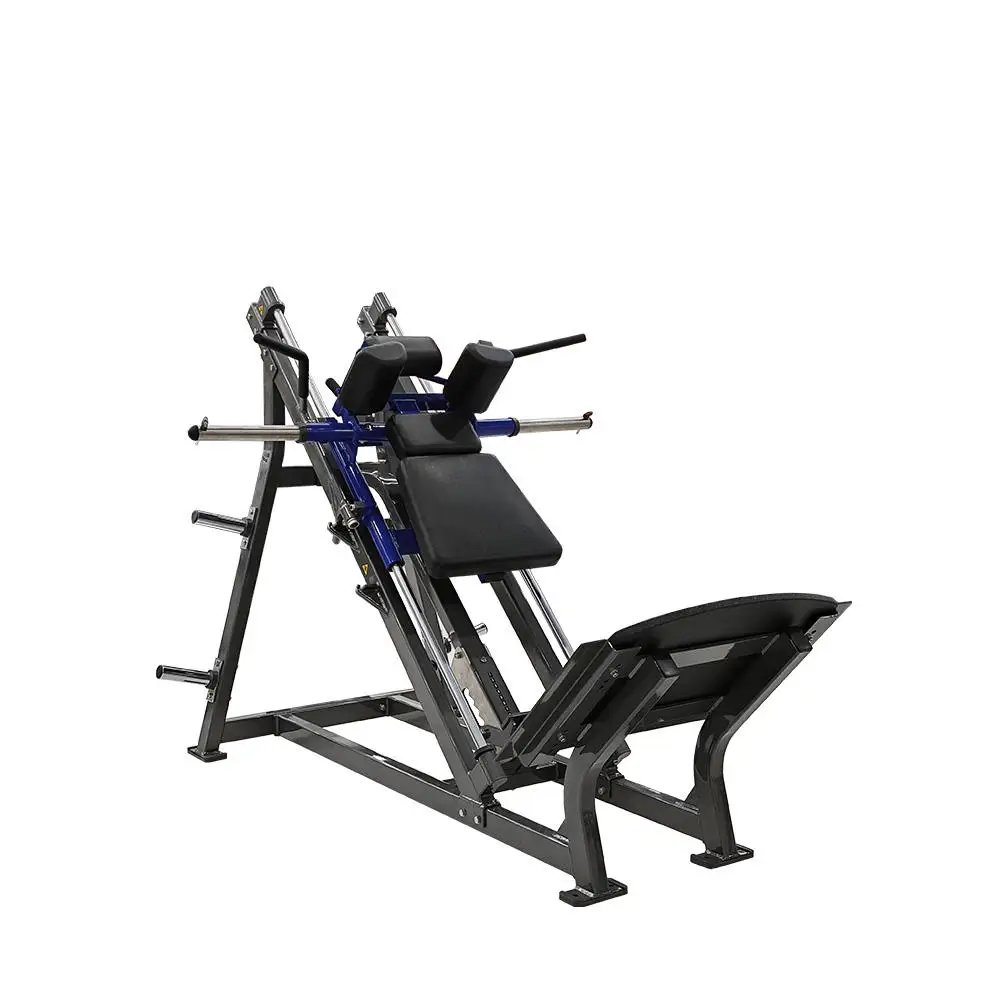
Steel Frame Rigidity — Welded steel construction tested for continuous load cycles in high-traffic commercial facilities.
Technical Specifications
| Parameter | Value |
|---|---|
| Product Type | Strength Machine (Leg Extension) |
| Exercise Part | Leg |
| Material | Steel |
| Product Dimensions | 1440 × 1695 × 1481 mm |
| Net Weight | 103 kg |
| Age Group | Adult |
| Gender | Unisex |
| Resistance Type | Plate-loaded or selectorized (configurable) |
| Seat Adjustment | Multi-position |
| Certification | ISO 9001, CE |
Application Suitability
| Deployment Scenario | Typical Use |
|---|---|
| Chain gym strength zone | High-frequency isolated quadriceps training across diverse membership |
| Corporate wellness room | Compact lower-body station for time-constrained employee workouts |
| Community fitness center | Durable leg isolation equipment for open-access supervised use |
| Sports performance training center | Targeted knee extension work for athlete conditioning and rehabilitation |
Why Frame Vibration Reaches Members Before Maintenance Notices It
A rigid frame eliminates the wobble that tells users a machine is wearing out.
In commercial strength areas, plate-loaded machines see hundreds of load cycles daily. When the steel tubing is undersized or the welds lack penetration, harmonic vibration develops at the pivot points within months. Members feel it as instability during heavy sets, and they simply stop using the station. I have walked into facilities where leg extension frames were visibly flexing under load — the machines were barely two years old [NEED_CITE: frame rigidity requirements for commercial strength equipment under repetitive loading].
The commercial hammer strength leg extension machine addresses this with a fully welded steel structure at 103 kg net weight. That mass is deliberate: it anchors the frame against lateral shift during aggressive extensions without requiring bolted floor plates in every deployment.
Where This Station Fits in a Strength Floor Layout
Isolated knee extension work occupies a specific niche between compound leg presses and free-weight squat racks. This commercial hammer strength leg extension machine serves users who need controlled quadriceps loading without spinal compression — post-injury members, older adults, and athletes isolating specific muscle groups for hypertrophy. It pairs naturally with a seated leg curl station on the adjacent pad, giving members a complete anterior-posterior leg circuit without crossing the gym floor. The 1440 × 1695 mm footprint fits standard commercial spacing grids, and the multi-position seat accommodates users across a wide height range.
Continuous Operation and Environmental Placement
Strength machines do not draw power, which simplifies deployment considerably — no dedicated circuits, no voltage matching, no motor thermal management. What matters here is floor loading and spacing. The 103 kg unit requires a level concrete subfloor with a rubber mat beneath the base feet to prevent creep during heavy sets. Plan for at least 600 mm clearance on the loading side for plate changes and 900 mm behind the seat for user entry. In multi-story hotel fitness centers, place it away from quiet zones; the sound of plates being loaded and the pivot mechanism cycling transmits through floor slabs [NEED_CITE: acoustic transmission standards for fitness equipment in mixed-use buildings].
What the Pivot Bearing and Frame Gauge Actually Mean
The bearing system at the pivot axis is where commercial and家用 equipment diverge most sharply. Sealed commercial bearings resist sweat ingress and chalk dust accumulation that degrade open bearings within months. On a leg extension, the pivot handles the full moment arm of the loaded lever — if the bearing develops play, the user feels lateral wobble at the shin pad, and the movement pattern degrades. The steel frame gauge determines how much the main spine deflects under peak load. A frame that flexes visibly under a heavy stack is absorbing energy that should transfer to the quadriceps, and over time those flex cycles initiate fatigue cracks near weld joints [NEED_CITE: fatigue cycle limits for welded steel frames in commercial fitness equipment].
The Hidden Cost of Underspec’d Pivot Hardware
Facilities that purchase leg extension machines on price alone typically discover the real cost around month fourteen. The pivot bearings develop axial play first — users report a clunking sensation at the top of the extension arc. Then the seat adjustment detent pins wear oval in their receivers, and the backrest slips mid-set. Eventually the frame welds at the pivot gusset show hairline cracks, and the entire unit is pulled from the floor. Replacing pivot hardware on a welded frame often costs more in labor downtime than buying a properly specified unit initially [NEED_CITE: total cost of ownership comparison for commercial versus light-commercial strength equipment].
Why This Product Line Exists in Our Catalog
Every unit undergoes durability testing on the pivot axis for 10,000 hours of continuous cycling under load — that number comes from actual commercial deployment data, not laboratory projections. The sealed bearing specification matches what we specify across our cardio range, so maintenance teams stock one bearing class for the entire facility. The six-series cardio family pairs with this strength line so a single source covers the full equipment schedule. OEM customization extends to powder-coat color and upholstery to match facility branding. We provide a 3D strength and cardio zone layout covering equipment spacing, sightlines, and member flow paths at no charge. Technical support runs 24/7 for commissioning questions and parts identification.
Documentation & Test Records
- CE declaration of conformity covering commercial strength equipment classification
- EN 957 test report for static and dynamic load verification on frame and pivot
- ISO 9001 certificate for manufacturing process control
- Durability test record documenting pivot cycle count under rated load
- Material specification sheet detailing steel grade and weld procedure
- Installation guide with floor anchoring and leveling instructions
Installation, Commissioning & Maintenance
- Verify floor levelness within 3 mm over the 1440 × 1695 mm footprint before positioning
- Place rubber isolation mats under all base feet to prevent creep under load
- Maintain 600 mm lateral clearance on the plate-loading side for safe operation
- Grease sealed pivot bearings per the maintenance schedule in the installation guide
- Inspect seat adjustment detent pins quarterly for wear and replace if play develops
- Wipe down upholstery and steel surfaces daily to prevent sweat corrosion on weld joints
Equipment Selection Next Steps
Provide your strength zone square footage and target equipment count so we can generate a 3D layout with spacing and member flow analysis. Specify whether your facility runs plate-loaded or selectorized resistance to confirm the configuration. Indicate the deployment floor and adjacent room types so we can advise on acoustic isolation measures. State your target market and any facility branding requirements for OEM customization scoping.
Frequently Asked Questions
Q: What structural differences separate commercial strength machines from light-commercial units?
A: Commercial frames use thicker steel tubing with full-penetration welds at every load-bearing joint, while light-commercial units often rely on thinner gauge steel and spot welds. The pivot bearings on commercial machines are sealed against sweat and dust ingress, rated for thousands of daily cycles rather than hundreds. This difference determines whether a leg extension station lasts two years or ten in a busy gym environment.
Q: How can I evaluate whether a leg extension frame handles high-frequency use?
A: Request the steel specification sheet showing tube wall thickness and the weld procedure documentation. Ask for the pivot bearing part number and its rated cycle life under load. A properly built commercial frame shows no visible flex when a user applies maximum force through the lever arm — if you can see the main spine bending, the steel gauge is insufficient for continuous commercial deployment.
Q: What maintenance does the pivot bearing system require?
A: Sealed commercial bearings on this machine require periodic greasing through the access fittings rather than full disassembly. The maintenance schedule specifies intervals based on daily usage volume — high-traffic facilities servicing hundreds of users daily will need more frequent attention. Inspect for axial play by rocking the lever arm laterally; any detectable movement indicates the bearing seal is compromised and replacement is due.
Q: How does the seat adjustment mechanism maintain stability during heavy sets?
A: The multi-position seat uses spring-loaded detent pins that lock into hardened steel receivers welded to the frame. These pins are sized to resist shear forces generated when a user drives hard into the backrest during maximal extensions. Quarterly inspection of the pin engagement surfaces ensures positive locking — worn pins allow the seat to shift under load, which compromises both safety and training effectiveness.

![Commercial Seated Arm Curl Machine for Professional Gyms [WARN] draft identifier mismatch](https://bicksport.com/wp-content/uploads/2026/08/commercial-seated-arm-curl-machine-for-professional-gyms-warn-draft-identifier-mismatch-b3cee7.webp)