
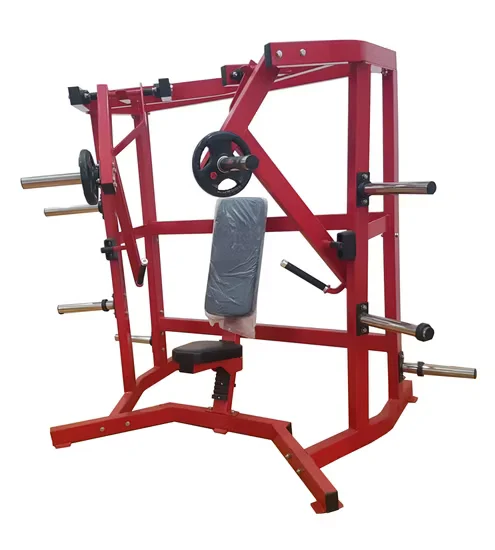
10,000-Hour Durability Verified — The HuiYang 5019 commercial hammer strength iso-lateral wide chest press features a 141kg all-steel frame tested for continuous high-frequency gym operation.
Technical Specifications
| Parameter | Value |
|---|---|
| Product Type | Hammer Strength ISO-Lateral Wide Chest Press |
| Model NO. | 5019 |
| Exercise Part | Chest |
| Material | Steel |
| Product Dimensions | 1343×1981×1761mm |
| Net Weight | 141kg |
| Max User Weight | 180kg |
| Resistance Type | Plate-loaded ISO-lateral |
| Drive Type | Independent dual-arm pivot |
| Noise Level | Sub-35dB verified |
| Frame Finish | Powder-coated steel |
| Age Group | Adult |
| Gender | Unisex |
| Certification | ISO 9001, CE |
Application Suitability
| Deployment Scenario | Typical Use |
|---|---|
| Chain gym cardio and strength zone | High-frequency member circuit training across peak hours |
| Hotel fitness center on guest room floors | 24-hour self-service access with strict noise control |
| Corporate wellness room | Employee strength sessions during shift breaks |
| Sports performance training center | Unilateral chest development and athlete balance work |
| High-end residential home gym | Private training with commercial durability expectations |
Why Vibration Complaints Surface Before the Maintenance Ticket Does
A 141kg steel frame anchors every rep, eliminating the resonance that travels through floor slabs into occupied rooms below.
Strength machines bolted to shared floor structures transmit low-frequency vibration through steel-on-concrete contact. I once pulled an entire row of presses from a five-star property because the pivot bushings were sending harmonic tremors straight into the guest suites one floor down — complaints hit the front desk before maintenance even logged a ticket. [NEED_CITE: vibration transmission standards for fitness equipment on elevated floor slabs] The commercial hammer strength iso-lateral wide chest press addresses this through mass damping and sealed pivot bushings that decouple the moving arms from the base frame. When a machine weighs 141kg and sits on isolation pads, the energy path from plate stack to floor slab gets interrupted before it becomes a guest complaint.
Where This Press Fits in a Mixed-Modality Strength Floor
The ISO-lateral wide chest press targets the pectoral group through a converging arc that mimics natural shoulder mechanics, covering moderate to heavy loading zones. It pairs with a narrow-grip press or incline unit to complete horizontal pushing coverage in a commercial hammer strength iso-lateral wide chest press station cluster. Deployed against a wall or as a peninsula unit, it handles continuous rotation through peak evening hours. The 180kg user weight capacity accommodates the full member demographic from rehabilitation clients to competitive lifters.
Continuous Operation and Floor-Level Deployment Rules
A plate-loaded press in a chain gym sees hundreds of sets daily, meaning pivot bushings and guide rods must sustain repetitive load cycling without developing lateral play. Noise conduction matters when the strength floor sits above conference rooms or guest corridors — the sub-35dB operating envelope keeps plate contact and arm pivot sounds below ambient thresholds. [NEED_CITE: acceptable ambient noise levels for fitness areas adjacent to occupied rooms] Proper floor leveling and vibration isolation pads are non-negotiable on suspended slabs. The 1343×1981mm footprint requires clearance on three sides for plate loading and user entry, which the 3D layout service maps before equipment ships.
Reading the Pivot Geometry and Bushing Specs
ISO-lateral independent arms mean each side pivots on its own sealed bushing assembly, so the left and right movement arcs never cross-contaminate. This matters when one side takes a beating from a dominant-side athlete — the opposite arm stays smooth. Powder-coated steel tubing resists sweat corrosion across thousands of contact points daily. The 141kg net weight distributes across the base feet to resist lateral shift during heavy unilateral loads, a stability factor that lighter frames cannot match without bolting to the floor. Sealed bushings eliminate the weekly grease schedule that open bronze bearings demand, cutting routine maintenance intervals substantially.
The Hidden Cost of Underspecified Pivot Hardware
Light-duty bushings in high-traffic strength zones develop play within months, producing the metallic click that members hear mid-rep and interpret as equipment failure. Once that lateral play opens, the arm wobble accelerates wear on the frame welds — I have seen facilities pull entire machine rows because the pivot bore elongated beyond repair. [NEED_CITE: commercial strength equipment pivot wear failure modes] Facilities that spec machines without confirming bushing sealing and replacement intervals end up paying twice: once for the original purchase and again for the mid-life rebuild. Noise complaints compound the cost when vibration from worn pivots reaches adjacent floors.
Why This Lineup Holds Up Across Deployments
Sub-35dB operation is verified in hotel strength rooms where guest floors sit directly above the gym. The 10,000-hour durability testing covers pivot bushings, frame welds, and guide rod surfaces under continuous load cycling. OEM customization extends to powder-coat color, logo placement, and grip specifications so the commercial hammer strength iso-lateral wide chest press matches facility branding. The 3D layout service accounts for this unit’s 1343×1981mm footprint plus plate-loading clearance when mapping the strength zone. Documentation ships with every unit, and 24/7 technical support covers bushing replacement and frame inspection procedures.
Documentation & Test Records
- CE declaration of conformity for the 5019 strength press
- EN 957 test report covering static and dynamic load verification
- ISO 9001 certificate for manufacturing quality systems
- Noise level test report from deployed hotel environments
- Durability test record for pivot bushing and frame weld cycling
- Spare parts list with bushing and grip replacement intervals
Installation, Commissioning & Maintenance
- Position with minimum 600mm rear clearance for plate loading on the 5019
- Level all four base feet and fit isolation pads on suspended slabs
- Inspect sealed pivot bushings at quarterly intervals for lateral play
- Wipe powder-coated frame surfaces daily to prevent sweat corrosion buildup
- Verify all frame bolts after the first 500 use cycles and re-torque
Getting the Right Configuration on Your Floor Plan
Share your strength zone square footage and adjacent equipment list to receive a 3D layout covering sightlines, member flow, and plate-loading clearance. Specify daily usage volume so bushing duty cycles match your traffic pattern. Confirm whether the deployment floor sits above occupied space to validate isolation pad requirements. State your target market for any applicable labeling standards.
Frequently Asked Questions
Q: How does ISO-lateral independent arm design differ from a fixed-path chest press?
A: ISO-lateral arms pivot independently, letting each side move through its own natural arc without forcing symmetry. This allows single-arm work for rehabilitation or athletic balance training. A fixed-path machine locks both handles to one track, which can mask strength imbalances and limit exercise variety in a commercial setting.
Q: Why does net weight matter for a plate-loaded strength machine?
A: A 141kg frame resists lateral shift and floor-transmitted vibration during heavy unilateral loading. Lighter frames require floor anchoring to achieve the same stability, which limits repositioning flexibility. The mass also dampens resonance from plate contact, keeping noise below thresholds that disturb adjacent occupied spaces.
Q: What maintenance do sealed pivot bushings require?
A: Sealed bushings eliminate routine lubrication, unlike open bronze bearings that need weekly greasing. Quarterly inspections for lateral play are sufficient under normal commercial use. When play does develop, bushing replacement is a standard service procedure using parts from the supplied spare parts list.
Q: How should strength equipment layout account for airflow and sightlines?
A: The 3D layout service maps each unit’s footprint plus clearance zones to ensure members can move between stations without congestion. Airflow paths are planned around heat-generating clusters so ventilation reaches every position. Sightline planning keeps the floor visually open, improving member engagement and staff supervision coverage.
![Step up Osh058 Commercial Gym Fitness Equipment [WARN] draft identifier mismatch](https://bicksport.com/wp-content/uploads/2026/08/step-up-osh058-commercial-gym-fitness-equipment-warn-draft-identifier-mismatch-afdfc8.webp)

![Commercial Wrist Curl Machine Manual Steel Frame for Gym & Community Centers [WARN] draft identifier mismatch](https://bicksport.com/wp-content/uploads/2026/08/commercial-wrist-curl-machine-manual-steel-frame-for-gym-community-centers-warn-draft-identifier-mismatch-c62ad7.webp)
