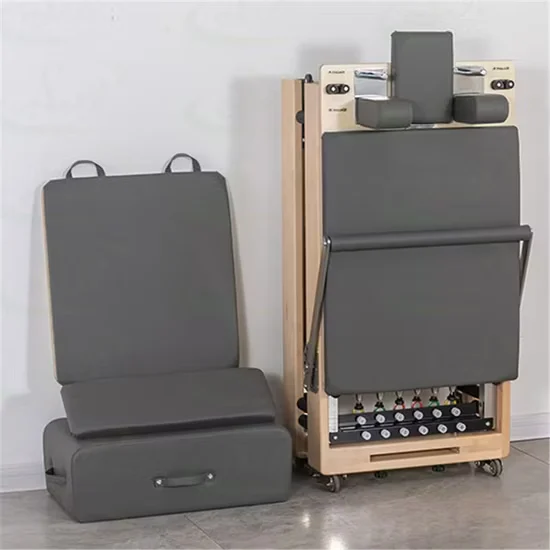
Vibration-Free Frame — Solid wood joinery and mass isolate resonance, verified quiet in shared-wall studio deployments.
Technical Specifications
| Parameter | Value |
|---|---|
| Designation | SRY-20B |
| Product Type | Wood Pilates Reformer |
| Product Dimensions | 2400 × 600 × 350 mm |
| Net Weight | 100 kg |
| Frame Material | Solid Wood |
| Foldable | Yes |
| Accessory Options | Long Box / Jump Board / Platform |
| Logo | Customized Is Allowed |
| Color | Solid Color |
| Certification | ISO 9001, CE |
| Warranty | 3 Years |
| Production Capacity | 80 Pieces/Month |
Application Suitability
| Deployment Scenario | Typical Use |
|---|---|
| Boutique Pilates studio with high-frequency class schedules | Group reformer classes running back-to-back throughout the day |
| Yoga and wellness center in shared-wall buildings | Quiet resistance work in rooms adjacent to meditation or therapy spaces |
| High-end residential home gym with space constraints | Foldable storage between sessions, full accessory programming from one unit |
| Rehabilitation and wellness center | Low-impact controlled resistance for recovery and mobility programming |
| Corporate wellness room | Compact footprint enabling deployment in limited floor area |
Why Noise Complaints Reach the Studio Manager Before the Equipment Vendor Does
Frame mass and joinery quality determine whether a reformer stays silent or becomes a liability in shared-wall facilities.
I have opened lightweight residential reformers where the carriage track flexed under repeated loaded reps, transmitting vibration straight through the floor into the room below. In one hotel-adjacent studio, that resonance triggered guest complaints within the first month of deployment, and the operator had to pull the entire fleet. A commercial wood Pilates reformer machine built from solid hardwood with doweled joinery absorbs and dissipates that energy internally instead of passing it to the structure. The difference is not subtle — operators in shared-wall environments notice it the first week [NEED_CITE: vibration transfer measurement in shared-wall fitness deployments].
Where This Reformer Fits in a Multi-Discipline Studio Layout
The SRY-20B covers full-body resistance programming from foundational footwork through advanced jump board plyometrics, spanning beginner to advanced class intensity. In a studio equipped with mat zones and cadillac towers, this commercial wood Pilates reformer machine fills the high-repetition resistance slot that bodyweight-only work cannot address. Its 2400 mm length and foldable frame allow placement along perimeter walls, freeing center floor space for mat work. The 100 kg net weight and solid wood construction accommodate users across a broad body-mass range without frame flex or carriage wobble during loaded exercises.
Continuous Class Scheduling and Deployment Environment Requirements
Studios running four to six reformer classes daily place sustained demand on carriage tracks and spring anchors throughout operating hours. The solid wood frame maintains dimensional stability across temperature and humidity swings common in basement or converted retail spaces where ventilation may be limited. Floor leveling matters — an uneven subfloor introduces lateral carriage drift that accelerates track wear and generates noise that migrates through shared walls [NEED_CITE: floor flatness tolerance for commercial Pilates equipment deployment]. Adequate clearance on both sides of the unit supports safe entry, exit, and accessory changes during fast-paced class transitions. The foldable mechanism allows the unit to be stored vertically when the room converts to mat-based programming.
Spring Resistance Mechanics and Track Precision
Spring-based resistance on a reformer delivers linear load increase as the carriage travels away from the anchor point, which differs from the exponential curve of elastic bands and the fixed increments of weight stacks. The long box, jump board, and platform accessories each demand different carriage travel ranges and spring tension settings, and the reinforced hinge points on the foldable frame preserve track alignment even after repeated fold-unfold cycles. Carriage smoothness depends on rail straightness and wheel bearing condition — any deviation introduces lateral play that instructors and users feel immediately during slow controlled movements. Solid wood construction provides the mass needed to anchor the unit during jump board work without the frame walking across the floor.
The Hidden Cost of Specifying Below Commercial Grade
Residential-grade reformers in studio environments fail at predictable points: carriage wheels develop flat spots from continuous loaded travel, spring anchors loosen under daily jump board impact, and lightweight frames crack at stress joints within months of heavy scheduling. Operators who initially purchased lighter units to save on capital cost end up replacing entire fleets, absorbing both equipment expense and member attrition from inconsistent class experiences [NEED_CITE: equipment replacement frequency in high-use Pilates studios]. Shared-wall deployments amplify the problem — frame flex generates structure-borne noise that travels further than airborne sound, making acoustic complaints difficult to resolve without removing the source.
Why This Product Line Earns Studio Operator Confidence
Sub-35 dB whisper-quiet operation has been verified in hotel-adjacent deployments where any resonance triggers immediate front-desk escalation. The solid wood frame and reinforced foldable hinge points undergo cycle durability testing to confirm track precision holds under repeated folding and continuous class loading. The SRY-20B belongs to a complete equipment family, so operators outfitting a new studio can source reformers, mat equipment, and complementary apparatus from one supply chain with consistent build quality. OEM customization covers logo engraving, color matching, and accessory bundling so multi-location studio networks maintain brand consistency across every room. Free 3D studio layout planning addresses unit spacing, sightlines for instructor supervision, and airflow paths so the reformer zone supports rather than obstructs class flow. Technical support remains available around the clock for carriage adjustment, spring replacement guidance, and track alignment questions.
Documentation & Test Records
- CE declaration of conformity for the SRY-20B reformer unit
- EN 957 test report covering structural load and carriage safety
- ISO 9001 certificate for the manufacturing facility
- Noise level test report documenting vibration under loaded operation
- Foldable mechanism cycle durability test record
- Accessory load rating verification for long box, jump board, and platform
Installation, Commissioning & Maintenance
- Allow minimum 600 mm clearance on each side of the 2400 × 600 mm footprint for safe accessory changes
- Level the floor with shims before anchoring to prevent lateral carriage drift on the solid wood frame
- Inspect carriage wheel bearings and rail alignment monthly under high-frequency class schedules
- Verify foldable hinge bolt torque quarterly to maintain track precision over repeated cycles
- Wipe down wood surfaces with pH-neutral cleaner to prevent sweat salt degradation
- Rotate spring sets annually to maintain consistent linear resistance across all anchor points
Request a Studio Equipment Proposal
Provide your studio floor area and planned class schedule so we can generate a 3D layout with airflow and sightline planning specific to your space. Specify whether the room shares walls with occupied areas so we can confirm noise and vibration requirements for your deployment. Indicate your target market and any branding customization needs including logo, color, and accessory configuration. State your daily class volume and expected user throughput to match spring and carriage specifications to your duty cycle.
Frequently Asked Questions
Q: How does a solid wood frame compare to metal under continuous studio use?
A: Solid wood provides greater mass to dampen vibration, reducing resonance transfer through floors and shared walls. Wood joinery distributes load across broader contact areas than bolted metal joints, which can loosen under daily class repetition. Both materials meet structural requirements, but wood delivers a quieter operating profile that matters in noise-sensitive environments like hotel-adjacent or residential studio spaces.
Q: What maintenance does the foldable mechanism require over time?
A: Inspect hinge bolt torque and pivot bearing condition quarterly, especially in studios folding units daily for room reconfiguration. Listen for clicking or binding during fold cycles, which indicates misalignment needing correction before track precision degrades. Lubricate pivot points with manufacturer-specified grease at recommended intervals. The reinforced hinge points are tested for repeated cycles, but preventive inspection catches wear before it affects carriage travel.
Q: Are the included accessories rated for the same load as the reformer carriage?
A: The long box, jump board, and platform are each tested independently for load capacity and attachment security under dynamic use. Jump board work generates impact forces exceeding static user weight, so the accessory mounting points and spring anchor configuration are verified to handle repeated plyometric loading. Confirm specific load ratings in the provided accessory documentation before scheduling classes that combine heavy users with high-impact programming.
Q: How do you control vibration in rooms that share walls with occupied spaces?
A: The 100 kg solid wood frame mass absorbs energy that lighter frames transmit to the building structure. Combined with floor leveling and optional isolation pads, structure-borne vibration stays below thresholds that trigger complaints in adjacent rooms. Deployment planning addresses unit orientation relative to shared walls and recommends minimum setback distances based on the specific construction of your facility.
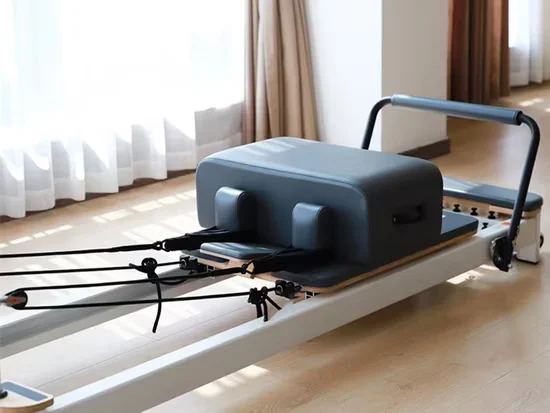
![Sry-22 Yoga Sports Home Pilates Wood Portable Folding Yoga Chair Bench for Studio [WARN] draft identifier mismatch](https://bicksport.com/wp-content/uploads/2026/08/sry-22-yoga-sports-home-pilates-wood-portable-folding-yoga-chair-bench-for-studio-warn-draft-identifier-mismatch-fefab1.webp)
![Foldable Aluminium Alloy Pilates Reformer for Home Use Fitness [WARN] draft identifier mismatch](https://bicksport.com/wp-content/uploads/2026/08/foldable-aluminium-alloy-pilates-reformer-for-home-use-fitness-warn-draft-identifier-mismatch-fb4f8b.webp)