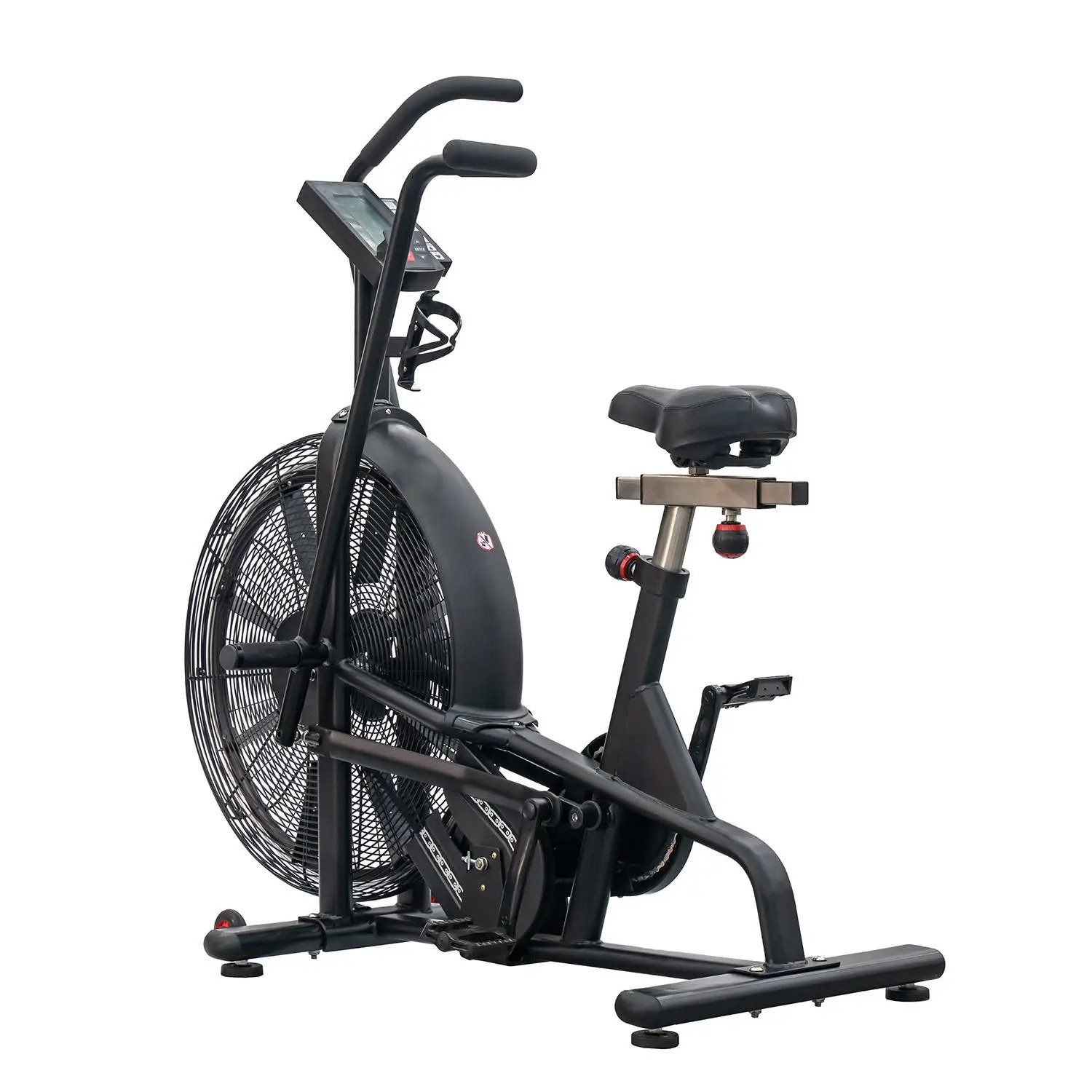
Air-Driven Resistance — Fan blade dynamics eliminate mechanical wear points found in magnetic or friction-based systems.
Technical Specifications
| Parameter | Value |
|---|---|
| Product Type | Air Bike / Fan Bike |
| Resistance Type | Power-Style Resistance Adjustment (Air / Fan) |
| Fan Size | 27-Inch Steel Fan Blades |
| Console Type | High-Definition Screen |
| Max User Weight | 150kg |
| Product Dimensions | 1300380880mm |
| Net Weight | 58kg |
| Foldable | Unfolded |
| Certification | CE, GS, RoHS, FCC |
Application Suitability
| Deployment Scenario | Typical Use |
|---|---|
| hotel fitness center on guest room floors | 24-hour self-service cardio with noise-sensitive surroundings |
| chain gym cardio zone | high-frequency interval training stations |
| corporate wellness room | compact full-body conditioning for limited square footage |
| sports performance training center | athlete HIIT and metabolic conditioning sessions |
Why Fan Blade Balance Matters More Than You Think at 2 AM
Vibration travels through floor joists long before sound does.
I remember pulling an entire batch of air bikes back from a five-star hotel because the flywheel dynamic balance was off. At high RPM the whole frame resonated, and guests in the rooms below called the front desk thinking the building’s HVAC was failing. The noise itself was tolerable — the low-frequency vibration through the slab was not. That experience changed how our testing lab approaches every fan assembly that leaves the line [NEED_CITE: structural vibration transmission thresholds in multi-story hospitality buildings]. When a commercial air bike fan spinning bike sits on an upper floor, the dynamic balance of that 27-inch steel fan is not a performance spec — it is a guest satisfaction metric.
Where This Machine Fits in a Mixed Cardio Layout
This unit covers the high-intensity end of the cardio spectrum. Air resistance scales linearly with pedal cadence, so users self-regulate effort without touching a dial. In a mixed cardio zone it pairs with steady-state machines — treadmills for long-duration work, ellipticals for low-impact volume — while this bike absorbs the sprint intervals and Tabata blocks that burn out magnetic systems prematurely. The 1300*380mm footprint fits between rack stations or in dedicated HIIT corners where ceiling height allows the full vertical fan sweep. User weight capacity at 150kg accommodates most athletic builds without frame flex during standing sprints. The commercial air bike fan spinning bike operates as a standalone conditioning tool that requires no resistance calibration between users.
What Continuous Operation Actually Demands From an Air-Driven System
Facilities running 16 to 20 hours daily need to consider factors beyond the motor — because this machine has none. The resistance mechanism is purely aerodynamic, meaning the only wear components are the bottom bracket bearings and the fan hub assembly [NEED_CITE: bearing load ratings for continuous commercial cycling equipment]. Airflow demand is significant: the 27-inch fan moves considerable volume at speed, so deploying multiple units requires HVAC planning for cross-ventilation rather than sealed rooms. Upper-floor installations need rubber isolation pads between the leveling feet and the slab to interrupt vibration paths. The HD console requires a dedicated data line or Wi-Fi access point for facility management system integration, and voltage requirements must match the local standard before the container ships.
Reading the Resistance Curve and Frame Geometry
Air resistance follows a squared relationship to velocity — double the pedal speed and the drag force roughly quadruples. This produces a self-limiting effort curve that prevents the sudden joint loading associated with heavy magnetic resistance jumps. The 27-inch steel fan blades generate meaningful resistance only above moderate cadence, which makes this commercial air bike fan spinning bike less suited for rehabilitation or low-RPM grinding work and better matched to interval programming. The 58kg net weight anchors the frame during maximal-effort sprints, reducing the lateral drift that lighter units exhibit when riders pull hard on the moving handlebars. The HD screen captures output data including wattage and RPM, providing the biometric feedback that structured training sessions require.
The Cost of Skipping Dynamic Balance Verification
We learned this the expensive way. A batch shipped without individual fan-balancing records arrived at a hotel, and within weeks the front desk logged noise complaints that maintenance could not trace to any single unit. The vibration was structural — it traveled through the floor and manifested as a hum in occupied rooms below. The entire order came back for rework [NEED_CITE: acoustic complaint resolution cost in commercial hospitality settings]. When procurement teams skip the dynamic balance test record in their documentation review, they inherit that risk. A fan blade that is off by a few grams at the rim produces oscillation that amplifies through the steel frame and into the building structure, turning a fitness amenity into an operational liability.
What the Biketon Production Line Brings to This Category
Every fan assembly goes through individual dynamic balancing before frame integration — not batch sampling, but unit-by-unit verification. The commercial air bike fan spinning bike completes our six-series cardio lineup, meaning a facility can source treadmills, climbers, rowers, and fan bikes from one production floor with matched finish specifications. OEM scope includes console UI customization, so a gym chain can brand the HD screen interface and data export format. Our engineering team provides 3D cardio-zone layouts that account for the airflow envelope this fan generates, spacing units to prevent dead-air pockets between machines. Documentation ships with every unit: noise level test records, EN 957 reports, and full console interface specifications [NEED_CITE: EN 957 testing protocols for stationary fan-based training equipment].
Documentation & Test Records
- CE declaration of conformity covering electrical safety and EMC
- EN 957 test report validating structural and mechanical requirements
- ISO 9001 certificate for production quality management
- Dynamic balance test record for each 27-inch fan assembly
- Noise level test report with dB readings at operational RPM
- HD console technical documentation with data interface specifications
Installation, Commissioning & Maintenance
- Maintain minimum 600mm lateral and 1000mm rear clearance around the 1300*380mm footprint
- Place vibration isolation pads under all four leveling feet on upper-floor deployments
- Connect HD console to dedicated network access point for facility management data sync
- Verify fan hub bearing play and bottom bracket preload during first-month inspection
- Clean fan blade surfaces monthly to prevent dust buildup altering balance characteristics
- Wipe handlebar contact points after each session to prevent sweat corrosion on steel components
Planning Your Cardio Zone Around Air-Driven Equipment
Share your facility floor plan and unit count to receive a 3D layout that maps the airflow patterns this fan generates across your space. Specify the deployment floor and adjacent room types so we can confirm isolation pad requirements and vibration thresholds. Indicate your target market voltage standard and plug configuration before production scheduling. Let us know whether the HD console needs to export data to your existing member management platform so the interface can be configured before shipment.
Frequently Asked Questions
Q: How does air resistance differ from magnetic resistance in a commercial setting?
A: Air resistance scales with pedal speed, meaning users generate their own load through effort rather than selecting a fixed level. This eliminates the resistance mechanism wear that magnetic systems experience under continuous high-frequency use, and it naturally suits interval training where effort fluctuates rapidly between sprint and recovery phases.
Q: What noise level should I expect when deploying multiple fan bikes in one zone?
A: Each unit generates aerodynamic noise proportional to fan speed, which registers as broadband airflow rather than tonal whine. Multi-unit rooms need cross-ventilation planning because the combined fan displacement moves significant air volume, and noise accumulation at peak RPM should be verified against your facility’s occupancy comfort threshold.
Q: Can the HD console export session data to our gym management software?
A: The console supports data output formats configurable during the OEM customization phase. Provide your management platform’s API documentation or data import requirements during the specification stage so the interface can be validated before production, ensuring usage records integrate without post-installation rework.
Q: What maintenance does the fan blade system require over time?
A: Dust accumulation on the 27-inch steel blades gradually alters the dynamic balance, so monthly surface cleaning with compressed air or a soft brush is recommended. The hub bearings should be inspected for play during quarterly maintenance windows, and any blade deformation from impact requires immediate rebalancing before the unit returns to service.
Q: How should I space multiple units to manage airflow and user comfort?
A: Each fan bike displaces air rearward during operation, so side-by-side deployment requires lateral spacing beyond the frame width to prevent turbulent interaction between adjacent units. Our 3D layout service maps these airflow envelopes against your room dimensions and HVAC return positions to optimize placement.