

Markdown
10,000-Hour Durability Verified — Continuous load testing confirms frame and adjustment mechanisms withstand high-frequency repositioning in commercial strength zones.
Technical Specifications
| Parameter | Value |
|---|---|
| Product Type | Adjustable Bench |
| Max User Weight | ≥200kg |
| Frame Material | Metal |
| Speed Control | Fixed |
| Folded | Unfolded |
| Color | Black (customization available) |
| Logo | Customized Logo Available |
| Product Dimensions | 1100300460mm |
| Condition | New |
| Target User | Adult |
| Application | Commercial Gym, Fitness Center |
| MOQ | 50 PCS |
Application Suitability
| Deployment Scenario | Typical Use |
|---|---|
| Chain gym strength training zone | Multi-angle pressing and dumbbell work across peak hours |
| Corporate wellness room | Space-efficient bench pressing and core training for employees |
| Sports performance training center | Incline and decline pressing for athlete strength programming |
| Hotel fitness center | Durable bench supporting varied guest routines without frequent maintenance |
| High-end residential home gym | Heavy-duty adjustable bench for serious lifters requiring commercial-grade stability |
What Wobbly Adjustment Pins Cost Your Strength Zone
Loose mechanisms turn a simple bench into a liability under daily commercial loads.
I’ve watched maintenance logs pile up with adjustment pin complaints on benches that started rattling within months of deployment. The pivot points take repetitive shock loads every time a user repositions between incline, flat, and decline. When the locking mechanism wears, the backrest shifts mid-set, and members notice immediately. Facility managers end up pulling benches off the floor for welding repairs that compromise the original finish. A commercial adjustable bench press gym operators choose must hold its angle under load without drift [NEED_CITE: adjustment mechanism durability standards for commercial strength equipment].
Positioning Within the Strength Training Floor
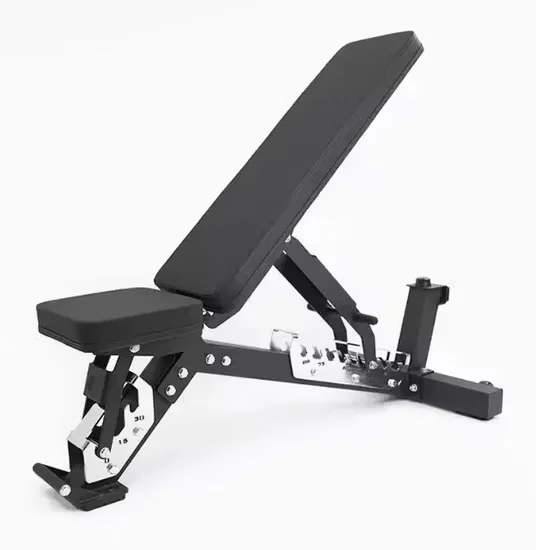
This adjustable bench fills the gap between fixed flat benches and specialized racks in commercial strength layouts. It pairs with dumbbell stations and Smith machines for incline pressing, decline flyes, and seated shoulder work. The 1100300460mm footprint fits standard spacing between racks, leaving enough clearance for spotters and dumbbell traffic. Users from beginners to advanced lifters benefit from the ≥200kg bearing capacity and multi-angle adjustment without needing multiple dedicated benches. A commercial adjustable bench press gym zones rely on reduces clutter by consolidating flat, incline, and decline work into one station.
Load Cycles and Placement in High-Traffic Zones
Bench frames in commercial gyms see hundreds of position changes daily as members cycle through exercises. Metal construction with reinforced welds handles this repositioning fatigue better than bolt-together designs that loosen over time. Placement near dumbbell racks minimizes carry distance for users, reducing the chance benches get dragged across flooring and damaging levelers. Unfolded configuration means the unit stays stationary once placed, avoiding the hinge wear that folding mechanisms introduce. Ground contact points require rubber padding to prevent floor scarring and reduce vibration transfer to adjacent equipment [NEED_CITE: floor loading requirements for commercial strength equipment].
Frame Geometry and Adjustment Mechanism Durability
The metal frame’s tube profile and wall thickness determine how much deflection occurs when a loaded barbell or heavy dumbbells press down during incline work. Thicker gauge steel at stress points—where the backrest pivot meets the base—prevents the frame from twisting under asymmetric loads. The adjustment mechanism uses positive-locking pins that engage detent holes at each angle position, preventing the backrest from creeping during use. Fixed speed control in this context means the adjustment is manual and mechanical rather than motorized, which eliminates electrical failure points in high-use environments. The unfolded design sacrifices portability for rigidity, appropriate for dedicated strength zones where benches remain in assigned positions.
The Hidden Cost of Specifying Below Commercial Grade
Benches specified for home use that end up in commercial facilities fail at the pivot welds within months. I’ve seen gym chains replace entire fleets because the adjustment detents wore smooth, letting backrests collapse during decline work. Members who experience shifting benches during heavy sets don’t complain—they simply stop using that station and tell others to avoid it. The revenue impact isn’t a single repair invoice but gradual underutilization of an entire dumbbell zone. When procurement decisions prioritize unit price over duty cycle, facilities face fleet replacement costs that dwarf the original savings [NEED_CITE: total cost of ownership for commercial gym benches].
Why This Product Line Holds Up
The manufacturer’s 15-year engineering background in commercial cardio equipment translates to frame testing protocols that exceed typical strength equipment requirements. Components undergo 10,000-hour continuous operation testing, ensuring adjustment mechanisms and weld points maintain integrity through extended use cycles. The six-series product family means facilities can source complementary equipment—cardio and strength—from coordinated production lines with consistent build quality. OEM customization covers logo placement, frame color, and pad material to match facility branding without compromising structural specifications. The MOQ of 50 pieces supports chain gym deployments where consistent bench inventory across locations matters for member experience. 24/7 technical support response ensures adjustment mechanism troubleshooting or replacement part sourcing doesn’t leave benches offline for days.
Documentation & Test Records
- CE declaration of conformity for European market compliance
- EN 957 test report covering structural integrity and safety
- ISO 9001 certificate demonstrating quality management systems
- Noise level test report for deployment in noise-sensitive environments
- Durability test record documenting adjustment mechanism cycle testing
- Frame material specification sheet with welding standards
Installation, Commissioning & Maintenance
- Verify 1100300460mm dimensions fit designated dumbbell zone spacing with user clearance
- Install rubber floor pads on all ground contact points to prevent scarring and dampen vibration
- Confirm adjustment pins engage positively at each angle position before releasing to members
- Inspect pivot welds and detent holes quarterly for wear patterns indicating mechanism degradation
- Clean vinyl or leather pads daily with pH-neutral cleaner to prevent sweat corrosion
- Replace worn adjustment pins immediately to prevent backrest drift during loaded exercises
Request Facility-Specific Configuration
Provide your strength zone square footage and planned bench count to receive layout recommendations that optimize dumbbell traffic flow. Specify expected daily usage hours so we can confirm the adjustment mechanism duty cycle matches your facility’s traffic patterns. Identify deployment location—ground floor, mezzanine, or above occupied spaces—to determine if additional vibration dampening is required. Confirm target market voltage standards if integrating with powered adjustment systems in future expansions. Indicate whether console data tracking or asset management tagging is needed for your facility maintenance system.
Frequently Asked Questions
Q: What distinguishes commercial benches from residential models?
A: Commercial benches use thicker gauge steel at pivot stress points and positive-locking adjustment mechanisms rated for hundreds of daily position changes. Residential benches optimize for folding storage and lighter duty cycles that fail under continuous gym use. The frame geometry prevents twisting under asymmetric dumbbell loads that home users rarely generate.
Q: How does the adjustment mechanism maintain accuracy over time?
A: The locking pins engage machined detent holes at each angle position, creating positive mechanical engagement rather than friction-based holding. Metal-on-metal contact at these points wears gradually and predictably, allowing scheduled pin replacement before slippage occurs. This contrasts with spring-loaded mechanisms that lose tension unpredictably.
Q: What load capacity should commercial facilities specify?
A: Facilities serving serious lifters should specify ≥200kg bearing capacity to accommodate heavy dumbbell work and larger users without frame deflection. The rating accounts for dynamic loads during exercise execution, not just static weight. Underspecifying capacity leads to premature weld fatigue at stress concentration points.
Q: How does customization integrate with structural specifications?
A: Logo placement, frame color, and pad material customization occurs after frame fabrication and welding, preserving structural integrity. Custom finishes use commercial-grade coatings that resist sweat corrosion and cleaning chemical exposure. Minimum order quantities ensure consistent appearance across multi-location deployments while maintaining production efficiency.
Q: What maintenance schedule prevents adjustment mechanism failure?
A: Quarterly inspection of pivot points and detent holes identifies wear before slippage occurs. Lubrication of moving parts uses dry-film products that don’t attract dust or transfer to user clothing. Pin replacement is scheduled based on engagement feel rather than calendar intervals, since usage intensity varies significantly between facilities.
![Dual Pec Fly Power Cage Commercial Gym Strength Training Machine PX-1069 [WARN] draft identifier mismatch](https://bicksport.com/wp-content/uploads/2026/08/dual-pec-fly-power-cage-commercial-gym-strength-training-machine-px-1069-warn-draft-identifier-mismatch-c8a764.webp)
![Commercial Multi Function Smith Machine Power Rack Gym Equipment [WARN] draft identifier mismatch](https://bicksport.com/wp-content/uploads/2026/08/commercial-multi-function-smith-machine-power-rack-gym-equipment-warn-draft-identifier-mismatch-55d111.webp)
