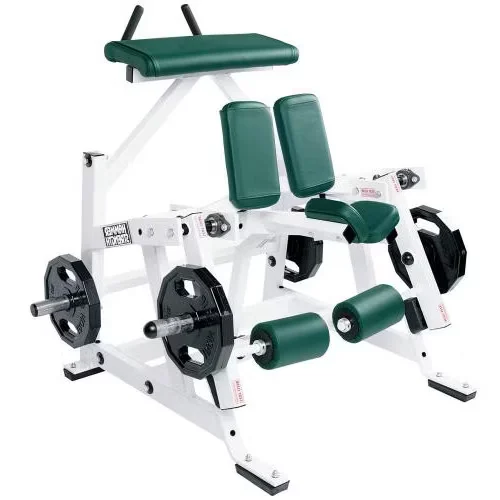
Steel-Frame Rotational Resistance — Sealed pivot bearings and a 121kg reinforced chassis deliver consistent oblique isolation under continuous commercial deployment.
Technical Specifications
| Parameter | Value |
|---|---|
| Product Type | Abdominal Oblique Crunch Machine |
| Designation | 5025 |
| Material | Steel |
| Exercise Part | Abdominal |
| Product Dimensions | 1670 x 1100 x 1600 mm |
| Net Weight | 121 kg |
| Max User Weight | 180 kg |
| Resistance Type | Fixed-path rotational |
| Age Group | Adult |
| Gender | Unisex |
| Certification | ISO 9001, CE |
Application Suitability
| Deployment Scenario | Typical Use |
|---|---|
| International gym chain cardio and core zone | High-rep oblique conditioning between peak-hour circuit rotations |
| Corporate wellness room with 24/7 access | Self-guided core rotation work during short breaks |
| Hotel fitness center on guest room floors | Quiet rotational training without disturbing adjacent occupied rooms |
| Professional sports training center | Athlete-grade core stabilization and rotational power development |
| Community fitness center | Durable abdominal equipment rated for unsupervised public use |
Why Bearing Wear Decides When a Rotational Machine Gets Pulled From the Floor
Sealed pivot bearings eliminate the open-bearing maintenance cycle that forces gym operators into premature equipment swaps.
I once pulled apart a rotational core machine from a chain gym that had been in service for barely fourteen months. The open bearings at the pivot axis had ingested enough dust and sweat residue to create visible play in the rotation — members were complaining about grinding noise and uneven resistance through the range of motion. The operator replaced the entire unit because the bearing housing was not field-serviceable [NEED_CITE: bearing service interval standards for commercial strength equipment]. With a commercial abdominal oblique crunch machine deployed in high-traffic facilities, the rotation axis sees hundreds of loaded cycles daily. If that pivot runs on open bearings, friction wear accelerates and the resistance profile degrades long before the frame or upholstery shows age.
Positioning Within the Core Training Zone
This unit fills a specific gap in commercial floor layouts: targeted rotational resistance for the oblique muscle group, complementing linear abdominal machines and free-weight core stations. It covers controlled, fixed-path movement suited to moderate-to-high repetition sets, fitting naturally between isolation machines and functional training rigs. The footprint and 121kg mass mean it anchors a dedicated core area without requiring floor bolts. Users across a wide range of body sizes can load the movement consistently, since the fixed rotational path reduces compensatory movement patterns that often limit machine usability for taller or heavier members. The commercial abdominal oblique crunch machine operates independently of power or data connections, making it deployable in zones where console-equipped cardio units would be impractical.
Continuous Operation and Floor Loading Considerations
A core machine in a 24/7 facility may see near-constant use during peak hours, with members cycling through sets at intervals measured in minutes. The sealed bearing system at the rotation axis is designed to sustain this cadence without scheduled lubrication, reducing the maintenance windows that take equipment offline [NEED_CITE: duty-cycle requirements for commercial rotational strength machines]. At 121kg net weight, floor load capacity must be verified before deployment — particularly on upper floors or suspended slab constructions common in hotel fitness centers. The steel frame transmits force directly to the floor surface, so vibration-dampening pads are recommended where noise transfer to rooms below is a concern. No electrical supply or network connection is required, which simplifies placement but also means usage data must be tracked through separate facility monitoring systems.
Decoding the Frame and Pivot Engineering
The steel frame on this unit is not simply a material choice — it is a structural decision tied to rotational force management. When a member drives through a loaded oblique crunch, the frame absorbs torsional stress at the pivot joint. Thin-gauge or welded-alternative frames flex under repeated asymmetric loading, and that flex compounds into fatigue cracking at the welds. The reinforced pivot joints on the 5025 are built to manage this torsional cycle over extended service periods. Sealed bearings at the rotation axis prevent particulate contamination — a failure mode that open bearings encounter predictably in gym environments where chalk dust, rubber flooring debris, and sweat aerosol are constant. Fixed-path mechanics mean the rotational arc is mechanically constrained, isolating the obliques while limiting the lower-back compensation that free-weight rotational movements often introduce. The 121kg mass provides inherent stability without anchoring; lighter frames in this category typically require floor mounting to prevent walking during aggressive sets.
The Cost of Underspecifying a Core Rotation Station
Operators who select rotational machines with light-duty bearings often see the first complaints within the initial year of deployment. The grinding noise is usually the earliest signal, followed by uneven resistance that members notice before maintenance staff do. Once the bearing play becomes visible, the machine gets tagged out — and if the bearing housing is not designed for field replacement, the entire unit is pulled. I have seen facilities replace core machines twice within a three-year cycle because the original specification prioritized unit cost over bearing durability [NEED_CITE: total cost of ownership for commercial strength equipment bearing systems]. Data isolation is another hidden cost: without usage tracking, operators cannot identify which machines justify their floor space and which are candidates for rotation or replacement.
Why This Product Line Fits Commercial Deployment
The 5025 is part of a broader equipment family engineered around the same durability principles — 10,000-hour continuous operation testing on structural and moving components across the range. The sealed bearing approach used here mirrors the sealed bearing strategy on the cardio line, where maintenance-free operation is a baseline requirement for hotel and 24/7 gym deployments. The steel frame gauge and weld specifications are consistent with commercial duty-cycle demands rather than light-commercial compromises. For facilities planning a complete core zone, the six-series product family means sourcing abdominal, rotational, and complementary movements from a single engineering standard. The free 3D layout and airflow planning service extends to strength zones, accounting for the 1670 x 1100mm footprint and member flow around rotational equipment where range of motion requires additional lateral clearance.
Documentation & Test Records
- CE declaration of conformity covering the 5025 rotational frame and pivot assembly
- EN 957 test report validating structural integrity under cyclic rotational loading
- ISO 9001 certificate for manufacturing process control
- Noise level test record for pivot bearing operation under load
- Durability test documentation for sealed bearing service life
- Installation guide with floor load verification and anchor specifications
Installation, Commissioning & Maintenance
- Verify floor load capacity for the 121kg static mass plus dynamic rotational forces before positioning
- Allow minimum 600mm lateral clearance on each side for full rotational range of motion
- Place vibration-dampening pads beneath frame feet on upper-floor or noise-sensitive deployments
- Inspect pivot bearing smoothness and resistance consistency across full arc during commissioning
- Clean pivot axis and frame contact surfaces monthly to prevent sweat and chalk buildup
- Check frame bolt torque at pivot joints after the initial 500-cycle break-in period
Planning Your Core Zone Deployment
Share your core training area dimensions and adjacent equipment list to receive a 3D layout that accounts for rotational clearance and member circulation around the 5025. Specify your facility’s daily operating hours so the duty-cycle rating can be matched to expected throughput. Identify the deployment floor and any noise-sensitive adjacent spaces to determine whether vibration isolation pads are required. Indicate your target market so documentation and compliance markings align with local regulatory requirements.
Frequently Asked Questions
Q: How does sealed bearing design reduce maintenance frequency in high-traffic commercial gyms?
A: Open bearings at a rotational pivot accumulate dust, chalk residue, and moisture over time, creating friction and play that degrades resistance consistency. Sealed bearings prevent contaminant ingress, so the pivot maintains smooth rotation without scheduled lubrication or disassembly. This eliminates the maintenance windows that take rotational machines offline and extends the interval before bearing replacement becomes necessary.
Q: What frame specifications distinguish commercial-grade rotational machines from light-commercial alternatives?
A: Commercial frames use heavier-gauge steel and reinforced weld geometry at pivot joints to absorb repeated torsional stress from loaded rotational movements. Light-commercial frames often show flex under asymmetric loading, which accelerates fatigue at weld points. The difference becomes apparent within the first year of high-frequency use, where underspecified frames develop visible movement at joints that should remain rigid.
Q: How does fixed-path rotational mechanics compare to free-weight oblique training for injury prevention?
A: Fixed-path mechanics constrain the rotational arc, preventing the compensatory lumbar twisting that commonly occurs when members fatigue during free-weight rotational exercises. The machine isolates the oblique muscle group through a controlled range of motion, reducing the lower-back strain associated with uncontrolled momentum in cable or dumbbell rotational movements. This makes it suitable for supervised and unsupervised environments alike.
Q: What floor load requirements should facilities verify before deploying 121kg strength equipment?
A: Facilities should confirm that the floor slab or suspended structure can support the static mass plus dynamic forces generated during loaded rotational sets. Upper-floor deployments in hotels or multi-story gyms require particular attention, as suspended slabs may have lower point-load ratings than ground-level concrete. Vibration-dampening pads distribute the load and reduce noise transfer to occupied spaces below.

![Hammer Strength ISO-Lateral D.Y. Row Commercial Gym Equipment [WARN] draft identifier mismatch](https://bicksport.com/wp-content/uploads/2026/08/hammer-strength-iso-lateral-d-y-row-commercial-gym-equipment-warn-draft-identifier-mismatch-bc5ba5.webp)