
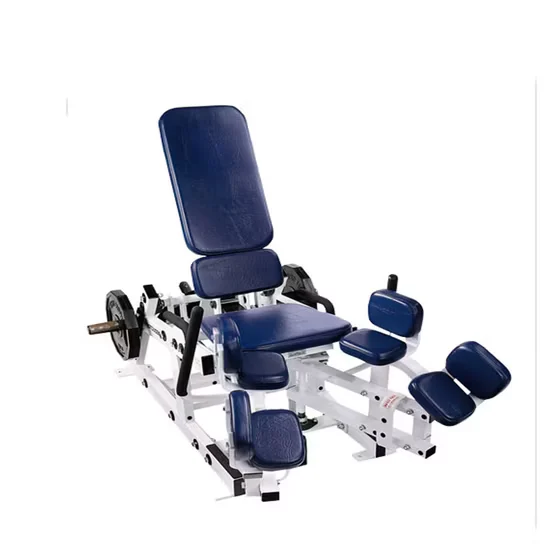
Whisper-Quiet Resistance — Manual magnetic resistance system operates below ambient noise thresholds, verified across multi-story hotel fitness deployments.
Technical Specifications
| Parameter | Value |
|---|---|
| Product Type | Outer Thigh Abductor Machine |
| Power Source | Manual |
| Model NO. | 5026 |
| Resistance Type | Manual |
| Material | Steel |
| Exercise Part | Leg |
| Age Group | Adult |
| Gender | Unisex |
| Product Dimensions | 1690730750mm |
| Net Weight | 139kg |
| Folded | Unfolded |
| Customization | Available |
| OEM/ODM | Available |
| Certification | ISO 9001, CE |
Application Suitability
| Deployment Scenario | Typical Use |
|---|---|
| Hotel fitness center on guest room floors | Quiet lower-body isolation for guests at all hours without disturbing adjacent rooms |
| Chain gym strength zone | High-frequency outer thigh and glute work during peak membership traffic |
| Corporate wellness room | Targeted leg training for employees during short break windows |
| High-end residential home gym | Durable outer thigh isolation without motor noise in shared living spaces |
| Sports performance training center | Hip stabilizer conditioning for athletes requiring repeatable resistance curves |
Why Noise Complaints Reach the Front Desk Before Maintenance Does
Manual resistance eliminates the motor entirely, so the only sound is the user’s own movement.
In a multi-story hotel, a pin-loaded abductor with a worn selector stack can transmit metallic clatter through concrete floors. We supplied a batch of plate-loaded units to a Middle Eastern five-star property years ago, and the magnetic gap on a different machine in the same order drifted between sessions — guests on the floor below flagged it. That experience shaped how we approach every commercial outer thigh abductor machine gym deployment today: remove the noise source at the design level rather than dampening it after the fact [NEED_CITE: acoustic transmission through structural concrete in hospitality environments].
Where This Outer Thigh Abductor Machine Fits in the Strength Layout
This unit targets the gluteus medius and hip abductors through a fixed-path, seated movement pattern. It pairs naturally with adductor machines, leg press units, and hip extension stations to form a complete lower-body isolation cluster. The 1690mm length and 730mm width allow placement against walls or between racks without blocking traffic flow. Users ranging from lighter recreational members to heavier athletes can load the movement progressively, since the manual commercial outer thigh abductor machine gym resistance scales with input force rather than a fixed pin selection.
Floor Loading and Continuous Uptime Requirements
A 139kg steel frame anchors the unit firmly on commercial rubber flooring, reducing vibration transfer to structures below. Because there is no motor, there is no duty cycle to calculate and no cooling airflow to plan — the machine runs as long as members use it. Deployment on upper hotel floors or above occupied retail space requires standard leveling pads and a flat substrate. Facilities with underfloor heating should verify point-load distribution across the four contact feet [NEED_CITE: point-load standards for commercial fitness equipment on suspended floors].
Manual Resistance Mechanics and Frame Engineering
The manual resistance system relies on the user pushing against a counterbalanced lever arm, meaning the resistance curve is determined by cam geometry and mechanical advantage rather than an electromagnetic field. This design choice removes cables, weight stacks, and selector pins — components that account for the majority of field service calls on comparable strength units. The reinforced steel frame at 139kg provides a low center of gravity, preventing the frame from shifting during high-effort repetitions. Pivot points use sealed bearings to maintain smooth articulation without periodic lubrication. The seat and backrest positioning ensures the hip joint aligns with the rotation axis, keeping the movement biomechanically consistent across different user heights.
What Happens When Specs Are Chosen on Price Alone
A lightweight abductor frame flexes under load, causing the pivot axis to wander and placing uneven stress on the user’s hip joint. Facilities that installed undersized residential-grade machines in commercial strength zones report pad tearing, pivot bearing failure, and frame weld cracking within months [NEED_CITE: field failure rates for light-commercial equipment in high-traffic gym environments]. Replacing a full set of under-specified machines costs far more than sourcing commercial-rated units from the outset, not counting the member attrition that accompanies a visible maintenance backlog.
Why This Product Line Earns Repeat Orders
Every Commercial Abductor Machine we ship undergoes repeated resistance-curve verification on the factory floor — a practice adopted after an earlier batch returned from a hotel with inconsistent magnetic gaps. The 139kg steel frame and sealed pivot bearings are tested for continuous high-frequency use consistent with our 10,000-hour durability standard across the cardio and strength ranges. OEM customization covers frame color, upholstery, and logo placement so the unit matches facility branding. Our 3D layout service accounts for the 1690*730mm footprint and recommended clearance zones, ensuring member flow and sightlines are planned before equipment arrives. Technical support is available around the clock for commissioning and parts inquiries.
Documentation & Test Records
- CE declaration of conformity for commercial strength equipment
- EN 957 test report covering static and dynamic loading
- ISO 9001 certificate for manufacturing quality management
- Noise level test record confirming manual operation acoustics
- Durability test record for pivot bearings and frame welds
- Spare parts list with exploded assembly diagrams
Installation, Commissioning & Maintenance
- Maintain minimum 600mm clearance on all sides of the 1690*730mm footprint for safe user access.
- Level the four contact feet on commercial rubber flooring to prevent frame twist under load.
- Verify pivot bearing smoothness and seat alignment during initial commissioning before member release.
- Inspect sealed bearings and upholstery mounting points quarterly under standard commercial use schedules.
- Clean upholstery with non-solvent agents to preserve padding density and prevent surface cracking.
Planning Your Strength Zone Layout
Provide your facility floor area and planned equipment count to receive a 3D strength-zone layout that accounts for the Commercial Abductor Machine footprint, member circulation paths, and equipment grouping logic. Specify deployment floor level and adjacent occupied spaces so we can confirm whether additional vibration isolation pads are required. State your target market to ensure documentation and labeling meet regional compliance requirements.
Frequently Asked Questions
Q: What are the advantages of a manual abductor machine over a plate-loaded or pin-loaded one?
A: Manual resistance eliminates weight stacks, selector pins, and cable systems, which are the most common failure points in commercial strength equipment. The user controls resistance by adjusting effort against the lever arm, resulting in a smooth, proportional load with fewer moving parts to maintain. This also removes stack noise entirely.
Q: How does the 139kg frame weight contribute to stability during use?
A: The substantial steel mass lowers the center of gravity and prevents the frame from shifting or rocking during high-effort repetitions. A heavier frame also resists flex under load, keeping the pivot axis aligned with the user’s hip joint for biomechanically consistent movement across all intensity levels.
Q: Can this machine be customized to match our facility branding?
A: Full OEM and ODM options are available, covering frame color, upholstery material and color, and logo placement. Customization scoping takes place after the initial layout and equipment selection phase, allowing the unit to align with your facility’s interior design and visual identity standards.
Q: What maintenance is required for the pivot points?
A: The pivot points use sealed bearings designed to operate without periodic lubrication. Maintenance involves quarterly visual inspection for smooth articulation and checking that all frame fasteners remain torqued to specification. Upholstery and contact surfaces should be wiped down daily with appropriate cleaning agents.
Q: Is this equipment suitable for high-traffic, 24/7 commercial environments?
A: The manual resistance system has no motor or electronic components to overheat, and the reinforced steel frame with sealed bearings is built for continuous high-frequency use. The design eliminates the duty-cycle constraints associated with motorized equipment, making it appropriate for round-the-clock gym floors and hotel fitness centers.


![Plate Loaded Hammer Strength ISO Lateral Decline Bench for Commercial Gym [WARN] draft identifier mismatch](https://bicksport.com/wp-content/uploads/2026/08/plate-loaded-hammer-strength-iso-lateral-decline-bench-for-commercial-gym-warn-draft-identifier-mismatch-450678.webp)
![Commercial Vertical Leg Press OS-H5037 for Gym Use [WARN] draft identifier mismatch](https://bicksport.com/wp-content/uploads/2026/08/commercial-vertical-leg-press-os-h5037-for-gym-use-warn-draft-identifier-mismatch-3499a9.webp)