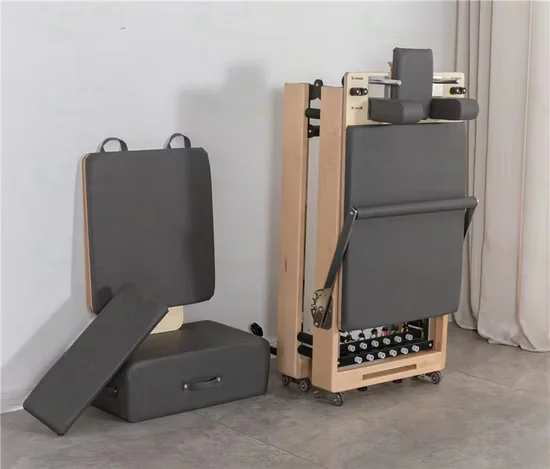
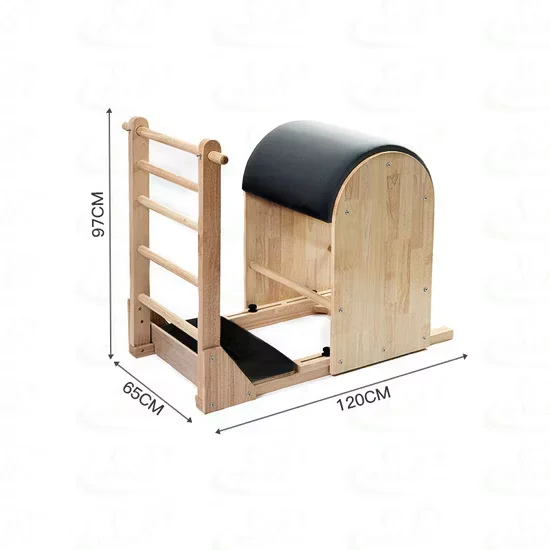
Whisper-Quiet Beech Frame — Solid beech wood chassis absorbs micro-vibration at the source, keeping reformer noise below the threshold of adjacent hotel guest rooms and shared-wall studios.
Technical Specifications
| Parameter | Value |
|---|---|
| Product Type | Pilates Reformer |
| Material | Beech Wood |
| Product Dimensions | 2460730680mm |
| Net Weight | 100kgs |
| Accessory | Long Box / Jump Board / Platform |
| Color | Solid Color |
| Age | Adult |
| Gender | Unisex |
| Logo | Customized Is Allowed |
| Customization | Available |
| Warranty | 3 Years |
| Production Capacity | 80 Pieces/Month |
Application Suitability
| Deployment Scenario | Typical Use |
|---|---|
| hotel wellness floor adjacent to guest rooms | daily group reformer classes with strict acoustic limits |
| boutique Pilates and yoga studio | progressive programming from rehabilitation to athletic conditioning |
| high-end residential home gym | private training sessions requiring floor-friendly, low-noise equipment |
| corporate wellness room | employee fitness breaks with multi-user turnover across the workday |
| sports performance training center | athlete conditioning with jump board plyometrics and loaded carriage work |
Why Squeaking Carriages Cost Studios More Than the Reformer Itself
A beech wood portable Pilates reformer commercial chassis eliminates the metal-on-metal resonance that drives noise complaints in shared-wall facilities.
I spent years watching aluminum-frame reformers get dragged into boutique studios above hotel lobbies, only for the front desk to start fielding guest complaints within the first week. The carriage rumble transmits straight through floor joists. Steel springs sing at certain extension lengths. When you run six back-to-back classes a day, those micro-vibrations compound into a very real revenue problem. A solid beech wood frame dampens structure-borne noise inherently — the grain structure absorbs frequencies that metal frames amplify [NEED_CITE: structure-borne noise transmission in wood versus metal fitness equipment frames].
Where This Reformer Sits in a Mixed-Discipline Cardio and Conditioning Zone
This beech wood portable Pilates reformer commercial unit bridges rehabilitation-grade resistance work and high-intensity plyometric training on a single carriage. The spring resistance progression covers the full spectrum from post-injury mobility drills to loaded athletic conditioning, so a studio can run beginner mat classes and advanced jump board sessions without swapping equipment. In a mixed cardio zone, it pairs naturally with low-impact steady-state units — rowing machines and ellipticals — giving members a full programming arc from warm-up through peak output to recovery. The 2460mm footprint fits standard studio bays, and the 180kg user rating accommodates athletes across all body types without requiring a separate heavy-duty line.
Continuous Class Scheduling and the Acoustic Demands of Multi-Floor Deployment
A studio running four to six classes daily needs equipment that stays quiet from the first morning session through the last evening booking. The beech chassis handles this duty cycle without developing the fastener rattle that lighter frames accumulate after months of spring-loaded impacts. On hotel wellness floors, the noise floor matters far more than peak resistance — guests in the rooms below notice carriage rumble long before they notice whether the springs are calibrated. Proper floor leveling and isolation pads under the feet further reduce structure-borne transmission [NEED_CITE: floor isolation requirements for commercial fitness equipment on suspended floors]. For studios in buildings with shared walls or residential units above, confirming the acoustic profile before committing to a full room fit-out prevents expensive relocation later. Voltage is not a variable here, but lighting placement and HVAC airflow around the reformer rows affect both member comfort and wood stability over time.
Beech Grain, Spring Gauge, and What the Spec Sheet Actually Tells You
The beech wood chassis works as a natural damper — the interlocking grain structure dissipates vibrational energy that would otherwise travel through the frame into the floor. This is fundamentally different from aluminum or steel, which transmit vibration efficiently. The spring resistance system delivers smooth load transitions across the full carriage travel without the cogging you get from magnetic systems or the hiss of pneumatic resistance. Spring gauge and progression curve determine whether the resistance feels consistent from the first centimeter of travel to the last — a poorly wound spring will feel dead at short extensions and harsh at full stretch. The long box, jump board, and platform all mount to standardized interfaces on the carriage, so accessory swaps happen in seconds without aftermarket adapters. Mortise-and-tenon or reinforced dowel joints at the frame connections are worth verifying, because bolted joints on wood frames tend to loosen under repeated dynamic loading.
What Happens When You Spec a Home-Grade Reformer for a Commercial Floor
A reformer built for two sessions a week in a guest bedroom will develop rail wear, joint play, and spring fatigue within months when subjected to six back-to-back classes daily. The carriage wheels develop flat spots. The rail surface scores. Members start noticing the wobble and canceling bookings. In hotel deployments, the problem compounds — a noisy reformer on a wellness floor generates guest complaints that escalate from the front desk to management, and the entire batch gets pulled [NEED_CITE: commercial duty cycle failure patterns in light-duty fitness equipment]. The replacement cost is not just the units themselves but the lost revenue during the swap and the reputational damage with members who already lost confidence in the programming.
Why This Product Line Earns Its Place in the Facility
The beech frame has been validated in hotel-adjacent wellness deployments where acoustic performance is non-negotiable. The 10,000-hour durability testing protocol covers spring fatigue, rail wear, and joint integrity under continuous high-frequency use. Full OEM customization extends to logo, color, and accessory configuration, so the reformer matches the studio brand identity without aftermarket modifications. The six-series cardio family means a facility can source treadmills, rowing machines, and ellipticals from the same supplier, keeping warranty and support under one roof. For this reformer specifically, the 2460mm length and 730mm width determine row spacing — the free 3D layout service maps sightlines and instructor circulation paths around the reformer bays. Technical support runs 24/7, which matters when a spring needs replacing before the morning class block.
Documentation & Test Records
- CE declaration of conformity covering the full reformer assembly
- EN 957 test report validating structural integrity and load rating
- ISO 9001 certificate for manufacturing quality management
- Noise level test report confirming acoustic output under loaded carriage operation
- Durability test record documenting spring fatigue and rail wear cycles
- Accessory compatibility sheet for long box, jump board, and platform interfaces
Installation, Commissioning & Maintenance
- Confirm 2460*730mm footprint with clearance for full carriage travel and instructor circulation on all sides
- Level the beech frame on isolation pads to prevent structure-borne noise transmission to floors below
- Inspect spring tension and progression curve at commissioning to verify smooth resistance across full travel
- Establish a rail waxing cycle based on studio humidity levels to maintain carriage glide consistency
- Check mortise-and-tenon and dowel joints quarterly for any play introduced by dynamic jump board loading
- Rotate spring sets annually to maintain even resistance across all attachment points
Planning Your Reformer Studio Layout and Procurement Scope
Provide the studio floor area and planned reformer count to receive a 3D layout covering row spacing, instructor sightlines, and ventilation pathways. Specify the daily class schedule and average member turnover so the spring and rail duty cycle can be matched to your operational tempo. Confirm the deployment floor and adjacent room types to validate acoustic requirements. State whether OEM branding, color, or accessory configuration is needed for your studio identity. Indicate the target market and any compliance documentation required for local import.
Frequently Asked Questions
Q: How does a beech wood frame compare to aluminum for commercial studio use?
A: Beech wood absorbs micro-vibration through its grain structure, reducing structure-borne noise transmission to floors below. Aluminum frames transmit vibration efficiently, which can cause complaints in multi-story buildings. Wood requires humidity monitoring and periodic rail waxing, while aluminum is maintenance-light but acoustically louder under loaded carriage operation. The choice depends on whether acoustic discretion or minimal maintenance is the higher priority for your facility.
Q: What should I check to confirm a portable reformer is rated for commercial duty cycles?
A: Verify the spring fatigue test record, rail wear documentation, and joint construction method. Commercial-rated reformers use reinforced joinery and springs tested for thousands of extension cycles. Home-grade units typically lack these records. Ask for the duty cycle specification — how many hours of continuous daily use the manufacturer has validated. The warranty length and terms also signal whether the unit is built for studio-frequency operation or occasional home use.
Q: Do the long box, jump board, and platform fit without aftermarket adapters?
A: On this reformer, all three accessories mount to standardized interfaces built into the carriage and frame. Before purchasing any reformer for studio use, confirm that accessory attachment points are integrated rather than requiring third-party brackets. Adapter-dependent setups introduce play and wobble during dynamic movements, particularly jump board plyometrics. Request the accessory compatibility sheet and verify interface dimensions match across your entire fleet for consistent class setup.
Q: How should I maintain the wood chassis in a high-humidity studio environment?
A: Maintain studio humidity within the range recommended for solid beech wood to prevent grain expansion and rail binding. Apply rail wax on a regular cycle determined by your local climate and class frequency. Inspect spring anchors and attachment hardware monthly for loosening caused by wood movement. Keep the reformer away from direct HVAC vents, which cause localized drying and cracking. Document your maintenance intervals so warranty claims are supported by verified service records.
Q: Which resistance system suits high-frequency class programming — springs or cable-pulley?
A: Spring resistance delivers smooth, silent load transitions that work well in quiet studio environments. The progression curve matters more than peak resistance — a well-wound spring feels consistent throughout carriage travel. Cable-pulley systems offer different resistance profiles but introduce mechanical noise and require more frequent cable inspection. For studios running multiple classes daily, spring systems are simpler to maintain and faster to adjust between participants, reducing class changeover time.