
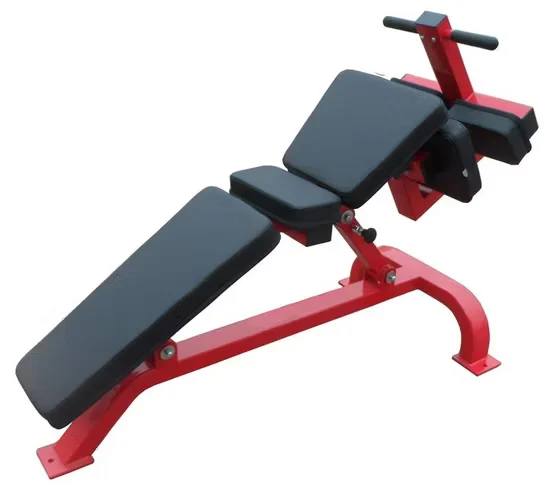
Industrial-Grade Frame Rigidity — The 5060 adjustable abdominal board uses a full-steel welded frame rated for 180kg, eliminating the wobble and loosening that plague commercial ab training stations after months of high-frequency use.
Technical Specifications
| Parameter | Value |
|---|---|
| Product Type | Adjustable Abdominal Board |
| Designation | 5060 |
| Brand | huiyang |
| Product Dimensions | 1400 × 680 × 600 mm |
| Net Weight | 48 kg |
| Max User Weight | 180 kg |
| Frame Material | Steel |
| Exercise Part | Abdominal |
| Age Group | Adult |
| Gender | Unisex |
| Adjustable Angle | Yes, multi-position |
| OEM/ODM | Available |
| Production Capacity | 500 PCS/Month |
| Certification | ISO 9001, CE |
Application Suitability
| Deployment Scenario | Typical Use |
|---|---|
| Chain gym strength and functional training zone | High-frequency abdominal and core training between compound lifts |
| Corporate wellness room | Compact core station for time-constrained employee workouts |
| Community fitness center | Durable ab training accessible to all membership tiers |
| Sports performance training center | Athlete core conditioning with progressive angle resistance |
| High-end residential home gym | Space-efficient abdominal station for dedicated training spaces |
Why Commercial Gyms Replace Ab Boards Every Year
A loose pivot pin and a warped back pad turn a simple core station into a member complaint magnet.
Walk through any commercial facility after six months of operation and you will find the adjustable abdominal boards with rattling adjustment knobs, torn vinyl, and frames that rock on uneven floors. Members notice the instability immediately, especially when loading their torso at steep decline angles. The facility ends up pulling the unit off the floor or replacing it entirely. [NEED_CITE: commercial strength equipment fatigue testing for adjustable pivot mechanisms]
The 5060 commercial adjustable abdominal board addresses this by pairing a fully welded steel frame with a reinforced adjustment mechanism that locks securely at each angle position. The 180kg max user weight rating ensures the structure handles heavy users without flex or rattle, even during dynamic movements.
Where This Abdominal Board Fits in a Commercial Strength Zone
This commercial adjustable abdominal board occupies a compact footprint at 1400 × 680 mm, making it suitable for placement along walls or between larger rack stations where floor space is limited. It pairs naturally with free-weight areas where users rotate between compound lifts and targeted core work, filling the gap that dedicated ab machines leave in functional training layouts.
The multi-position angle adjustment supports a range of intensity levels, accommodating beginners performing basic crunches at low decline and advanced users executing weighted decline sit-ups at steep angles. The 180kg user weight capacity covers the full spectrum of gym membership demographics. No electronic console or connectivity is involved — this is a pure mechanical training tool designed for environments where simplicity and uptime matter more than screen-based engagement.
Daily Throughput and Facility Environment Requirements
In a busy chain gym, an abdominal board can see dozens of users per day, each adjusting the angle and applying concentrated load to the pivot points and frame joints. The 5060 is built for this duty cycle, with reinforced steel connections at every stress point. [NEED_CITE: EN 957 structural load requirements for adjustable bodyweight training equipment]
The unit requires a level, hard floor surface for stable positioning — uneven rubber matting can introduce lateral play that accelerates wear on the adjustment mechanism. No power supply or data connection is needed, which simplifies deployment in any corner of the facility. Facilities should plan for adequate clearance around the board so users can mount and dismount safely, particularly when the board is set at maximum decline.
Decoding the Frame and Adjustment Engineering
The 48kg net weight of the 5060 reflects the mass of its full-steel construction — lighter ab boards typically rely on thin-gauge tubing that flexes under load and fatigues at weld points. The 1400mm length provides a stable base that resists tipping even when a heavy user shifts position at steep angles.
The adjustable angle mechanism uses a pin-and-hole locking system, a mechanically simple approach that avoids the failure modes of lever-clamp or ratchet designs in high-use environments. Each position locks with positive engagement, so there is no gradual slippage mid-set. The steel frame is finished to resist corrosion from sweat exposure, a factor that degrades unprotected equipment rapidly in humid gym environments.
The Hidden Cost of Spec-Compromised Abdominal Boards
Facilities that purchase abdominal boards based on price alone typically discover the real cost within the first year. Lightweight frames bend under repeated loading, causing the adjustment holes to elongate and the locking pins to lose engagement. Vinyl pads separate from their backing plates. The unit becomes a liability rather than an asset. [NEED_CITE: facility equipment replacement frequency for light-commercial versus commercial-grade strength stations]
When a member is injured by a collapsing adjustment mechanism or a slipping back pad, the consequences extend far beyond the cost of a replacement unit. The 5060 addresses this with its commercial-grade steel construction and 180kg rating, designed to stay rigid and reliable through continuous daily use in high-traffic strength zones.
Why This Product Line Fits Commercial Procurement
The 5060 benefits from the same manufacturing discipline applied across the full Biketon cardio and strength range — vertical integration from CNC machining through final assembly, with ISO 9001 process controls at every stage. Each unit undergoes structural load verification before leaving the factory.
The 180kg max user weight and 48kg frame mass reflect deliberate over-engineering for commercial duty, not minimum-spec compliance. OEM and ODM customization is available, including logo placement and color matching to facility branding. The production capacity of 500 units per month supports both single-site deployments and multi-location rollouts. Free 3D strength-zone layout planning is available to help operators position the board within existing floor plans for optimal member flow and equipment spacing.
Documentation & Test Records
- CE declaration of conformity for the 5060 adjustable abdominal board
- EN 957 structural load and stability test report
- ISO 9001 manufacturing process certificate
- Frame weld inspection and fatigue test record
- Material specification sheet for steel frame components
- Installation guide with floor anchoring recommendations and spare parts list
Installation, Commissioning & Maintenance
- Position the 1400 × 680 mm frame on level flooring with clearance on all sides for safe mounting and dismounting
- Verify each angle lock position engages fully before releasing the unit to member use
- Inspect pivot pins and locking holes monthly for elongation or wear in high-throughput environments
- Wipe steel frame and pad surfaces daily to prevent sweat-induced corrosion and vinyl degradation
- Check all frame bolts and fasteners quarterly, retorquing to factory specification as needed
Project Scoping and Equipment Matching
Provide your strength zone square footage and planned equipment list to receive a 3D layout showing optimal placement of the 5060 within your member flow and sightline plan. Specify the expected daily user volume so the deployment plan accounts for wear patterns and maintenance intervals. If the board will sit on an upper floor or adjacent to quiet zones, note this so floor treatment recommendations are included. State your target market to ensure all hardware and labeling meets local compliance requirements.
Frequently Asked Questions
Q: What structural differences separate a commercial abdominal board from a home-use model?
A: Commercial boards like the 5060 use full-steel welded frames rated for 180kg, with reinforced pivot points and heavy-gauge tubing. Home models typically use lighter materials and thinner padding that compress and tear under daily multi-user loading. The locking mechanisms on commercial units are designed for thousands of adjustment cycles without loosening.
Q: How does the angle adjustment mechanism work, and is it secure under load?
A: The 5060 uses a steel pin-and-hole locking system that provides positive engagement at each angle position. Unlike lever clamps or friction-based adjusters, this mechanical lock cannot slip during a set. Each hole is precision-drilled into the frame to prevent elongation over time, even under repeated heavy-user loading at steep decline angles.
Q: What maintenance schedule should a commercial facility follow for this equipment?
A: Monthly inspection of locking pins and adjustment holes for wear, daily surface cleaning to prevent corrosion, and quarterly bolt retorquing cover the essential maintenance. The all-steel construction and absence of electronic components mean there are no firmware updates, belt adjustments, or motor brushes to manage. This simplicity is a deliberate design choice for uptime in busy facilities.
Q: How should the abdominal board be positioned within a strength training zone layout?
A: Place the 5060 along a wall or between larger stations where its compact 1400 × 680 mm footprint does not obstruct primary traffic paths. Allow enough clearance at the head end for users to mount and dismount safely at maximum decline. Positioning near free-weight areas encourages natural rotation between compound lifts and targeted core work.
![V-Squat Machine Hip and Glute Gym Equipment for Commercial Use [WARN] draft identifier mismatch](https://bicksport.com/wp-content/uploads/2026/08/v-squat-machine-hip-and-glute-gym-equipment-for-commercial-use-warn-draft-identifier-mismatch-0fdabd.webp)


