

Whisper-Quiet Frame Stability — Solid oak and maple construction paired with modular accessory mounts keeps vibration below the threshold that disturbs adjacent studio spaces during high-frequency reformer sessions.
Technical Specifications
| Parameter | Value |
|---|---|
| Designation | SRY-01A |
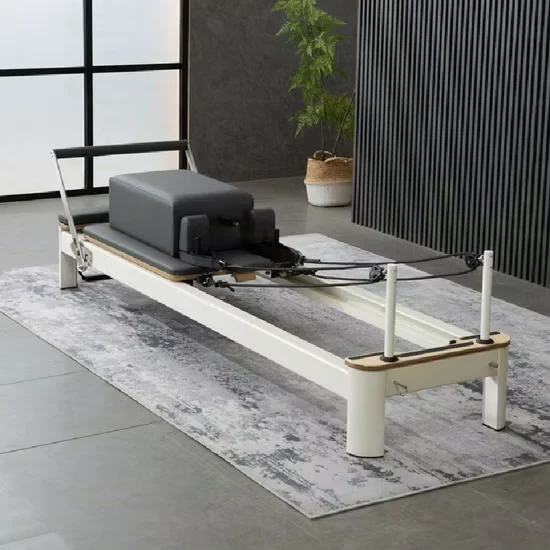
| Product Type | Pilates Cadillac Reformer |
| Frame Material | Solid Wood (Oak / Maple) |
| Dimensions | 2400 × 770 × 2160 mm |
| Net Weight | 150 kg |
| Included Accessories | Long Box / Jump Board / Platform |
| Color Options | Solid Color (custom options available) |
| Logo | Customized Is Allowed |
| Target User | Adult, Unisex |
| Warranty | 3 Years |
| Origin | China |
| HS Code | 9506911900 |
| Production Capacity | 80 Pieces / Month |
Application Suitability
| Deployment Scenario | Typical Use |
|---|---|
| Pilates studio with group class scheduling | Full-body Cadillac routines across multiple class formats throughout operating hours |
| High-end fitness center Pilates zone | Semi-private and one-on-one sessions requiring rapid accessory changeover between clients |
| Rehabilitation clinic or physiotherapy room | Controlled range-of-motion work on the platform with Long Box support for mobility patients |
| High-end residential home gym | Personal practice with Jump Board and Platform configurations for varied intensity |
Why Frame Rigidity Matters More Than Accessory Count on a Commercial Pilates Cadillac Reformer
A commercial Pilates Cadillac reformer that flexes under load compromises both exercise precision and the quiet environment studios depend on.
When wooden frames are undersized or joints lack reinforcement, the entire tower sways during spring-loaded overhead work. In a shared studio or hotel wellness floor, that sway translates into audible creaks and rattles that carry through hard flooring to adjacent rooms. Members notice the instability before they can name it — they simply feel less confident hanging from the push-through bar or pressing against the Long Box. Over months of scheduling back-to-back sessions, those small flex points compound into visible joint separation and hardware loosening that pulls the unit out of service for unplanned maintenance [NEED_CITE: structural load testing standards for commercial Pilates equipment].
Where This Reformer Sits in a Multi-Apparatus Studio Layout
The SRY-01A covers the full vertical envelope of Cadillac training — supine spring work, overhead bar exercises, and standing platform sequences — in a single 2400 × 770 mm footprint. In a studio layout, it typically anchors a wall or partition line while reformers and chairs occupy the central floor, so sightlines remain open for instructor monitoring. The modular Long Box, Jump Board, and Platform allow rapid session switching without rolling additional equipment into the training area. This commercial Pilates Cadillac reformer accommodates adult users across a wide range of body sizes within its 150 kg structural rating.
Continuous Scheduling Demands and Deployment Environment Requirements
A studio running six to eight Cadillac sessions per day places repetitive load on every wooden joint and spring anchor point. The solid oak or maple frame must maintain dimensional stability through seasonal humidity shifts to prevent joint creep that loosens tower alignment [NEED_CITE: wood dimensional stability under fluctuating indoor humidity]. Floor leveling is critical: the 2400 mm length amplifies even minor subfloor irregularities into a perceptible wobble during standing Platform work. Rubber isolation pads beneath each foot help decouple vibration from hard flooring, particularly on upper floors where sound transmits downward. Adequate ceiling clearance above the 2160 mm tower height must be confirmed before placement, accounting for suspended lighting and HVAC ducts.
Reading the Wood, Spring, and Hardware Specifications
Solid hardwood frames in oak and maple offer different stiffness-to-weight ratios: oak delivers higher density and damping, absorbing micro-vibrations before they reach the floor, while maple provides a harder surface that resists denting from accessory clamps. The 150 kg unit weight reflects the mass needed to resist tipping during offset loading on the Jump Board. The three included accessories — Long Box, Jump Board, and Platform — each interface with the frame through standardized mounting points; verifying that those attachment mechanisms use captive hardware rather than friction-fit sleeves prevents accessories from shifting mid-session. Spring anchor placement along the frame determines the resistance angle for each exercise, so anchor spacing directly affects the tension curve felt by the user [NEED_CITE: spring anchor positioning and resistance curve mechanics in Cadillac design].
The Hidden Cost of Compromising on Frame Mass and Joinery
Studios that select lighter frames to simplify delivery and repositioning often discover within the first year that lighter construction translates to faster joint wear under commercial scheduling. Spring anchors embedded in thinner stock strip out under repeated loading, requiring drilling and helicoil repair that takes the unit offline. Accessory mounting points that rely on friction rather than positive locking develop play that instructors compensate for by reducing exercise range — effectively limiting what the equipment can deliver. In multi-floor hotel deployments, insufficient frame mass also means more vibration transfers through the structure, generating noise complaints from occupied rooms below [NEED_CITE: vibration transmission through floor assemblies in multi-story hospitality venues].
Why This Product Line Covers the Deployment Gaps
The SRY-01A is part of a broader equipment family sourced from a 50,000 m² ISO 9001-certified facility with vertical integration from R&D through final assembly. Every frame undergoes load-cycle verification before shipping, and the accessory mounting system uses standardized interfaces so replacement Long Box or Jump Board units ship without custom fitting. OEM customization extends to logo engraving and color matching, letting chain studios maintain visual consistency across locations without managing separate suppliers. The manufacturer provides a free 3D layout plan that accounts for this unit’s 2400 × 770 mm footprint, required clearance zones, and airflow paths so the Cadillac does not end up blocking HVAC returns or instructor sightlines.
Documentation & Test Records
- CE declaration of conformity for commercial fitness equipment
- EN 957 test report covering structural integrity and safety
- ISO 9001 quality management system certificate
- Noise and vibration assessment for multi-floor deployment
- Solid wood material specification and moisture content record
- Accessory compatibility and mounting hardware documentation
Installation, Commissioning & Maintenance
- Confirm 2400 × 770 mm footprint plus 600 mm clearance on all sides before placement
- Level all four feet with isolation pads to prevent tower sway on uneven subfloors
- Verify ceiling clearance exceeds 2160 mm plus overhead bar travel range
- Torque all frame bolts to specification after the first 50 hours of use
- Inspect spring anchors and accessory mounting points monthly for loosening
- Clean wood surfaces with pH-neutral solution to prevent sweat residue buildup
Requesting a Deployment Assessment
Provide your studio floor dimensions and planned equipment count to receive a 3D layout that positions this Cadillac reformer within the available envelope while preserving instructor sightlines and airflow. Specify whether the unit will sit on a ground-level slab or an upper floor to confirm vibration isolation requirements. State your target market so that accessory labeling and documentation language align with local regulations. Indicate whether logo customization or color matching is needed to maintain brand consistency across your location network.
Frequently Asked Questions
Q: What is the practical difference between oak and maple frames for studio use?
A: Oak provides greater density and natural vibration damping, which matters on upper floors where sound transmission is a concern. Maple offers a harder surface that resists dents from clamps and accessory mounts over years of daily changeovers. Both species are kiln-dried to a stable moisture content before machining. The choice depends on whether your deployment priority is acoustic isolation or surface durability.
Q: How do the included accessories support different session types?
A: The Long Box enables supine and seated exercises that require a stable elevated surface for leg and arm spring work. The Jump Board attaches at the base to allow plyometric rebound sequences against spring resistance. The Platform provides a raised standing surface for balance and tower-bar exercises. Together, the three accessories let an instructor cover most Cadillac syllabus exercises without additional equipment.
Q: What is the lead time for custom logo and color orders?
A: Logo engraving or application and custom solid-color finishing are handled during the production cycle at the factory. Standard lead time aligns with the production capacity of approximately 80 units per month. Providing vector artwork and Pantone references at the inquiry stage avoids revision delays. A pre-production sample or digital proof is available for approval before the full batch enters finishing.
Q: How should the studio floor be prepared before delivery?
A: The floor must be level within a tolerance suitable for a 2400 mm rigid frame — even slight slopes cause rocking that accelerates joint wear. Rubber isolation pads are recommended under each foot, especially on upper floors, to decouple vibration from the building structure. Confirm that the delivery path accommodates the unit’s full dimensions and 150 kg weight, including elevator capacity and corridor turns if applicable.


![Factory Price Pilates Chair Reformer Gym Equipment for Studio [WARN] draft identifier mismatch](https://bicksport.com/wp-content/uploads/2026/08/factory-price-pilates-chair-reformer-gym-equipment-for-studio-warn-draft-identifier-mismatch-e20dc4.webp)