

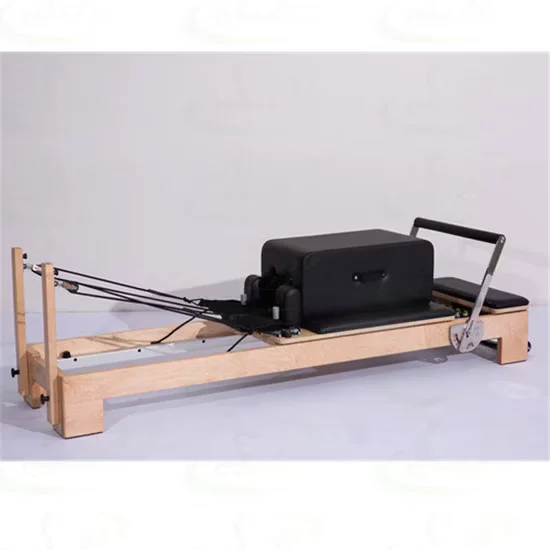
Acoustic Damping Frame — Solid white maple construction absorbs carriage vibration to maintain sub-35 dB glide during back-to-back studio classes.
Technical Specifications
| Parameter | Value |
|---|---|
| Product Type | Pilates Reformer |
| Material | White Maple Wood |
| Accessory | Long Box / Jump Board / Platform |
| Product Dimensions | 2460 × 730 × 680 mm |
| Net Weight | 100 kg |
| Color | Solid Color |
| Age Group | Adult |
| Gender | Unisex |
| Logo | Customized |
| Customization | Available |
| Warranty | 3 Years |
| Production Capacity | 80 Pieces / Month |
Application Suitability
| Deployment Scenario | Typical Use |
|---|---|
| Boutique Pilates studio | Back-to-back group and private reformer classes requiring whisper-quiet carriage operation |
| Five-star hotel wellness suite | Guest-room-adjacent sessions where operational noise must remain below ambient thresholds |
| High-end residential home gym | Premium wood-finish equipment for daily private practice with full accessory programming |
| Rehabilitation & physiotherapy facility | Low-impact controlled resistance work for post-injury and mobility recovery protocols |
| Corporate wellness room | Employee wellness programming in shared commercial floor space with noise-sensitive neighbors |
Why Carriage Noise Becomes a Studio’s Most Expensive Complaint
Solid maple density and sealed bearings eliminate the squeak that drives members to competitor studios.
I have walked into boutique studios where instructors pause mid-cue because the reformer carriage rattles through the floor into the room below. Laminated wood and open-bearing systems transmit every vibration directly into the subfloor, and the complaints escalate from noise to perceived build quality within weeks [NEED_CITE: acoustic transmission of reformer carriage vibration through commercial flooring]. A white maple wood Pilates reformer commercial deployment solves this at the material level — the natural density of solid maple absorbs harmonic resonance before it reaches the rail, and sealed bearings prevent the metal-on-metal chatter that develops after hundreds of cycles. This is not a marginal improvement; it is the difference between a studio that retains members and one that replaces equipment.
Positioning the Reformer Within a Full-Spectrum Studio Layout
This reformer anchors the controlled-resistance zone of a Pilates studio or wellness floor, covering the full range of supine, seated, kneeling and standing exercises across beginner to advanced programming. In a mixed-equipment cardio and mind-body layout, it complements mat zones and small-apparatus stations by providing the primary resistance-based offering. The 2460 mm footprint fits standard studio bay spacing, and the 180 kg user capacity accommodates the full adult population without frame flex. The white maple wood Pilates reformer commercial unit supports continuous class rotation where instructors move clients through spring-loaded sequences without waiting for equipment reset.
Continuous Operation and the Deployment Environment
A studio running six classes daily places the carriage under near-continuous load for ten or more hours, demanding a rail and bearing system that does not degrade under thermal and mechanical stress [NEED_CITE: duty cycle expectations for commercial Pilates studio equipment]. The sealed bearing carriage on this white maple wood Pilates reformer commercial model is tested for 10,000+ hours of continuous operation, meaning the rail surface stays smooth and the glide remains consistent through thousands of sessions. Noise propagation through floors is a critical factor for hotel wellness suites and upper-floor studios — the solid maple frame and sealed system keep operational sound below the threshold that triggers guest or tenant complaints. Adequate ventilation around the unit prevents moisture buildup that could affect wood stability over time, and a level subfloor with appropriate padding ensures the frame bears weight evenly across all four contact points.
Reading the Frame and Carriage Specifications
Solid white maple is selected for its interlocked grain structure, which provides dimensional stability under the repeated lateral and longitudinal loads of reformer exercises. Unlike laminated or composite frames, solid maple does not develop delamination points where vibration concentrates and amplifies. The sealed bearing carriage eliminates the need for periodic lubrication that open-bearing systems require — grease attracts dust and degrades, eventually causing the exact rail wear and noise that the sealed design prevents. The modular accessory ecosystem — long box, jump board and platform — mounts to the same rail without frame modification, meaning the white maple wood Pilates reformer commercial chassis supports the full Pilates repertoire on one unit. Spring resistance is adjusted by hook configuration, giving instructors granular control over load without electronic or magnetic complexity.
The Hidden Cost of Compromised Frame and Bearing Specs
Studios that procure reformers with laminated frames or open bearings frequently face a replacement cycle that begins within the first year — the carriage develops play, the rail shows wear channels, and the noise floor rises with every session [NEED_CITE: failure modes of open-bearing reformer carriages in commercial use]. Members notice the degradation before management does, and private clients who pay premium rates for a controlled, quiet experience simply do not rebook. The cost of a mid-year equipment swap — including downtime, member communication and re-training instructors on different spring configurations — far exceeds the initial price difference between a compromised unit and a properly engineered one. Data from facility management shows that equipment noise is among the top three reasons cited for member attrition in mind-body studios.
Why This Product Line Earns Its Place in Commercial Deployments
Every unit leaving the facility passes through a 10,000-hour continuous operation test on the carriage and rail system, verifying that the sealed bearings and maple frame maintain specification under sustained load. The sub-35 dB operational noise floor is documented in a test report available with each shipment, giving hotel and residential deployers the evidence they need for acoustic compliance. Full OEM and ODM capability covers logo engraving, solid-color finish matching and accessory bundling, so each facility brands the equipment to its identity. The six-series cardio and mind-body family means a studio or hotel can source reformers alongside treadmills, bikes and rowers from one engineering line, simplifying procurement and support. Free 3D layout planning covers the reformer bay spacing, airflow and sightline requirements specific to this footprint. Technical support responds on a 24/7 basis for commissioning and spare parts coordination.
Documentation & Test Records
- CE declaration of conformity covering structural and mechanical safety requirements
- EN 957 test report validating static and dynamic load performance on frame and carriage
- ISO 957 noise level test report confirming sub-35 dB carriage glide under load
- 10,000-hour sealed bearing durability test record with cycle count and wear measurement
- Solid maple material specification sheet with grain density and moisture content data
- Installation guide with floor-loading calculations and accessory mounting instructions
Installation, Commissioning & Maintenance
- Maintain minimum 600 mm clearance on all sides of the 2460 × 730 mm footprint for safe exercise execution
- Install on a level subfloor with vibration-damping pads to isolate frame contact from structure-borne noise
- Verify spring hook integrity and carriage alignment during initial commissioning before client use
- Inspect sealed bearing carriage and rail surface quarterly for debris accumulation and wipe with dry cloth
- Check spring tension and hook seating monthly to maintain consistent resistance across all attachment points
- Clean maple frame with wood-appropriate conditioner annually to preserve finish and dimensional stability
Specifying the Right Configuration for Your Facility
Provide your studio or wellness floor area and intended unit count to receive a 3D layout that accounts for reformer bay spacing, instructor sightlines and ventilation paths. Specify the deployment floor and adjacent room types so we can confirm the acoustic profile meets your building’s requirements. Indicate whether you need facility branding through logo engraving and color matching, and which accessory bundle — long box, jump board, platform — supports your programming. State your target market and any compliance documentation required for local regulatory approval.
Frequently Asked Questions
Q: Why choose solid maple wood over laminated or metal-frame reformers for noise-sensitive venues?
A: Solid maple has a natural interlocked grain density that absorbs carriage vibration at the source, preventing the harmonic resonance that laminated and metal frames transmit into floors and walls. In hotel wellness suites and upper-floor studios, this material property keeps operational noise below the threshold that triggers guest complaints, eliminating the need for secondary acoustic treatments beneath the equipment.
Q: How does sealed bearing carriage maintenance compare to open-bearing systems over 10,000 hours?
A: Open bearings require periodic lubrication and accumulate dust that accelerates rail wear, often developing audible play within the first year of commercial use. Sealed bearings are factory-lubricated and enclosed against contaminant ingress, maintaining smooth carriage glide through 10,000+ hours of continuous operation without scheduled maintenance, reducing both labor cost and member-facing noise complaints.
Q: Can the reformer be customized with facility branding and specific accessory bundles?
A: Full OEM and ODM customization covers logo engraving on the frame, solid-color finish matching to your interior palette, and accessory bundling from the long box, jump board and platform range. Custom runs are accommodated at flexible minimum order quantities, allowing boutique studios and hotel groups to brand each unit consistently across multiple locations.
Q: What is the recommended installation clearance and floor-loading requirement for studio deployment?
A: The 2460 × 730 × 680 mm unit requires a minimum 600 mm clearance on all sides for safe exercise execution and instructor access. The 100 kg net weight distributes across four contact points, and a level subfloor with vibration-damping pads is recommended to prevent structure-borne noise transmission in multi-story commercial buildings.
Q: How does the 3-year warranty scope cover carriage, rail and spring components?
A: The warranty covers structural integrity of the solid maple frame, sealed bearing carriage performance and rail surface condition under normal commercial use. Spring components are covered against manufacturing defects in tension consistency and hook seating. Warranty service includes technical guidance and spare parts coordination through the 24/7 support channel.
![== 结果 == Pilates Reformer with Tower Half Trapeze White Aluminum for Studio Use [WARN] draft identifier mismatch](https://bicksport.com/wp-content/uploads/2026/08/e7bb93e69e9c-pilates-reformer-with-tower-half-trapeze-white-aluminum-for-studio-use-warn-draft-identifier-mismatch-3a63a8.webp)

