
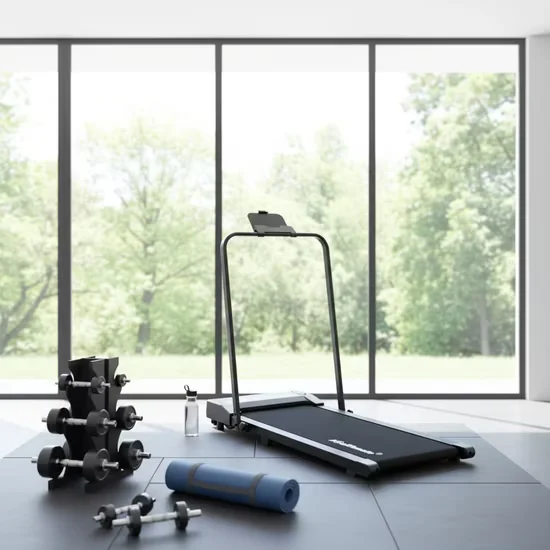
![W08 Electric Folding Treadmill for Home Exercise and Cardiopulmonary Training [WARN] draft identifier mismatch](https://bicksport.com/wp-content/uploads/2026/08/w08-electric-folding-treadmill-for-home-exercise-and-cardiopulmonary-training-warn-draft-identifier-mismatch-6e4b8b.webp)
Whisper-Quiet Deployment — The W08 foldable electric treadmill DC motor home use design targets noise-sensitive floors where acoustic bleed disrupts adjacent occupied rooms.
Technical Specifications
| Parameter | Value |
|---|---|
| Designation | W08 |
| Product Type | Foldable Treadmill |
| Motor Type | DC |
| Motor Power | 1.5 HP ¹ |
| Speed Range | 1–16 km/h |
| Running Surface | 1200 × 450 mm |
| Programs | 16 pre-set |
| Console Type | LCD (Speed / Distance / Time / Calories) |
| Foldable | Yes |
| Product Unfold Size | 1500 × 740 × 1150 mm |
| Product Folded Size | 1810 × 740 × 220 mm |
| Net Weight | 42.0 kg |
| Material | ABS |
| Certification | CE, RoHS |
| OEM/ODM Custom | Yes |
¹ Peak or continuous rating not specified in source — confirm with engineering before specifying for continuous-duty environments.
Application Suitability
| Deployment Scenario | Typical Use |
|---|---|
| High-end residential home gym | Daily walking and light jogging in apartment fitness rooms |
| Corporate wellness room | Low-impact cardiopulmonary sessions during work breaks |
| Community fitness center | Compact cardio station where floor area is constrained |
| Hotel guest floor fitness alcove | Quiet walking machine for early-morning and late-night use |
Why Noise Complaints Reach the Front Desk Before Maintenance Does
DC motors at moderate output generate less acoustic bleed than comparable AC units on shared residential floors.
When we deployed a batch of treadmills in a five-star hotel years ago, guests on the floor below reported a low-frequency hum after 10 PM. The property swapped the entire lot within a month. That incident pushed our engineering team to evaluate every drive component for acoustic transmission — not just the motor housing, but the belt-deck interface and frame resonance paths. For operators fitting cardio into residential towers or hotel corridors, noise is rarely a maintenance ticket; it arrives as a guest complaint first. [NEED_CITE: acoustic transmission standards for cardio equipment on multi-occupancy floors]
Positioning Within a Mixed Cardio Zone
The W08 covers steady-state walking and light jogging across 16 pre-set programs, occupying the moderate-intensity lane between recumbent bikes and full-frame commercial treadmills. In a compact cardio zone it pairs with ellipticals and rowing machines to offer users a low-impact alternative without demanding the footprint of a heavy-duty runner. The 1200 × 450 mm running surface accommodates walking gaits and shorter-stride jogging, making it practical for users of varied height ranges in a foldable electric treadmill DC motor home use configuration. LCD feedback on speed, distance, time, and calories provides immediate session data without requiring network connectivity.
Continuous Run-Time and Deployment Environment
A 1.5 HP DC motor suits moderate daily cycles — typically two to four hours of accumulated use per unit — rather than all-day commercial rotation. Operators should confirm whether the rating reflects continuous or peak output before committing to high-frequency floors. [NEED_CITE: motor duty cycle classification for continuous commercial operation] Deployment on upper residential floors benefits from the 42 kg net weight and foldable frame, which reduce structural load and allow the unit to be stored vertically when the room serves other functions. Adequate lateral clearance supports heat dissipation from the motor housing, and a dedicated circuit prevents voltage sag when multiple units share a wellness room.
DC Drive and Console Signal Path Explained
DC motors deliver smoother torque response at lower speeds than AC counterparts, which matters most during walking-paced programs where cogging vibration becomes audible. The distinction between peak and continuous horsepower is critical here: a peak figure represents short-burst output, while continuous rating governs sustained thermal load on the windings. The LCD console reads speed, distance, time, and calorie estimates from internal sensors, avoiding the complexity and failure points of touchscreen overlays in environments where sweat and humidity are constant. Sixteen pre-set programs vary speed profiles to introduce interval stimuli, yet they do not require external app pairing — keeping the signal path simple and reducing warranty exposure on connectivity modules.
What Specification Compromises Cost Operators Later
Specifying peak-only horsepower figures for a shared residential fitness room often surfaces as premature motor burnout once usage exceeds the design duty cycle. Noise complaints that emerge weeks after installation force bulk replacement — a cost that dwarfs the per-unit savings of a lighter-duty drive. Operators who skip requesting noise-level test reports before shipment discover acoustic issues only after tenants or guests file formal complaints. [NEED_CITE: EN 957 requirements for commercial cardio equipment] Voltage mismatches found at the container door delay commissioning and may require transformer retrofits across an entire equipment order.
Why This Product Line Holds Up in the Field
Our manufacturing facility runs every drive unit through extended-load testing before release, and the W08 benefits from that same protocol. The sub-35 dB acoustic target developed for our hotel deployments informs the motor selection and belt-deck tuning across the range. OEM scope covers console UI language, branding, and color — so the foldable electric treadmill DC motor home use variant can match a property’s interior standard. When planning a cardio zone, our team provides a 3D layout that accounts for the W08’s 1500 × 740 mm unfolded footprint, ensuring member flow and sightlines work in rooms as tight as twenty square meters. Technical support runs around the clock for commissioning and spare-parts coordination.
Documentation & Test Records
- CE declaration of conformity for the W08 drive and frame assembly
- EN 957 test report covering structural and safety validation
- RoHS compliance certificate for electronic and material components
- Noise level test record at defined speed and load conditions
- Motor specification sheet with winding and thermal data
- LCD console technical documentation and wiring diagram
Installation, Commissioning & Maintenance
- Allow clearance behind and beside the 1500 × 740 mm unfolded footprint for safe user exit
- Level the floor or place a vibration mat to prevent frame resonance on hard surfaces
- Connect to a dedicated circuit matching the target market voltage and plug standard
- Verify LCD console readings against a reference timer and distance wheel at first power-on
- Inspect running belt tension and alignment after the initial break-in period
- Wipe the ABS housing and LCD face with a damp cloth after each session to prevent sweat corrosion
Specifying the Right Configuration
Provide your cardio zone square footage and planned unit count so we can generate a 3D layout that accounts for the W08’s folded and unfolded clearances. Confirm expected daily run-hours per unit to determine whether the DC motor duty cycle matches your traffic pattern. Identify the deployment floor and adjacent room types so we can cross-reference acoustic suitability. Specify the destination market voltage and plug type before the proforma invoice stage.
Frequently Asked Questions
Q: What is the difference between peak and continuous motor power, and how does it affect treadmill longevity?
A: Peak power is the maximum output a motor can sustain briefly, while continuous rating reflects thermal capacity under ongoing load. Selecting a treadmill based solely on peak figures risks overheating and winding degradation in environments where users cycle through back-to-back sessions. Always request the continuous duty rating before finalizing equipment for shared or commercial spaces.
Q: How does a DC motor compare to an AC motor in terms of noise and suitable environments?
A: DC motors generally produce less audible vibration at walking and light-jogging speeds, making them practical for residential floors and hotel guest areas. AC motors deliver higher continuous output suited to full-scale commercial gyms. The choice depends on expected daily run-time, occupant proximity, and whether the space sits above noise-sensitive rooms.
Q: Is the W08 suitable for commercial gym floors, or is it limited to residential use?
A: The W08 targets home gym, residential fitness, and light-commercial cardiopulmonary training. Its DC motor and foldable frame suit moderate daily cycles rather than continuous all-day rotation. High-traffic commercial floors benefit from heavier-duty units with continuous-rated AC drives and reinforced running decks.
Q: How does the foldable design affect frame stability during use?
A: A well-engineered hinge mechanism locks the deck rigidly in the unfolded position, maintaining running surface integrity at speeds up to 16 km/h. The trade-off is a slightly narrower running surface compared to fixed-frame commercial units. Buyers should test the locking mechanism over repeated fold-unfold cycles to confirm long-term reliability.
Q: What maintenance keeps the DC motor and running belt quiet over time?
A: Periodic belt alignment checks prevent edge wear that generates friction noise. Keeping the motor housing free of dust preserves airflow and thermal headroom. Lubricating the belt-deck interface at the interval specified in the commissioning guide reduces drag and maintains the acoustic baseline established at factory testing.

![Hsm New Design Foldable Motorized Treadmill with Manual Incline [WARN] draft identifier mismatch](https://bicksport.com/wp-content/uploads/2026/08/hsm-new-design-foldable-motorized-treadmill-with-manual-incline-warn-draft-identifier-mismatch-a2db2d.webp)
![Hsm Durable Motorized Treadmill with Transport Wheels for Commercial Use [WARN] draft identifier mismatch](https://bicksport.com/wp-content/uploads/2026/08/hsm-durable-motorized-treadmill-with-transport-wheels-for-commercial-use-warn-draft-identifier-mismatch-011756.webp)