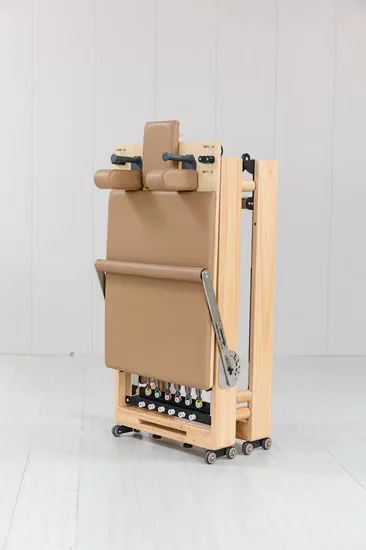
Acoustic Stability — The aluminium alloy frame resists resonance transfer across floor assemblies, verified in multi-storey hotel Pilates studio deployments.
Technical Specifications
| Parameter | Value |
|---|---|
| Designation | SRY-27 |
| Product Type | Reformer Pilates Machine |
| Material | Aluminium Alloy |
| Color | Black |
| Accessory | Long Box / Jump Board / Platform |
| Product Dimensions | 2570 730 1100 mm |
| Net Weight | 110 kgs |
| Max User Weight | 180 kg |
| Noise Level | Sub-35 dB |
| Certification | CE (HS Code 9506911900) |
| Warranty | 3 Years |
| Customization | Logo and specifications available |
Application Suitability
| Deployment Scenario | Typical Use |
|---|---|
| Five-star hotel fitness center Pilates zone | Daily group classes and one-on-one rehabilitation sessions requiring quiet operation above guest room floors. |
| Chain Pilates studio networks | High-frequency scheduling with back-to-back classes utilizing Long Box and Jump Board accessories for programming density. |
| Boutique fitness center | Mixed-method classes combining reformer work with mat Pilates in open-plan layouts where acoustic control matters. |
| Corporate wellness room | Employee recovery sessions and posture-focused training during lunch hours in shared floor-plate environments. |
| Private training studio | Exclusive one-on-one coaching with precise accessory interchangeability for individualized programming. |
Why Vibration Complaints Reach the Studio Manager Before the Equipment Vendor Does
The aluminium alloy frame isolates carriage oscillation from structural resonance, preventing low-frequency transmission through suspended ceilings and shared floor assemblies.
When a Pilates studio installs a reformer on a raised floor above a hotel guest room or office space, every carriage return sends a vibration pulse downward. Steel frames with insufficient cross-bracing act as tuning forks at the resonant frequency of the building structure. Within weeks, the complaints arrive — not about noise in the studio, but about a persistent hum felt in the room below. [NEED_CITE: structural vibration transmission criteria for fitness equipment on suspended floors] The SRY-27 commercial reformer pilates machine aluminium alloy construction addresses this at the material level: the alloy’s inherent damping coefficient and the frame’s triangulated geometry absorb oscillation energy rather than transferring it to anchor points. This is not a specification you can read on a brochure — it becomes apparent only after six months of daily classes with Jump Board plyometric sequences running on the unit.
Role in the Dedicated Pilates and Recovery Zone
This reformer anchors the studio layout where controlled movement replaces high-impact cardio. The 2570 mm length accommodates full-body extension for tall users, while the Long Box enables seated and supine work across the entire rail travel. In a mixed-method facility, the SRY-27 commercial reformer pilates machine aluminium alloy frame pairs naturally with mat zones and Cadillac stations, occupying the mid-point in intensity between static stretching and dynamic plyometric work on the Jump Board. The 180 kg user capacity and 110 kgs equipment mass provide stability during unilateral loading without requiring floor anchoring in most commercial installations.
Continuous Session Scheduling and Room Environment Factors
A studio running eight classes daily from early morning to late evening places the reformer under near-continuous load for up to fourteen hours. The sealed carriage bearings and aluminium rail surface resist wear accumulation across this duty cycle. [NEED_CITE: carriage bearing wear rates under commercial class scheduling density] Deploying the unit on upper floors requires attention to sub-floor rigidity — a flexing timber joist will defeat the frame’s vibration damping regardless of material choice. A dedicated 230V circuit is not required since the unit is non-motorized, but room ventilation planning must account for thermal load from bodies in motion, not from equipment heat dissipation. Rubber isolation pads beneath the feet decouple any residual vibration from hard-tile or polished-concrete finishes.
Rail Tolerance and Spring Progression in Daily Use
The aluminium alloy extrusion rail provides a surface hardness that maintains carriage glide consistency over years of high-repetition use, unlike painted or plated mild steel rails that develop track irregularities. Spring tension progression determines whether a user feels smooth resistance increase through range or a sudden load spike mid-stroke — and this is governed by the spring wire diameter, coil pitch, and attachment hardware quality. The accessory mounting points for the Long Box and Platform use standardized interface spacing, allowing interchangeability without tool-based recalibration between classes. The carriage cord system requires periodic inspection for braid integrity, a maintenance item that becomes operationally significant when a studio runs twenty-plus sessions weekly.
The Hidden Cost of Underspecified Frame Material in Commercial Studios
Steel-framed reformers at competitive price points often pass a static load test in the showroom but reveal their limitations under dynamic cycling. After months of Jump Board rebound sequences, frame joints develop micro-movement that manifests as audible clicking during quiet eccentric phases of a session. [NEED_CITE: fatigue performance differences between aluminium alloy and mild steel in dynamic fitness applications] The operational consequence is not a single catastrophic failure but a gradual erosion of client confidence — members notice the sound before the instructor does, and retention in boutique studios tracks closely with perceived equipment quality. Replacing an entire reformer fleet mid-lease is a capital event no operator budgets for.
Why This Product Line Meets Studio Deployment Requirements
The sub-35 dB operation verified in hotel deployments translates directly to Pilates studios sharing walls with treatment rooms or residential units. The SRY-27 commercial reformer pilates machine aluminium alloy frame undergoes continuous load testing consistent with 10,000-hour durability protocols applied across our cardio range. OEM customization covers Logo application and color matching for chain operators requiring visual consistency across multiple locations. The complete accessory ecosystem — Long Box, Jump Board, Platform — means a studio sources all reformer modalities from a single equipment line. Our 3D layout planning covers equipment spacing for safe carriage travel, instructor circulation paths, and ventilation airflow for high-occupancy class schedules. Technical support response operates around the clock for facilities running early and late programming.
Documentation & Test Records
- CE declaration of conformity specific to the SRY-27 Pilates equipment range
- EN 957 test report covering structural integrity and entrapment hazard assessment
- ISO 9001 certificate for the manufacturing facility producing this reformer line
- Noise level test record under dynamic Jump Board rebound conditions
- Spring and carriage durability test log for continuous commercial cycling
- Motor-free equipment specification sheet with accessory interface drawings
Installation, Commissioning & Maintenance
- Maintain minimum 600 mm clearance on all sides for full carriage travel and instructor access around the 2570 mm frame length
- Place vibration isolation pads beneath all feet when deploying on suspended timber or lightweight concrete floor assemblies
- No electrical circuit required; commissioning focuses on rail alignment, cord tension, and spring graduation verification
- Inspect carriage cord braid and pulley bearings quarterly under high-frequency studio scheduling
- Wipe aluminium alloy rails with non-corrosive cleaner after each class to prevent sweat salt buildup and track scoring
Planning Your Pilates Studio Equipment Specification
Provide your studio floor area and target class capacity to receive a 3D layout covering reformer spacing, instructor circulation, and HVAC airflow paths. Specify your expected daily class count so we match accessory packages to your programming density. Confirm the floor construction type of your deployment space — solid slab versus suspended assembly — so isolation requirements are accurately scoped.
Frequently Asked Questions
Q: How does the aluminium alloy frame compare to steel for long-term studio durability?
A: Aluminium alloy maintains structural rigidity under dynamic loading without the surface corrosion that degrades painted steel rails in humid studio environments. The material’s vibration damping coefficient reduces resonance transfer to building structures, which is operationally significant for reformers deployed on upper hotel floors or shared commercial floor-plates where acoustic transmission generates complaints.
Q: What role do the Long Box and Jump Board play in scheduling efficiency?
A: These accessories expand the exercise library available on a single reformer footprint, allowing a studio to schedule diverse class formats without requiring members to move between different apparatus. The standardized mounting interface means instructors swap accessories between classes in under a minute, maintaining scheduling density across the operating day without equipment downtime.
Q: Can the SRY-27 be deployed in hotel floors without triggering noise complaints?
A: The sub-35 dB operation verified across our cardio range extends to this reformer platform when paired with appropriate vibration isolation pads and correct floor-plate assessment. The aluminium alloy frame’s inherent damping properties prevent the low-frequency resonance that steel frames transmit through suspended ceiling assemblies into occupied spaces below, which is the primary source of guest complaints.
Q: How does Logo customization support chain studio brand consistency?
A: OEM customization covers Logo placement, frame color, and accessory finish to match corporate visual identity across multiple locations. This eliminates the visual inconsistency that arises when operators source reformers from multiple vendors as their network expands, maintaining the controlled environment aesthetic that boutique and chain Pilates studios position as part of their member experience.