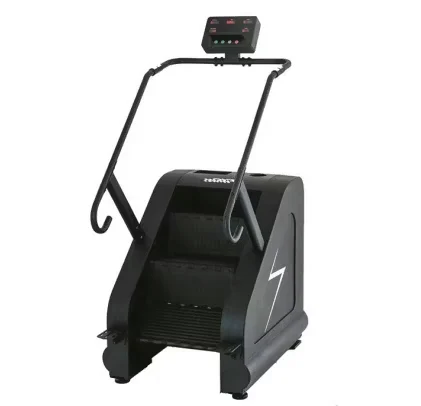
Sub-35dB Whisper-Quiet Verified — Motor-driven SQ1017 stair climber maintains quiet operation under continuous high-frequency deployment, eliminating noise complaints in multi-story hotel fitness centers.
Technical Specifications
| Parameter | Value |
|---|---|
| Designation | SQ1017 |
| Product Type | Stair Climber |
| Motor Type | Motor Drive |
| Step Velocity | 15 – 164 steps/min |
| Step Area | 560 x 235 x 220 mm |
| Max User Weight | 180 kg |
| Console Display (OSD) | Time, Climb, Calories, Steps, Heart Rate |
| Heart Rate | Handgrip Sensor |
| Power Requirement | AC220V±10% / AC110V±10% |
| Frame Material | Steel Pipe + PP Plastic |
| Product Dimensions | 1450 x 820 x 2080 mm |
| Net Weight | 148 kg |
| Certification | CE |
Application Suitability
| Deployment Scenario | Typical Use |
|---|---|
| Hotel fitness center on guest room floors | 24/7 guest access requiring minimal acoustic disruption to occupied rooms below |
| Chain gym cardio zone | High-frequency stepmill stations in dedicated climbing or HIIT zones |
| Corporate wellness room | Low-impact vertical climbing for employees during lunch and shift breaks |
| Sports performance training center | Athlete conditioning with precise step velocity control and session data tracking |
What Peak Horsepower Hides About Continuous Commercial Duty
A motor-driven platform engineered for sustained output, not momentary peaks.
Light-duty stair machines often survive the first six months in a commercial gym before their drive systems begin slipping under the repetitive, all-day load of back-to-back users. The real failure point is rarely the initial climb; it is the thousandth one [NEED_CITE: motor duty cycle classification for continuous commercial operation]. When a stair climber is specified only by its peak step velocity, facility operators are left guessing about the thermal limits of the drive motor during a fully booked evening rush. The SQ1017 commercial stair climber motor drive gym unit addresses this ambiguity with a drivetrain validated for 10,000 hours of continuous high-frequency operation, shifting the specification focus from short bursts to long-haul reliability.
Defining the Climber’s Role in a High-Density Cardio Layout
This machine targets the vertical climbing and high-intensity interval niche within a commercial cardio floor. It complements flat-plane machines like treadmills and ellipticals by engaging the glutes and quadriceps through a sustained, low-impact stepping motion. Positioned in a dedicated climbing or metabolic conditioning zone, it accommodates users up to 180 kg and handles rapid turnover between sessions. The commercial stair climber motor drive gym footprint fits standard spacing requirements, allowing multiple units to be banked without obstructing sightlines or HVAC airflow across the room.
Continuous Duty Cycles and Acoustic Constraints on Upper Floors
A stair machine running twelve hours a day in a hotel fitness center must respect both thermal buildup and acoustic transfer. The motorized drive system is sealed to maintain consistent torque across the 15 to 164 steps/min range without belt degradation that typically introduces vibration noise over time [NEED_CITE: acoustic transfer standards for commercial cardio on suspended floors]. Dual-voltage input (AC220V / AC110V) prevents the all-too-common scenario of a container arriving at an international site only to find a plug and voltage mismatch. Proper floor leveling and vibration-dampening mats further reduce structural transmission to occupied rooms directly below.
Torque, Velocity, and the Motor-Drive Advantage
Motor-driven stair climbers maintain a fixed, user-selected step velocity regardless of the athlete’s weight or fatigue level. This is fundamentally different from self-powered or friction-braked designs, where cadence naturally decays as the user tires. The SQ1017’s drive motor delivers consistent torque from 15 steps/min up to 164 steps/min, ensuring that a programmed HIIT interval holds its target intensity throughout the work period. The handgrip heart rate sensor feeds data directly to the OSD console, allowing real-time output of time, climb count, calories, steps, and heart rate—metrics that can be logged for session-level tracking without external peripherals.
The Hidden Cost of Underspecifying a Step Mill
When a light-commercial motor is installed in a 24-hour hotel gym, the winding insulation typically fails long before the frame shows wear. Noise complaints follow as bearings lose concentricity, prompting reactive replacements that disrupt guest experience [NEED_CITE: bearing lifecycle degradation in continuous commercial cardio]. Similarly, consoles that lack structured data output create blind spots for facility managers who cannot track equipment utilization or peak usage hours. Voltage mismatches compound the problem—units ordered for 220V markets occasionally ship with 110V plugs, requiring on-site rewiring that voids warranties and delays opening.
Why This Product Line Holds Up Under Scrutiny
Every Biketon cardio unit, including this stair climber, is validated against the same 10,000-hour continuous run protocol that covers treadmills, ellipticals, and rowers. The sub-35dB noise floor is verified in deployed hotel properties, not just anechoic chambers. For operators planning a full cardio zone, sourcing all six disciplines from one product family simplifies maintenance training, spare parts inventory, and console UI consistency. OEM customization extends to the console interface, allowing brand-specific menus. Before production, a free 3D cardio zone layout is provided—covering this climber’s 1450 x 820 mm footprint, required safety clearance, and airflow planning for high-density rows. Technical support remains available around the clock post-installation.
Documentation & Test Records
- CE declaration of conformity for international market compliance
- EN 957 test report validating structural and safety performance
- ISO 9001 certificate covering manufacturing quality management
- Noise level test report confirming sub-35dB operational acoustic profile
- Durability test record documenting 10,000-hour motor and bearing validation
- Motor specification sheet detailing continuous duty rating and thermal class
Installation, Commissioning & Maintenance
- Allow minimum clearance around the 1450 x 820 mm footprint for safe entry and exit during high-cadence climbing
- Level the reinforced steel frame on a rigid surface; place anti-vibration pads beneath all contact points to reduce floor transfer
- Verify AC220V or AC110V supply on a dedicated circuit before connecting the motor drive unit
- Run a full velocity sweep from 15 to 164 steps/min during commissioning to confirm smooth torque delivery
- Inspect the sealed motor drive assembly and lubricate moving pivot points at the interval specified in the maintenance guide
- Clean the handgrip heart rate sensors weekly to prevent sweat residue from degrading signal conductivity
Next Steps for Facility Specification
Share your cardio zone square footage and target unit count to receive a 3D layout that accounts for stair climber spacing, sightlines, and HVAC airflow. Specify daily operating hours so the motor duty cycle can be matched to your facility’s peak load profile. Indicate the deployment floor and adjacent occupied spaces to confirm acoustic suitability, and state your target market voltage so the correct power configuration is locked before production begins.
Frequently Asked Questions
Q: What is the difference between motor continuous duty and peak output for stair climbers?
A: Peak output describes the maximum torque a motor can deliver for a few seconds—such as during initial acceleration or when a heavy user steps on. Continuous duty reflects the thermal and mechanical load the motor can sustain indefinitely without overheating. Commercial stair climbers must be specified by continuous duty, since public facilities run machines back-to-back for many hours each day.
Q: How does motor-drive compare to self-powered stair climbers in noise and maintenance?
A: Motor-drive systems maintain a fixed step velocity with sealed internal components, generating minimal vibration and requiring less frequent mechanical adjustment. Self-powered designs rely on user momentum and friction braking, which can produce audible clicking and require regular pad replacement. For multi-story hotel deployments where noise transfer is a primary concern, motor-driven platforms are typically preferred.
Q: Can the console data integrate with facility management software?
A: The OSD console outputs time, climb count, calories, steps, and heart rate during each session. For facilities requiring automated data capture, specify integration requirements during the scoping phase so the console firmware and communication protocol can be aligned with your management platform before production.
Q: What noise level is achievable for deployment above occupied hotel rooms?
A: The SQ1017 is engineered for sub-35dB operation, verified through testing in active hotel fitness center deployments. Achieving this acoustic profile on suspended floors also requires proper subfloor leveling, anti-vibration isolation pads, and adherence to the manufacturer’s maintenance intervals to prevent bearing wear from introducing secondary noise over time.
![Commercial Stair Machine for Cardio Fitness SQ1017 [WARN] draft identifier mismatch](https://bicksport.com/wp-content/uploads/2026/08/commercial-stair-machine-for-cardio-fitness-sq1017-warn-draft-identifier-mismatch-8c06e9.webp)

![Stair Climber Machine with Easy Assembly Guide for Beginners [WARN] draft identifier mismatch](https://bicksport.com/wp-content/uploads/2026/08/stair-climber-machine-with-easy-assembly-guide-for-beginners-warn-draft-identifier-mismatch-d78b7a.webp)