
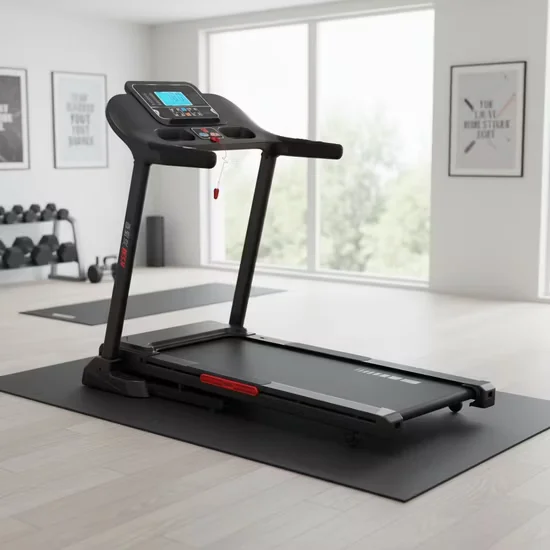
Space-Optimized Cardio Integration — A foldable motorized treadmill engineered with a DC drive and compact footprint to resolve deployment constraints in shared residential and light-use fitness environments.
Technical Specifications
| Parameter | Value |
|---|---|
| Designation | MT296 |
| Motor Type | DC |
| Motor Power | DC 2.0 HP* |
| Speed Range | 1–20 km/h |
| Running Surface | 1200 x 520 mm |
| Console Type | LCD (Speed / Distance / Time / Calories / Pulse) |
| Programs | 16 Preset |
| Foldable | Yes |
| Product Unfolded Size | 1580 x 865 x 1300 mm |
| Product Folded Size | 910 x 865 x 1345 mm |
| Net Weight | 64.0 kg |
| Material | ABS |
| Color Options | Multicolor / Customizable |
| Certification | CE, RoHS |
| OEM/ODM | Available |
*Peak or continuous duty not specified in source catalog; verify against manufacturer data sheet before deployment planning.
Application Suitability
| Deployment Scenario | Typical Use |
|---|---|
| High-end residential home gym | Daily individual sessions in apartment or villa settings with limited floor area |
| Corporate wellness room | Low-traffic employee fitness breaks during workday hours |
| Private personal-training studio | Light daily usage for guided one-on-one conditioning sessions |
| Boutique recovery suite | Low-intensity steady-state cardio complementing treatment or rehab protocols |
Why Home Cardio Deployments Fail Before the First Service Call
A foldable motorized treadmill DC motor home use unit often fails not because of the runner but because of the room it sits in. Noise and vibration migrate through floor joists long before a motor overheats. Property managers and facility operators receive noise complaints from adjacent or downstairs occupants weeks before any maintenance ticket is filed. Residential flooring amplifies low-frequency resonance from undersized drive systems, and the resulting friction with building occupants forces equipment removal or replacement. [NEED_CITE: structural vibration transmission in multi-story residential cardio deployments]
Positioning This Foldable Treadmill Within a Compact Cardio Zone
The MT296 covers steady-state and interval walking through moderate-speed running, occupying the foundational aerobic conditioning slot in a small-footprint cardio layout. It pairs naturally with a compact elliptical or stationary bike to offer impact variety without demanding additional square footage. The foldable motorized treadmill DC motor home use design suits deployment against walls or in alcoves where the unit folds vertically between sessions. Its 1200 x 520 mm running surface accommodates most adult stride lengths, while the LCD console provides pulse monitoring and program selection without requiring external device connectivity.
Continuous Operation Limits and Deployment Environment Factors
This DC-driven platform is rated for intermittent duty cycles typical of residential and light-use environments rather than continuous commercial run-times. Operators should plan for individual sessions with rest intervals between users rather than back-to-back scheduling across multiple hours. The foldable frame and 64 kg net weight allow repositioning, but the unit still requires a level, rigid floor surface to prevent belt drift and uneven deck wear. Standard single-phase household voltage powers the motor, though operators in export markets must confirm plug type and voltage match before production. [NEED_CITE: voltage and frequency compatibility for cross-border fitness equipment deployment] Adequate clearance behind and beside the unit supports heat dissipation from the motor housing during extended sessions.
DC Drive and Foldable Frame: What the Specifications Actually Mean
The DC motor in the MT296 delivers smooth speed modulation across the 1–20 km/h range with lower startup current draw compared to AC alternatives, which suits residential circuits that share loads with other appliances. DC motors inherently produce less electromagnetic noise, contributing to quieter operation in enclosed rooms. The 16 preset programs on the LCD console allow structured sessions without requiring a connected app or external device — a deliberate trade-off favoring reliability and simplicity over data ecosystem complexity. The foldable frame hinges reduce the stored footprint from 1580 mm to 910 mm in depth, a practical advantage in apartments or multi-purpose rooms. Pulse sensors integrated into the handlebar provide basic heart rate feedback, though grip-based readings may drift during high-intensity intervals compared to chest-strap telemetry. [NEED_CITE: heart rate sensor accuracy comparison between grip-based and chest-strap methods]
The Cost of Overlooking Motor Duty Classification
Deploying a treadmill with a motor rated for intermittent residential use in a setting where multiple users run consecutive daily sessions leads to premature winding degradation and eventual motor failure. The noise floor rises as bearings wear unevenly under sustained thermal load. Facilities that install units without verifying continuous versus peak horsepower ratings face batch replacement costs within months. Similarly, placing any treadmill on an upper residential floor without confirming the structural damping capacity invites low-frequency complaints that no amount of deck cushioning can resolve. [NEED_CITE: motor winding failure patterns under continuous versus intermittent duty cycles] Data from the LCD console remains isolated if the deployment plan does not account for facility management integration needs.
Why This Product Line Addresses Deployment Friction
Every unit undergoes noise level verification to confirm suitability for noise-sensitive environments, drawing on engineering experience resolving low-frequency resonance complaints in hotel-adjacent installations. The 10,000-hour durability testing protocol applied across the commercial cardio range informs component selection standards even for light-use models. OEM and ODM customization extends to console interface language, color matching, and branding so the unit aligns with the visual identity of the host space. The six-series cardio family means this foldable treadmill can be sourced alongside ellipticals, bikes, and rowers from a single production facility, simplifying logistics and spare parts management. Free 3D cardio-zone layout planning covers equipment spacing, airflow, and sightlines specific to the room dimensions provided. Technical support remains available around the clock for commissioning questions and field troubleshooting.
Documentation & Test Records
- CE declaration of conformity covering the MT296 foldable treadmill platform
- EN 957 test report validating safety and performance requirements
- RoHS compliance documentation for restricted substance limits
- Noise level test record under standardized operating conditions
- Motor specification sheet detailing DC drive parameters
- Installation and commissioning guide with spare parts list
Installation, Commissioning & Maintenance
- Maintain minimum 600 mm rear clearance from walls for belt access and motor ventilation
- Place on a level surface with a vibration-damping mat to reduce structural transmission
- Confirm local voltage and plug type match the DC motor power supply specification before energizing
- Calibrate belt tracking and tension during first startup to prevent lateral drift
- Inspect belt lubrication and deck alignment at intervals defined by cumulative usage hours
- Wipe LCD console and pulse sensors with a non-corrosive cleaner after each session
Equipment Selection and Inquiry Direction
Provide the cardio zone square footage and intended equipment count to receive a 3D layout with airflow and sightline planning specific to this foldable motorized treadmill DC motor home use platform and complementary units. Specify the expected daily session frequency per unit to confirm motor duty-cycle alignment. Indicate the deployment floor level and adjacent occupied spaces so noise transmission requirements can be verified. State the target market voltage and plug standard to ensure electrical compatibility before production scheduling.
Frequently Asked Questions
Q: What is the difference between peak and continuous motor power for a foldable treadmill?
A: Peak horsepower describes the motor’s maximum short-burst output during acceleration or incline transitions, while continuous duty rating reflects sustained output under steady load. A treadmill may list a higher peak figure that does not represent its ability to run for extended sessions without thermal stress. Confirming the continuous rating against the expected daily run-time prevents premature motor degradation in deployments exceeding light personal use.
Q: How does a DC motor compare to an AC motor for residential treadmill deployments?
A: DC motors typically offer smoother low-speed modulation, lower startup current draw, and reduced electromagnetic noise compared to AC motors of equivalent output. This makes them better suited to residential circuits and noise-sensitive rooms. However, DC motors generally suit intermittent duty cycles rather than continuous multi-user commercial run-times, so matching the motor type to the expected usage pattern is essential for long-term reliability.
Q: Can the LCD console on this treadmill sync with third-party fitness apps?
A: The LCD console on this model displays speed, distance, time, calories, and pulse data locally across 16 preset programs. It does not include wireless connectivity modules for third-party app synchronization. Facilities requiring member usage tracking or integration with management software should evaluate models from the same product line equipped with IoT-enabled touchscreen consoles that support data export.
Q: What noise level should be expected when placing this treadmill on an upper residential floor?
A: Actual noise output depends on motor load, belt condition, floor construction, and user weight. DC-driven foldable treadmills generally produce lower operational noise than AC-driven commercial units, but low-frequency vibration can still transmit through structural elements. Requesting a noise level test report and deploying a vibration-damping mat helps verify suitability for upstairs placement before committing to a production order.
Q: Does the foldable design affect running stability during use?
A: A foldable frame introduces a hinge mechanism that, when properly engineered and locked, maintains adequate rigidity for walking and moderate-speed running. The 64 kg net weight and ABS construction provide a stable base on level flooring. Users engaging in high-speed intervals may notice marginally more lateral flex compared to a fixed-frame commercial treadmill, which is a standard trade-off for the space-saving benefit.

![W08 Electric Folding Treadmill for Home Use DC Motor Walking Machine [WARN] draft identifier mismatch](https://bicksport.com/wp-content/uploads/2026/08/w08-electric-folding-treadmill-for-home-use-dc-motor-walking-machine-warn-draft-identifier-mismatch-d6c377.webp)