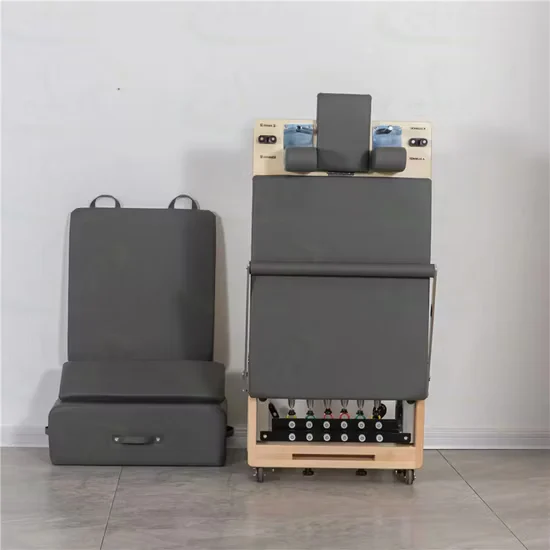
Precision Machined Rail Interface — Aluminum extrusion with tolerance-machined carriage wheels delivers whisper-quiet rolling suitable for hotel-adjacent and shared-wall studio deployment.
Technical Specifications
| Parameter | Value |
|---|---|
| Designation | SRY-12 |
| Product Type | Pilates Reformer |
| Frame Material | Aluminum |
| Color | White |
| Product Dimensions | 2570 × 730 × 270 mm |
| Net Weight | 90 kg |
| Accessories | Long Box / Jump Board / Platform |
| Max User Weight | Available upon request from manufacturer catalog |
| Warranty | 3 Years |
| Logo Customization | Customized Is Allowed |
| Age Group | Adult |
| Gender | Unisex |
| Production Capacity | 80 Pieces/Month |
Application Suitability
| Deployment Scenario | Typical Use |
|---|---|
| Boutique Pilates and yoga studio | High-frequency group reformer classes with rapid carriage transitions |
| Five-star hotel wellness center | Mind-body studio adjacent to guest rooms requiring quiet carriage operation |
| Corporate wellness fitness room | Employee Pilates programming with moderate daily scheduling |
| Professional Pilates training facility | Instructor certification courses and advanced repertoire practice |
| High-end residential home gym | Private daily use with full accessory ecosystem |
Why Carriage Noise Becomes the First Complaint in Shared-Wall Studios
Aluminum rail straightness and wheel tolerance determine whether a reformer operates silently or resonates through floor slabs.
Pilates reformers deployed above occupied hotel rooms or beside residential units often generate carriage rumble and spring harmonics that travel through concrete. Unlike cardio machines where motor noise dominates, the reformer’s noise profile comes from wheel-to-rail contact and spring oscillation. Operators replacing steel-framed units after guest complaints consistently find that precision-machined aluminum rails with matched carriage wheels address the source rather than adding isolation pads after the fact [NEED_CITE: structural vibration transmission in shared-wall fitness deployments].
Role Within the Studio Equipment Matrix
The commercial aluminum Pilates reformer white configuration covers the full classical and contemporary repertoire from foundational footwork through advanced jump board plyometrics. In a group studio layout, reformers pair with mat stations and Cadillac units to create a complete equipment ecosystem. This unit accommodates adult users across the full height and weight spectrum supported by its aluminum frame, and its 2570 mm length allows placement against standard studio walls with adequate clearance for carriage extension and instructor circulation.
Continuous Scheduling and Studio Environment Requirements
A boutique studio running four to six group classes daily places each reformer through repetitive loading cycles with rapid spring changes between users. The aluminum frame resists corrosion from studio humidity and cleaning solutions applied between sessions. Floor-leveling requirements matter: uneven surfaces introduce lateral carriage drift that accelerates wheel wear and generates rolling noise. Studios planning reformer zones should account for lateral clearance beside each unit and overhead clearance for jump board exercises [NEED_CITE: group reformer class spacing and ventilation standards].
Decoding Aluminum Frame Engineering and Spring Resistance
Aluminum extrusion for reformer frames delivers structural rigidity at roughly one-third the mass of welded steel, which eases repositioning when studios reconfigure layouts for different class formats. The carriage wheel-to-rail interface is the critical noise-determining assembly: wheels machined to tight diameter tolerances ride smoothly without the clicking or rumbling that signals rail irregularity. Multi-spring resistance configurations allow instructors to match load progression to individual users within a group class without introducing friction-based wear or noise degradation. The spring mechanism itself operates silently compared to friction-resistance systems, maintaining consistent load curves across the full carriage travel. Accessory integration — long box for seated work, jump board for plyometrics, platform for standing exercises — extends the exercise catalog without requiring additional floor space or separate equipment procurement.
The Cost of Overlooking Rail Tolerance Specifications
Studios that procure reformers based on appearance alone frequently discover carriage noise issues only after installation. Imprecise rail straightness causes the carriage to bind or rattle during transitions, producing the low-frequency rumble that penetrates floor slabs into occupied spaces below. Spring assemblies that lack calibration documentation lead to inconsistent resistance between units in the same studio, frustrating instructors who expect uniform loading across a class. Accessory attachment points that loosen under repeated engagement compromise exercise safety and generate service calls [NEED_CITE: Pilates reformer carriage wheel tolerance and rail straightness inspection].
Why This Product Line Addresses Studio Procurement Gaps
The sub-35dB operational philosophy verified in hotel cardio deployments extends to this reformer’s aluminum rail and carriage assembly, addressing the shared-wall noise problem at the engineering level. The 10,000-hour durability testing protocol applied across the commercial range informs spring fatigue ratings and wheel bearing longevity under continuous studio scheduling. Complete accessory inclusion eliminates the procurement friction of sourcing long boxes, jump boards, and platforms from separate suppliers. OEM customization covers logo application and color specification to align with studio branding. Free 3D studio layout planning accounts for reformer spacing, instructor sightlines, and airflow between units during high-intensity group sessions. Technical support covers accessory fitment questions and maintenance scheduling from commissioning onward.
Documentation & Test Records
- CE declaration of conformity for studio equipment deployment
- EN 957 test report covering structural load and carriage safety
- ISO 9001 certificate for manufacturing quality management
- Noise level test record verifying carriage rolling acoustics
- Durability test record for spring fatigue and wheel bearing life
- Accessory attachment mechanism load-cycle documentation
Installation, Commissioning & Maintenance
- Maintain 600 mm lateral clearance between reformers for instructor circulation and carriage extension
- Level all four feet on hard flooring to prevent lateral carriage drift and uneven wheel wear
- Verify spring resistance calibration across full carriage travel during first-day commissioning
- Inspect carriage wheel surfaces and rail contact points monthly for debris accumulation
- Wipe aluminum frame with pH-neutral cleaner to prevent corrosion from sweat and studio humidity
- Confirm long box, jump board, and platform attachment mechanisms engage securely before each class
Aligning Your Studio Requirements With Equipment Selection
Provide your studio square footage and planned reformer count to receive a 3D layout addressing spacing, sightlines, and HVAC airflow between units. Specify your daily class schedule and average user turnover so spring duty cycles can be matched to your operational intensity. Indicate whether the studio shares walls or floor slabs with occupied spaces to confirm noise performance requirements. State your target market to verify accessory configuration and logo customization scope.
Frequently Asked Questions
Q: What advantages does an aluminum frame offer over steel for commercial reformer deployment?
A: Aluminum delivers equivalent structural rigidity at substantially lower mass, making studio reconfiguration manageable without technician assistance. The material resists corrosion from cleaning solutions and studio humidity that accelerate surface degradation on untreated steel. For shared-wall environments, the precision extrusion process produces straighter rail surfaces, reducing carriage noise at the source.
Q: How do carriage wheel specifications affect long-term rolling smoothness?
A: Wheel diameter tolerance and bearing type directly determine whether the carriage glides silently or develops clicking sounds over months of use. Precision-machined wheels matched to the rail profile maintain consistent contact without lateral play. Studios should request dimensional inspection reports confirming wheel-to-rail fitment tolerances before procurement.
Q: How should spring resistance be configured for mixed-level group classes?
A: Multi-spring setups allow instructors to select lighter or heavier resistance per user without hardware swaps. Springs calibrated for incremental load progression let beginners build capacity while advanced practitioners access higher resistance on the same unit. Calibration documentation should confirm consistent tension curves across the full carriage stroke.
Q: What spacing requirements apply to group reformer studio layouts?
A: Each unit needs lateral clearance for instructor access and longitudinal clearance for full carriage travel plus jump board exercises. Adequate overhead height accommodates standing and kneeling work on the platform. Airflow planning between units prevents heat buildup during back-to-back class scheduling [NEED_CITE: group Pilates studio ventilation and spacing guidelines].