
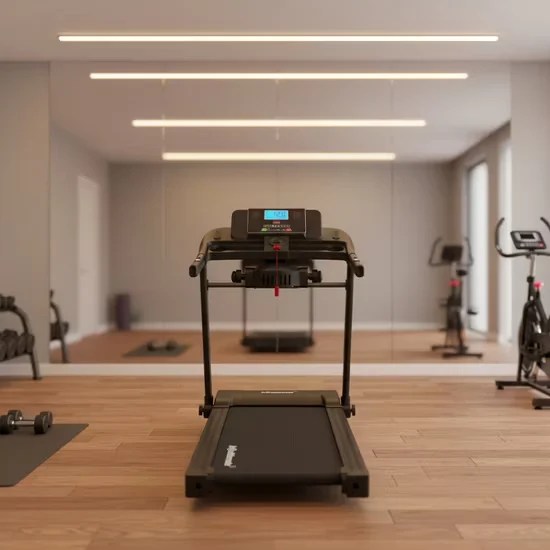
![Quiet Mt026m Foldable Electric Treadmill for Home Use Physical Fitness [WARN] draft identifier mismatch](https://bicksport.com/wp-content/uploads/2026/08/quiet-mt026m-foldable-electric-treadmill-for-home-use-physical-fitness-warn-draft-identifier-mismatch-bd1920.webp)
Quiet Operation — DC motor architecture keeps acoustic output low enough for apartments and shared residential floors, eliminating vibration complaints from adjacent units.
Technical Specifications
| Parameter | Value |
|---|---|
| Designation | MT026M |
| Motor Type | DC |
| Motor Power | 1.5 HP* |
| Speed Range | 1–12 km/h |
| Running Surface | 1200 × 460 mm |
| Console Type | LCD (Speed / Distance / Time / Calories / Pulse) |
| Programs | 12 |
| Product Unfold Size | 1465 × 750 × 1150 mm |
| Product Folded Size | 1465 × 750 × 390 mm |
| Net Weight | 46.0 kg |
| Foldable | Yes |
| Material | ABS |
| Certification | CE, RoHS |
| OEM / ODM Custom | Yes |
*1.5 HP rating — peak or continuous duty not specified in source; confirm with manufacturer before deployment scoping.
Application Suitability
| Deployment Scenario | Typical Use |
|---|---|
| High-end residential home gym | Daily walking and light jogging in noise-sensitive apartments |
| Corporate wellness room | Compact stowable cardio for limited-footprint employee fitness areas |
| Apartment complex shared fitness space | Foldable unit that stores flat against walls between user sessions |
| Serviced apartment guest floor | Quiet DC motor operation beside occupied living spaces |
What Peak Horsepower Hides About Continuous Duty
A foldable home electric treadmill DC motor rated at peak output can stall under sustained loads that a lower-rated continuous-duty motor handles without thermal stress.
Motor labels on residential cardio equipment frequently advertise peak horsepower — the burst output achievable for seconds before winding temperature forces a shutdown. Continuous duty, by contrast, describes what the motor delivers indefinitely under load. When a user runs intervals at 11–12 km/h for thirty minutes on a motor rated only for peak, thermal cutouts interrupt sessions and winding insulation degrades prematurely. The MT026M uses a 1.5 HP DC platform, and confirming whether that figure is continuous or peak determines whether the unit supports sustained jogging or is limited to walking and walk-run transitions. [NEED_CITE: motor duty cycle classification for residential treadmill deployment]
Where This Treadmill Sits in a Compact Cardio Zone
The MT026M covers walking through light jogging at speeds up to 12 km/h, making it suitable for users who prioritize low-impact steady-state movement and interval walking programs. In a residential fitness room it pairs well with a stationary bike or elliptical, filling the treadmill discipline slot without demanding a dedicated commercial-grade electrical circuit. The 1200 × 460 mm belt accommodates walking gaits and shorter-stride jogging comfortably, while the foldable chassis lets operators reclaim floor area when the unit is idle. The foldable home electric treadmill DC motor design targets user demographics under the specified weight ceiling and intermittent daily sessions rather than back-to-back class schedules.
Continuous Operation Limits and Room-Level Constraints
A DC motor at this power rating supports intermittent daily use — typically one to two hours per session — and requires cooldown intervals between consecutive users in shared residential facilities. Noise transmission through floor slabs remains a primary concern when the unit is placed above occupied rooms, and deploying a vibration-dampening mat beneath the frame addresses structure-borne resonance. The MT026M does not demand a dedicated 20-amp circuit, but the local voltage standard and plug type must be confirmed before the production run. Adequate clearance around the rear of the deck ensures belt heat dissipates during extended sessions. [NEED_CITE: residential treadmill deployment ventilation and floor loading requirements]
Motor, Belt, and Console Architecture Explained
DC motors produce lower audible noise at partial load than AC equivalents, which suits the start-stop cadence of home fitness sessions. The 1.5 HP output on the MT026M drives the belt through a roller system sized for the 1200 × 460 mm running surface, keeping belt tension within a range that prevents slip without over-stressing bearings. The LCD console displays speed, distance, time, calories, and pulse, with handgrip sensors providing basic heart rate feedback — sufficient for effort monitoring but subject to motion artifact during vigorous jogging. Twelve preset programs handle varied pacing without requiring manual speed adjustments mid-session. The foldable frame pivots at the deck joint, reducing stored height to 390 mm and allowing the unit to sit flush against a wall when not in use.
The Cost of Underspecifying a Foldable Treadmill
Deploying a treadmill with a motor rated only for peak output in a setting where multiple users share the unit daily leads to thermal shutdowns that interrupt sessions and shorten winding life. Inadequate deck cushioning on budget frames transmits repetitive impact to knees and ankles, producing member complaints within months of installation. When a console lacks any biometric feedback, users abandon structured pacing and revert to arbitrary intensity, undermining retention in corporate wellness programs. Voltage mismatches discovered after delivery force entire shipments back to the factory for rewiring. [NEED_CITE: treadmill motor failure patterns in shared residential fitness rooms]
Why This Product Line Was Built Around Noise and Space Constraints
Biketon Sport engineered the MT026M from a lesson learned on an apartment basement gym project where conventional electric treadmills generated enough vibration to trigger neighbor complaints and a full batch return. The foldable home electric treadmill DC motor configuration directly addresses that failure mode with a drive system sized for quiet intermittent operation. The foldable frame reduces stored height to 390 mm, freeing floor area in compact residential gyms. Each unit ships with documentation covering noise level testing, motor specifications, and LCD console technical parameters. OEM customization extends to console labeling and color matching for branded residential developments. Free 3D cardio-zone layout planning covers the MT026M footprint, required safety clearances, and airflow paths so the unit integrates cleanly into rooms as small as a studio apartment corner.
Documentation & Test Records
- CE declaration of conformity covering electrical safety and EMC requirements
- EN 957 test report validating mechanical and structural performance
- RoHS compliance record for restricted substance content
- Noise level test report documenting acoustic output under load
- Motor specification sheet detailing rated power and duty cycle
- LCD console technical documentation with pulse sensor calibration data
Installation, Commissioning & Maintenance
- Maintain minimum clearance behind the 1465 mm frame length for safe mounting and dismounting
- Level the running surface on firm flooring and add a rubber mat to reduce vibration transfer
- Verify local voltage and plug standard before connecting the DC motor to the power supply
- Run a belt tension check and speed calibration after the first hour of operation
- Inspect deck lubrication and belt alignment every three months under regular use
- Wipe the LCD console and handgrip pulse sensors after each session to prevent sweat corrosion
Requesting a Deployment Match
Share the floor plan dimensions and total unit count of the target cardio area to receive a 3D layout with spacing and airflow planning for the MT026M. Specify expected daily usage duration per unit so the motor duty cycle can be validated against the 1.5 HP rating. Confirm deployment floor level and adjacent room occupancy to verify acoustic suitability. State the target market voltage and plug standard, and indicate whether the LCD console needs OEM branding or custom program labels.
Frequently Asked Questions
Q: What is the difference between peak horsepower and continuous duty horsepower for treadmill motors?
A: Peak horsepower describes the maximum burst output a motor achieves for seconds before thermal limits engage. Continuous duty horsepower reflects what the motor sustains indefinitely under load without overheating. A motor labeled 1.5 HP peak may deliver considerably less during sustained running, so confirming the duty classification prevents unexpected thermal cutouts during longer sessions.
Q: How does a DC motor compare to an AC motor in noise output and maintenance requirements?
A: DC motors operate at lower audible noise during partial-load and intermittent use, which matches typical home and residential fitness patterns. They also use carbon brushes that eventually require inspection and replacement. AC motors run cooler under continuous commercial loads but produce more audible hum at low speeds, making them less suitable for quiet residential deployments.
Q: Is this treadmill suitable for commercial gym environments or strictly home use?
A: The MT026M is engineered for home gym, residential fitness, and corporate wellness rooms where usage is intermittent and sessions are spaced apart. High-traffic commercial gyms with back-to-back users throughout the day require heavier-duty motors and frames rated for continuous commercial operation.
Q: What heart rate monitoring method is used and how reliable is handgrip pulse reading?
A: The MT026M uses handgrip sensors integrated into the console handles to detect pulse. Readings are reliable during walking and steady-state use but can drift during vigorous jogging when grip pressure varies. Users seeking continuous accurate heart rate data during intervals typically supplement with a chest strap monitor.
Q: How does the foldable mechanism affect frame rigidity and running stability?
A: The foldable hinge on the MT026M is designed to lock securely in the unfolded position, providing a rigid frame during use. Folded height reduces to 390 mm for storage. Stability during running is comparable to fixed-frame units at walking and light jogging speeds, though higher-intensity running benefits from non-folding commercial-grade frames.

![Mt296 Motorized Running Machine Treadmill for Maintaining Health [WARN] draft identifier mismatch](https://bicksport.com/wp-content/uploads/2026/08/mt296-motorized-running-machine-treadmill-for-maintaining-health-warn-draft-identifier-mismatch-ace1e5.webp)