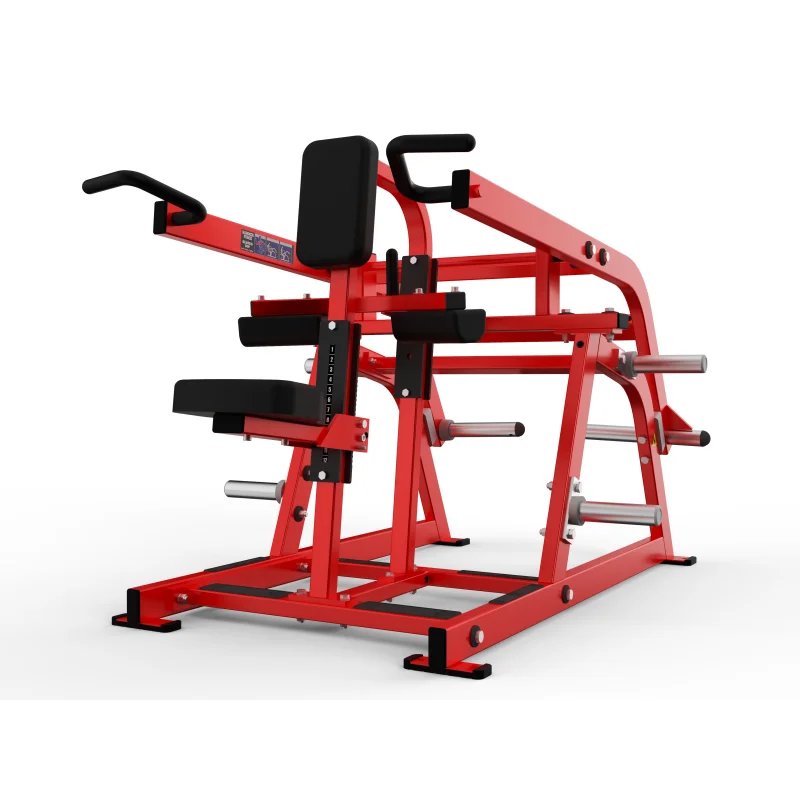
ISO-Lateral Convergence — Independent arm mechanics match natural pressing arcs under continuous commercial loading cycles.
Technical Specifications
| Parameter | Value |
|---|---|
| Designation | 5019 |
| Product Type | Plate-Loaded ISO-Lateral Chest Press |
| Exercise Part | Chest |
| Material | Steel |
| Product Dimensions | 1343×1981×1761 mm |
| Net Weight | 141 kg |
| Max User Weight | Not specified in source — verify against manufacturer catalog |
| Age Group | Adult |
| Gender | Unisex |
| Resistance Type | Plate-Loaded |
| Certification | ISO 9001, CE |
| OEM/ODM | Available |
| HS Code | 9506911900 |
| Production Capacity | 500 PCS/Month |
| Transport Package | Plywood Case |
Application Suitability
| Deployment Scenario | Typical Use |
|---|---|
| International chain gym strength zones | High-frequency chest training across peak and off-peak member traffic |
| Corporate wellness fitness rooms | Compact plate-loaded pressing for employee strength programs |
| Community fitness center strength areas | Durable chest loading for diverse adult membership bases |
| Professional sports training centers | Athlete-grade independent arm loading for sport-specific programming |
| Hotel fitness centers with dedicated strength rooms | Low-maintenance pressing station for guest use without cable-stack service calls |
Why Plate-Loaded ISO-Lateral Architecture Matters in Commercial Strength Floors
Independent converging arms eliminate the fixed-bar compromise that drives shoulder complaints in high-volume facilities.
When a chain gym specifies a fixed-bar chest press for its strength zone, members with different arm lengths and shoulder mobility end up forcing their joints through a path the machine dictates rather than one their anatomy allows. Over weeks of high-frequency use, that mismatch surfaces as member complaints and eventual attrition [NEED_CITE: member retention correlation with biomechanically appropriate strength equipment]. Plate-loaded ISO-lateral machines remove that fixed path entirely. Each arm tracks independently, converging naturally as the user extends — the same movement pattern a free-weight bench press demands but with the load stability that commercial environments require.
This plate-loaded ISO-lateral chest press commercial gym operators deploy sits at the intersection of progressive overload capacity and biomechanical tolerance, and that positioning is what separates equipment that earns its floor space from units that quietly gather dust.
Independent Arm Tracking for Variable Strength Floors
This plate-loaded ISO-lateral chest press covers horizontal pressing across beginner to advanced load ranges, limited only by the plates loaded onto the horns. In a strength zone layout, it complements pin-loaded fly machines and cable crossover stations by handling the heavy compound pressing role without occupying the footprint a full bench-and-rack setup requires. The ISO-lateral convergence suits deployment against perimeter walls where member flow needs clear sightlines across the floor, and the 1343×1981 mm footprint fits standard commercial spacing grids. The reinforced steel frame accommodates users across a broad body-weight spectrum, though the exact maximum user weight requires confirmation against the manufacturer catalog before specification sheets go to procurement.
Continuous Load Cycles and Facility Environment Demands
A commercial strength zone in a chain gym or community fitness center runs plate-loaded stations through hundreds of sets per day across peak hours. Sealed pivot bearings on this unit handle that repetitive load cycling while resisting dust and sweat intrusion common in unclimatized strength areas [NEED_CITE: sealed bearing specifications for commercial strength equipment pivot points]. The steel frame construction and 141 kg net weight provide the mass needed to resist lateral shift during heavy unilateral loading — a stability concern when members load one horn significantly heavier than the other during single-arm pressing work. Floor anchoring points should be verified against the installation guide, and rubber matting beneath the unit protects both the frame base and the facility floor from plate-drop impact during loading and unloading.
Frame Geometry and Pivot Engineering
The ISO-lateral independent arm design relies on converging pivot geometry: as each handle moves forward through the pressing arc, the arms draw inward toward a shared convergence point in front of the user’s sternum. This replicates the natural adduction that occurs during a dumbbell press, reducing shoulder shear compared to machines that lock both hands into a fixed horizontal bar path. The 1761 mm frame height accommodates the full range of handle travel without overhead obstruction, important when ceiling clearance in converted commercial spaces runs lower than purpose-built gym architecture. Steel gauge and weld specifications at the pivot junctions determine long-term rigidity — deflection under load is the primary indicator of frame quality in plate-loaded equipment and the parameter facility operators should verify during on-site evaluation.
What Specification Shortcuts Cost on the Strength Floor
Facility operators who select chest presses based primarily on unit cost without verifying pivot bearing seals or frame weld documentation frequently encounter premature play in the arm joints [NEED_CITE: pivot wear patterns in high-frequency commercial strength deployments]. Once a pivot develops lateral play, the converging arc degrades into an unpredictable wobble that members notice immediately — and that notice translates directly into equipment avoidance. Lighter-gauge frames that flex under heavy bilateral loading create a secondary problem: the noise generated by frame resonance in a multi-station strength zone contributes to the overall acoustic environment and drives member perception of equipment quality. Units deployed in hotel or residential-adjacent fitness rooms face additional scrutiny, where structural vibration transmits through flooring into occupied spaces below.
Why This Product Line Fits Commercial Specification
The 5019 operates within a product ecosystem built for 10,000-hour durability testing protocols, applied here to sealed pivot bearings and reinforced steel welds rather than motors and drive systems. The 1343×1981 mm footprint integrates directly into 3D strength-zone layout planning that covers equipment spacing, plate storage logistics, and member flow patterns across the entire floor. OEM and ODM customization extends to pad color, frame finish, and branded shrouds, letting facility operators match the chest press to existing equipment aesthetics or corporate identity requirements. ISO 9001 and CE certification underpin the manufacturing process, and the 500-unit monthly production capacity supports multi-site rollout schedules for chain operators without extended lead times.
Documentation & Test Records
- CE declaration of conformity covering structural and mechanical safety requirements
- EN 957 test report validating static and dynamic load performance
- ISO 9001 certificate for quality management across manufacturing
- Noise level test record documenting acoustic output under loaded operation
- Durability test record for pivot bearings and frame weld fatigue life
- Installation and commissioning guide with spare parts list
Installation, Commissioning & Maintenance
- Confirm 1343×1981 mm footprint clearance with minimum 600 mm perimeter access for plate loading
- Level the steel frame on rubber matting to isolate vibration from adjacent floor zones
- Inspect all pivot bearing seals upon delivery and verify smooth arm convergence through full travel
- Establish monthly pivot lubrication schedule per maintenance documentation for high-frequency environments
- Check plate horn retention collars weekly to prevent plate dislodgement during heavy sets
- Wipe down upholstery and frame contact points daily to prevent sweat-induced corrosion on steel surfaces
Procurement Specifications and Facility Matching
Share your strength-zone square footage and target equipment count to receive a 3D layout covering plate storage, member flow, and equipment sightlines. Specify expected daily use volume so pivot bearing duty-cycle requirements can be confirmed against your facility’s traffic pattern. Identify the deployment floor and adjacent occupied spaces to determine whether additional vibration isolation measures are necessary beneath the unit. Indicate whether OEM customization for pad upholstery, frame color, or branded shrouds is required for your rollout.
Frequently Asked Questions
Q: How does ISO-lateral convergence differ from a fixed-cam chest press in commercial programming?
A: ISO-lateral arms track independently, converging naturally through the pressing arc to match individual biomechanics. Fixed-cam machines lock both handles into one predetermined path, forcing all users through the same geometry regardless of shoulder width or arm length. For facilities serving diverse membership populations, ISO-lateral designs reduce joint discomfort complaints and support broader exercise variation across programming cycles.
Q: What maintenance advantages does plate-loaded offer over pin-select stack machines?
A: Plate-loaded units eliminate cable, pulley, and weight-stack guide rod wear entirely — the components that generate the majority of service calls on pin-select equipment. Pivot bearings and frame welds become the primary maintenance focus, and sealed bearings on commercial-grade units resist sweat and dust intrusion. This reduces both scheduled service frequency and unplanned downtime during peak operating hours.
Q: What frame specifications should operators verify before committing to a plate-loaded chest press?
A: Steel gauge at pivot junctions, weld penetration documentation, and load-rating test records should all be available from the manufacturer. Frame deflection under maximum rated load indicates structural adequacy. Operators should also confirm pivot bearing seal type — open bearings in commercial environments develop lateral play rapidly and compromise the converging arm geometry that defines ISO-lateral performance.
Q: How should strength-zone layout account for plate-loaded equipment spacing?
A: Plate-loaded stations require additional lateral clearance for plate storage racks and member movement during loading and unloading, typically exceeding the clearance needed for pin-select machines. The 3D layout process covers these logistics alongside member sightlines and traffic flow patterns, ensuring plate handling does not create congestion points in high-traffic strength areas during peak hours.