
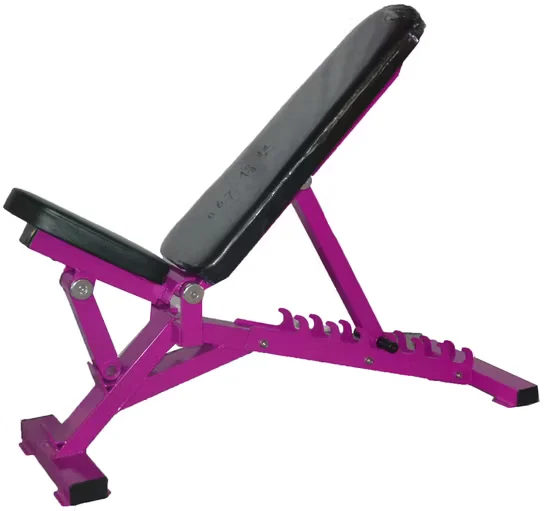
Structural Rigor — All-steel frame engineered for repeated incline, flat, and decline adjustments under continuous commercial gym loading.
Technical Specifications
| Parameter | Value |
|---|---|
| Designation | H067 |
| Product Name | Adjustable Bench Incline / Flat / Decline |
| Type | Integrated Gym Trainer |
| Exercise Part | Chest |
| Material | Steel |
| Net Weight | 38 kg |
| Dimensions | 1673 × 706 × 1390 mm |
| Main Frame Color | Customizable per buyer requirements |
| Cushion Color | Customizable per buyer requirements |
| Age Group | Adult |
| Gender | Unisex |
| Certification | ISO 9001, CE |
| OEM/ODM | Acceptable |
| Production Capacity | 1,000 units/month |
| HS Code | 9506911900 |
Application Suitability
| Deployment Scenario | Typical Use |
|---|---|
| Chain gym strength zone | Bench press, dumbbell fly, seated shoulder press across incline, flat, and decline angles |
| Corporate wellness center | Multi-user adjustable bench for general strength training and rehabilitation support |
| Community fitness center | Durable chest and upper-body training station for adult members of varying fitness levels |
| Professional sports training facility | Structured hypertrophy and strength cycles requiring precise angle adjustments |
| Hotel fitness room | Compact strength station alongside free-weight racks for 24-hour guest access |
Why Wobbly Backrests Drive Members to Competing Gyms
A bench that shifts mid-set signals poor equipment management before the member ever voices a complaint.
Loose adjustment pins, compressed cushion foam, and frame resonance during heavy presses are not cosmetic issues. They accumulate into negative impressions that members struggle to articulate but act on — switching gyms, skipping free-weight zones, or canceling personal training sessions that depend on stable incline surfaces [NEED_CITE: member retention correlation with strength equipment condition]. When a commercial adjustable bench incline flat decline strength equipment unit fails to lock securely, the vibration travels through the frame and into the floor, compounding noise across adjacent equipment zones. Facility operators who audit their strength areas quarterly often discover that the most replaced items are not the obvious wear parts but the adjustment mechanisms that silently degrade under daily commercial loads.
Positioning Within the Free-Weight Training Zone
This adjustable bench covers the full incline, flat, and decline range required for structured chest, shoulder, and dumbbell training programs. It pairs directly with squat racks, dumbbell stations, and plate-loaded systems, occupying a fixed footprint that anchors one training position within a multi-station layout. The 1673 × 706 mm base dimension fits standard commercial spacing grids and allows clearance for spotters and plate loading on either side. Designed for adult users in professional gym and club environments, the frame geometry accommodates a broad range of body sizes while maintaining stable ground contact during loaded exercises. As a commercial adjustable bench incline flat decline strength equipment station, it serves as the primary upper-body training platform in any free-weight zone.
Load Cycles and Floor-Level Deployment Considerations
A busy gym sees the same bench adjusted dozens of times daily by different users, each applying lateral torque during position changes and vertical compression during loaded sets. The all-steel frame and welded joint construction address this repetitive stress pattern, maintaining alignment over extended deployment [NEED_CITE: EN 957 static load testing requirements for adjustable benches]. Unlike cardio machines that require dedicated circuits and ventilation, this bench is self-contained — but floor leveling still matters. Uneven surfaces transfer asymmetric loads through the frame, accelerating wear on the adjustment pins and reducing contact stability. Rubber matting beneath the base dampens vibration transmission to adjacent stations and protects finished floors from scuff marks during repositioning.
Frame Geometry and Material Behavior Under Load
The H067 bench uses a tubular steel frame with reinforced weld points at the primary stress junctions — the hinge where the backrest meets the seat, and the base uprights that bear vertical compression. Tubular steel offers a favorable strength-to-weight ratio for commercial adjustable bench incline flat decline strength equipment, resisting deformation under static loads while keeping the unit movable for floor cleaning and layout changes. The multi-position adjustment mechanism allows discrete angle stops for incline, flat, and decline configurations, relying on mechanical locking rather than continuous friction to hold position. Cushion density and upholstery thickness determine both user comfort and long-term foam recovery — low-density fill compresses permanently within months of heavy commercial use, exposing the steel frame beneath and creating pressure points that members associate with inferior equipment.
The Unseen Cost of Under-Specified Benches
Benches sourced without verifying frame gauge, weld penetration depth, or cushion foam density often appear identical in catalog photos but diverge sharply after six months of commercial use. Adjustment pins bend under repeated lateral loading, causing the backrest to drift from the selected angle during sets. Cushion surfaces crack and delaminate, exposing foam that absorbs sweat and deteriorates rapidly in humid gym environments [NEED_CITE: commercial upholstery durability standards for gym equipment]. When an entire row of benches reaches this condition simultaneously, operators face bulk replacement costs and member complaints that trace directly back to procurement specifications that focused on price rather than structural duty cycle.
What This Product Line Delivers to Your Facility
Every unit undergoes frame and weld inspection before leaving the production line, ensuring structural consistency across volume orders. The adjustable mechanism is cycle-tested to verify positive locking at each position under repeated commercial adjustment patterns. OEM customization covers frame color and cushion color, allowing facilities to match brand palettes without minimum order complications that block smaller projects. The complete six-series cardio family complements this strength station, enabling single-source procurement for entire facility fit-outs. Free 3D layout planning accounts for bench spacing, sightlines, and member flow within the free-weight zone, and the 24/7 technical support line covers parts identification and replacement guidance long after commissioning.
Documentation & Test Records
- ISO 9001 quality management certificate for manufacturing process verification
- CE declaration of conformity for European market regulatory compliance
- EN 957 test report covering static and dynamic load performance of the frame
- Durability test record documenting adjustment mechanism cycle count results
- OEM specification sheet listing available frame and cushion color options
- Spare parts list with exploded assembly diagram for maintenance reference
Installation, Commissioning & Maintenance
- Position on level ground with minimum 600 mm clearance on all sides for user access and spotter movement
- Install on rubber flooring or anti-vibration mat to protect subfloor and dampen frame-transmitted noise
- Inspect all adjustment pin engagement points after first week of operation and re-torque fasteners as needed
- Wipe down cushion surfaces daily with pH-neutral cleaner to prevent sweat-driven upholstery degradation
- Check weld joints and frame connections quarterly during routine facility maintenance cycles
- Rotate bench position within the strength zone semi-annually to equalize floor wear patterns
Request a Layout and Equipment Matching Plan
Share your strength zone square footage and planned equipment list to receive a 3D layout showing bench placement relative to racks, dumbbell stations, and member circulation paths. Specify your expected daily user volume so the adjustment mechanism duty cycle can be matched to operational intensity. Confirm your target market voltage if any adjacent powered equipment shares the same procurement batch, and indicate whether frame or cushion color customization is required to align with your facility brand standards.
Frequently Asked Questions
Q: How does a commercial adjustable bench differ structurally from a home-use model?
A: Commercial benches use heavier-gauge steel tubing, reinforced weld penetration at stress junctions, and higher-density cushion foam rated for dozens of daily users. Home models optimize cost for occasional use and often feature thinner frame walls and adjustment mechanisms that loosen under repeated commercial loading cycles.
Q: What locking mechanism does this bench use for angle adjustments?
A: The H067 uses a mechanical pin-lock system that engages positive stops at each incline, flat, and decline position. This approach avoids the gradual slippage associated with friction-based mechanisms and provides tactile confirmation that the backrest is fully secured before loading begins.
Q: How does cushion foam density affect long-term usability?
A: Higher-density foam resists permanent compression under repeated body-weight loading, maintaining even support across the seat and backrest surfaces. Low-density foam compresses within months, creating hard spots where users feel the underlying steel frame, leading to discomfort and accelerated upholstery wear.
Q: What is the minimum order for custom frame and cushion colors?
A: OEM customization for frame and cushion color is available with flexible minimum order quantities depending on the specific color selection. Contact the sales team with your target colors and unit count to confirm production feasibility and lead time for your project.
Q: How should bench spacing be planned relative to dumbbell racks and squat stations?
A: Allow a minimum of 1.2 meters between bench edges and adjacent equipment to accommodate spotters, dumbbell carry paths, and plate loading movements. A 3D layout plan accounts for these clearances along with member flow during peak occupancy periods.
![V-Squat Machine Hip and Glute Gym Equipment for Commercial Use [WARN] draft identifier mismatch](https://bicksport.com/wp-content/uploads/2026/08/v-squat-machine-hip-and-glute-gym-equipment-for-commercial-use-warn-draft-identifier-mismatch-0fdabd.webp)

![Commercial ISO Lateral Leg Press Machine Hammer Strength [WARN] draft identifier mismatch](https://bicksport.com/wp-content/uploads/2026/08/commercial-iso-lateral-leg-press-machine-hammer-strength-warn-draft-identifier-mismatch-a50c6d.webp)