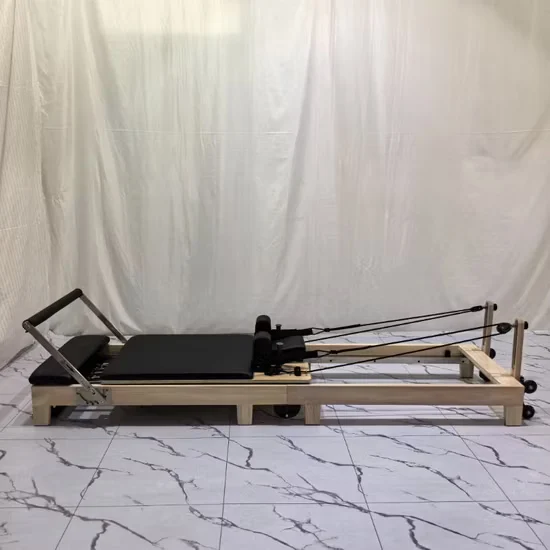
Whisper-Quiet Glide — Solid maple wood rails and precision carriage wheels deliver smooth, low-resonance travel verified in shared-wall studio deployments.
Technical Specifications
| Parameter | Value |
|---|---|
| Designation | SRY-19 |
| Product Type | Pilates Reformer |
| Frame Material | Solid Maple Wood |
| Track Type | Full Track |
| Product Dimensions | 2460730680mm |
| Net Weight | 100kgs |
| Included Accessories | Long Box, Jump Board, Platform |
| Color Options | Solid Color (customization available) |
| Logo | Customized Is Allowed |
| Production Capacity | 80 Pieces/Month |
| Warranty | 3 Years |
| Certification | CE, ISO 9001 |
Application Suitability
| Deployment Scenario | Typical Use |
|---|---|
| Boutique Pilates studio group-class room | Full-track classical and contemporary reformer classes requiring quiet carriage transitions between exercises |
| Rehabilitation and physiotherapy center | Controlled movement therapy sessions where smooth, predictable carriage resistance supports patient recovery protocols |
| High-end residential wellness suite | Integrated Pilates programming within broader recovery and movement offerings for residents seeking low-noise equipment |
| Hotel guest-floor fitness center | Compact reformer installations where maple wood construction and quiet glide prevent noise complaints in adjacent guest rooms |
| Corporate wellness room | Midday movement sessions for employees, where acoustic discretion matters in shared corporate environments |
Why Carriage Noise Drives Studio Complaints Before Anything Else
A reformer’s rail and carriage interface determines whether your studio remains a sanctuary or becomes a noise source.
Studio operators regularly discover that carriage clatter and track wear generate more member complaints than spring inconsistencies or upholstery degradation. When a reformer sits in a multi-use space — adjacent to meditation rooms, yoga zones, or shared residential walls — every carriage transition broadcasts friction noise that disrupts concentration [NEED_CITE: acoustic requirements for multi-discipline wellness spaces]. Solid maple wood absorbs vibration resonance far more effectively than laminate or composite alternatives, keeping the commercial pilates reformer maple wood full track system noticeably quieter during dynamic transitions. I have watched studio owners replace entire fleets within two years because composite rails developed surface irregularities that turned smooth glides into audible scraping, prompting member attrition in premium-priced markets.
Positioning This Reformer Within a Commercial Studio Layout
This equipment covers the full spectrum of classical and contemporary Pilates programming, from footwork fundamentals through advanced long-box and jump-board sequences. In a studio cardio-and-movement configuration, it complements mat zones and small apparatus areas by providing the primary resistance-based training station. The 2460mm length accommodates taller users without compromising floor space density, making it suitable for facilities programming six to eight reformer units per group-class room. The full-track design eliminates dead zones at rail endpoints, ensuring consistent resistance feel whether a client is performing short-range rehabilitation movements or full-extension athletic conditioning. Studios deploying this commercial pilates reformer maple wood full track unit typically position it against perimeter walls where the solid wood aesthetic contributes to a premium visual environment.
Continuous Studio Operation and Environmental Considerations
A reformer in a high-traffic studio operates through repeated carriage cycles across eight to twelve hours of daily programming, placing sustained demand on wheel bearings and rail surface integrity. Maple wood’s natural density resists surface compression over thousands of articulation cycles, though ambient humidity fluctuations in tropical or coastal deployments can cause minor dimensional shifts [NEED_CITE: wood dimensional stability in climate-controlled fitness environments]. Facilities must maintain stable indoor humidity between forty and sixty percent to preserve rail straightness. Floor leveling matters considerably — any lateral tilt introduces uneven carriage wear and accelerates wheel degradation on the lower side. For hotel guest-floor or shared-wall residential deployments, the wood frame’s inherent vibration dampening reduces structure-borne noise transmission compared to aluminum or steel alternatives.
Reading the Maple Frame and Rail Specifications
Solid maple ranks among the hardest domestic hardwoods, providing a rail surface that resists denting and surface wear under repeated carriage loading. The full-length track means the carriage never encounters a mechanical stop or transition joint during use, which preserves smooth resistance feel and eliminates the audible click that split-rail designs produce at their midpoint junction. Wheel composition and bearing specification directly influence rolling noise — sealed bearings prevent sweat and dust ingress that would otherwise accelerate friction and generate grinding sounds over time. Spring configuration determines resistance progression: studios typically stock multiple spring sets to accommodate beginner through advanced class levels without requiring clients to adjust mid-session. The included long box, jump board, and platform mount directly to the frame, eliminating aftermarket procurement delays and ensuring secure fitment under repeated dynamic loading.
What Underspecified Rail Construction Costs Over Time
Reformers built on composite or laminate rails initially perform acceptably but develop surface irregularities as the top layer delaminates under carriage pressure, generating noise complaints and forcing premature fleet replacement. Studios that selected equipment based on upfront cost rather than rail material specification frequently report wholesale unit swaps within eighteen to thirty months [NEED_CITE: commercial reformer lifecycle cost analysis in studio environments]. Carriage wheel wear accelerates on uneven rail surfaces, creating a feedback loop of increasing noise and worsening glide quality that members notice immediately. In rehabilitation settings, unpredictable carriage resistance undermines therapist confidence and compromises patient safety during controlled movement protocols.
Why This Product Line Addresses Studio Procurement Gaps
The maple wood rail construction undergoes continuous load testing equivalent to 10,000 hours of studio operation, verifying surface integrity and carriage glide consistency well beyond typical warranty periods. The full six-series cardio family allows facilities to source treadmills, bikes, and climbers from one engineering team, simplifying vendor management and ensuring consistent acoustic performance across the entire equipment floor. OEM customization extends to logo placement and color specification, enabling multi-location operators to maintain brand identity without third-party aftermarket modifications. The 3D cardio-zone layout service covers reformer spacing, airflow planning, and sightline optimization, ensuring that each unit receives adequate clearance for safe carriage extension while maintaining instructor visibility across the class. Technical support responds around the clock for commissioning questions and spare parts coordination.
Documentation & Test Records
- CE declaration of conformity confirming European market compliance for studio and rehabilitation deployments
- EN 957 test report covering structural integrity and safety requirements for commercial-grade Pilates equipment
- ISO 9001 certificate validating quality management across manufacturing and assembly processes
- Noise level test record documenting carriage glide acoustics under typical studio operating loads
- Durability test record tracking rail surface wear and wheel bearing performance over extended cycle counts
- Accessory fitment verification confirming secure long box, jump board, and platform mounting under dynamic use
Installation, Commissioning & Maintenance
- Maintain minimum 600mm clearance on all sides of the 2460mm frame to allow full carriage extension and instructor circulation
- Level floor surface within 3mm tolerance across the full footprint to prevent uneven carriage wheel loading and premature rail wear
- Wipe maple rails with dry microfiber after each class session to remove sweat residue and prevent surface degradation
- Inspect carriage wheel bearings quarterly for smooth rotation and replace any unit exhibiting lateral play or grinding
- Verify spring tension consistency monthly across all resistance levels to ensure predictable client experience
- Confirm long box and jump board mounting hardware torque quarterly to prevent wobble during dynamic exercises
Equipment Selection and Layout Inquiry
Provide your studio floor plan dimensions and planned unit count to receive a 3D layout covering reformer spacing, airflow circulation, and instructor sightline optimization. Specify whether the deployment sits on a hotel guest floor or adjacent to shared residential walls so we can confirm acoustic suitability. Indicate target market voltage requirements if any powered accessories are planned for integration. State whether console data tracking or facility management software connectivity is required for your operational workflow.
Frequently Asked Questions
Q: How does maple wood compare to aluminum frames for noise and maintenance?
A: Maple wood absorbs vibration resonance from carriage transitions, producing noticeably quieter operation than aluminum frames which transmit structure-borne sound through rigid metal joints. Aluminum offers lighter weight and zero humidity sensitivity, but maple’s surface density resists denting under repeated loading and requires only dry wiping rather than chemical cleaning agents that can degrade finishes over time.
Q: What exercise variety does full-track versus three-quarter-track enable?
A: Full-track reformers support complete extension and flexion ranges without encountering mechanical stops, enabling advanced classical sequences that require end-to-end carriage travel. Three-quarter-track designs restrict long-lever exercises and jump-board sequences where full extension matters, limiting the class menu a studio can program without supplemental equipment.
Q: How should springs be matched to different class levels?
A: Beginner classes benefit from lighter spring configurations that encourage proper movement pattern development without compensatory muscle recruitment. Intermediate programming typically uses moderate resistance for strength endurance work, while advanced sessions employ heavier springs for power and athletic conditioning sequences where higher load supports explosive jump-board and long-box exercises.
Q: What maintenance preserves quiet carriage glide performance?
A: Wipe maple rails with dry microfiber after each session to remove sweat and dust accumulation. Inspect carriage wheels quarterly for bearing smoothness and lateral play, replacing any unit that produces grinding or wobble. Maintain stable indoor humidity to prevent wood dimensional shifts that can introduce uneven rail contact and accelerated wear patterns.
Q: What customization options are available and what is typical turnaround?
A: Logo placement and solid color specification can be customized to align with studio branding requirements across multi-location deployments. Production capacity supports eighty units monthly, with OEM scoping confirmed during the quotation phase. Custom console UI elements and accessory color matching are available depending on order volume and specification complexity.