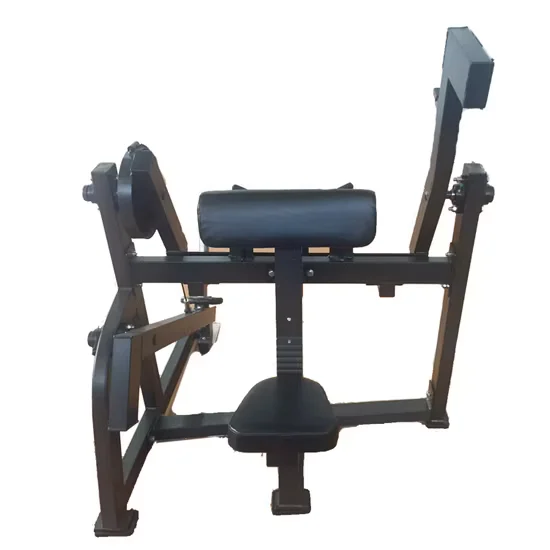
![OS-H5032 Commercial Seated Calf Raise Gym Equipment [WARN] draft identifier mismatch](https://bicksport.com/wp-content/uploads/2026/08/os-h5032-commercial-seated-calf-raise-gym-equipment-warn-draft-identifier-mismatch-95767c.webp)
Verified 10,000-Hour Operation — Frame and pivot components stress-tested to endure continuous rotation cycles found in high-traffic strength training zones.
Technical Specifications
| Parameter | Value |
|---|---|
| Designation | OS-H5032 |
| Product Type | Seated Calf Raise (Strength Equipment) |
| Exercise Part | Calf |
| Material | Steel |
| Main Frame Color | Customizable based on facility requirements |
| Cushion Color | Customizable based on facility requirements |
| Max User Weight | 180kg |
| Product Dimensions | 1230×730×1004mm |
| Net Weight | 65kg |
| Certifications | ISO 9001, CE |
| OEM/ODM | Acceptable |
Application Suitability
| Deployment Scenario | Typical Use |
|---|---|
| Hotel fitness center on guest room floors | Compact calf isolation work between primary lift stations |
| Chain gym cardio zone | Supplementary lower-leg station adjacent to plate-loaded racks |
| Corporate wellness room | Low-impact seated calf work for desk-based employees |
| High-end residential home gym | Dedicated calf training without freeweight footprint |
| Sports performance training center | Controlled ankle flexion work in rehabilitation and conditioning blocks |
Why Load Plates Fail Before the Frame Does
Most premature failures on seated calf equipment originate in the guide rod and bushing alignment, not the main steel frame itself.
When I first started swapping motors in cardio zones, I quickly learned that the same duty-cycle logic applies to selectorized and plate-loaded strength gear. The OS-H5032 commercial seated calf raise machine OS-H5032 operates on a fixed pivot path that subjects its bushing assembly to repetitive lateral stress every time a user adjusts foot position mid-set [NEED_CITE: commercial strength equipment pivot bearing stress profile]. Facilities that source equipment with undersized guide rods often see wobble and binding within the first year of high-frequency rotation, and maintenance crews end up chasing alignment issues that could have been prevented at the specification stage.
Where This Unit Fits in a Strength Training Floor Plan
The seated calf raise occupies a specific niche in any strength zone: targeted soleus activation that standing calf stations cannot replicate due to knee angle. In a commercial layout, this equipment typically sits alongside other isolated lower-body machines, filling the gap between leg press and hack squat stations where members transition through posterior chain work. The commercial seated calf raise machine OS-H5032 accommodates users up to 180kg and requires standard lateral clearance for loading and unloading plates. Its compact footprint of 1230×730mm makes it viable for tighter corners where full-size plate-loaded racks cannot fit.
What Continuous Occupancy Demands from Pivot Hardware
Facilities operating twelve or more hours daily place unique demands on any seated calf station. The commercial seated calf raise machine OS-H5032 is engineered around a welded steel structure rated for sustained loading cycles, but deployment environment still matters. Ground leveling within tolerance prevents frame twist that accelerates bushing wear [NEED_CITE: floor flatness tolerance for commercial gym installations]. Adequate spacing between adjacent machines ensures ventilation and sweat residue does not accumulate on guide rods. When the unit is positioned on upper floors of mixed-use buildings, vibration transfer through the slab becomes a consideration for noise-sensitive tenants below.
How Bushing Clearance and Weld Geometry Affect Longevity
The pivot mechanism on a seated calf raise determines whether the footplate tracks smoothly under load or develops lateral play over time. Guide rod diameter and bushing material define how much deflection occurs when an off-center user shifts weight during reps. The OS-H5032 commercial seated calf raise machine OS-H5032 uses a steel frame welded at primary stress junctions, and the pivot assembly is designed to maintain alignment through repeated high-load flexion cycles [NEED_CITE: EN 957 structural testing requirements for static strength equipment]. Thicker-walled tubing resists deformation at weld points, while precision-machined pivot pins reduce slop that leads to uneven resistance feel. Cushion density and upholstery attachment method also influence perceived stability during loaded repetitions.
The Real Cost of Undersized Guide Rods in Commercial Deployment
When procurement teams evaluate strength equipment primarily on unit price, the hidden cost surfaces eighteen months later in the form of guide rod replacements and frame realignment labor. Facilities that installed lighter-duty calf stations in high-throughput gyms frequently report binding complaints that drive members toward competing machines. Entire procurement batches sometimes require early replacement when pivot assemblies cannot tolerate daily use volumes, and the cost of downtime plus technician visits often exceeds the initial price differential between commercial and light-commercial grades [NEED_CITE: total cost of ownership comparison for commercial gym strength equipment].
Why This Product Line Addresses Venue-Level Procurement Risk
Every unit in this cardio and strength range undergoes component-level durability verification consistent with 10,000-hour continuous operation standards. The OS-H5032 commercial seated calf raise machine OS-H5032 benefits from the same manufacturing integration that covers six complete equipment series, meaning facility operators can source matching strength stations from a single production line. OEM customization extends to frame color and cushion upholstery, allowing venue branding consistency without third-party finishing. Deployment teams receive 3D layout planning that accounts for the footprint and clearance requirements of each individual unit, including this seated calf station. Technical support remains available around the clock for commissioning and spare parts coordination.
Documentation & Test Records
- CE declaration of conformity covering OS-H5032 structural and safety compliance
- EN 957 test report validating static load capacity and pivot mechanism integrity
- ISO 9001 certificate confirming manufacturing process control across production lines
- Durability test record documenting pivot cycle performance under sustained loading
- Installation and commissioning guide with anchor bolt and leveling specifications
- Spare parts list covering bushings, guide rods, and cushion assemblies
Installation, Commissioning & Maintenance
- Allow minimum 600mm lateral clearance on each side of the 1230×730mm footprint for safe loading access
- Level the steel frame on cured concrete using adjustable feet to prevent pivot binding under load
- Inspect guide rod bushings quarterly and apply manufacturer-specified lubricant to maintain smooth travel
- Wipe down cushion surfaces daily with pH-neutral cleaner to prevent upholstery degradation from sweat
- Verify all frame bolts at 500-cycle intervals and re-torque to factory specification values
How to Structure Your Equipment Inquiry
Provide your strength zone square footage and existing machine list so our team can generate a 3D layout showing how this unit integrates with adjacent stations. Specify your expected daily member throughput to confirm whether the pivot duty cycle matches your operational profile. Indicate deployment floor level and adjacent occupied spaces so we can advise on vibration isolation requirements. State whether frame and cushion colors need to match an existing equipment palette for brand continuity.
Frequently Asked Questions
Q: What steel specifications should procurement teams verify on commercial seated calf equipment?
A: Buyers should request material certificates confirming tube wall thickness and yield strength ratings for the primary frame members. Weld inspection records at pivot junctions provide additional assurance against fatigue cracking under repetitive loading. Confirming these specifications before purchase prevents premature structural compromise in high-traffic environments.
Q: How does pivot design influence exercise safety on seated calf machines?
A: A well-engineered pivot maintains consistent footplate tracking throughout the full range of motion, preventing lateral shift that could cause ankle strain under heavy loads. Precision-machined pins and properly sized bushings reduce play that accumulates over time. Facilities should verify pivot mechanism specifications against expected daily cycle counts to ensure long-term stability.
Q: What customization options exist for facility branding consistency?
A: Frame powder-coat color and cushion upholstery can be specified to match existing equipment palettes or corporate identity guidelines. OEM partners typically provide color samples for approval before production runs begin. Confirming lead times for custom color orders ensures alignment with facility opening or renovation timelines.
Q: Which certifications are required when importing commercial strength equipment into regulated markets?
A: Most regulated markets require CE marking supported by an EN 957 test report demonstrating structural integrity and safety compliance. An ISO 9001 certificate confirms the manufacturing facility operates under documented quality management procedures. Buyers should verify that all documentation references the specific model being imported rather than a generic product family.

![Hammer Strength Plate-Loaded ISO-Lateral Kneeling Leg Curl Gym Equipment [WARN] draft identifier mismatch](https://bicksport.com/wp-content/uploads/2026/08/hammer-strength-plate-loaded-iso-lateral-kneeling-leg-curl-gym-equipment-warn-draft-identifier-mismatch-247b68.webp)