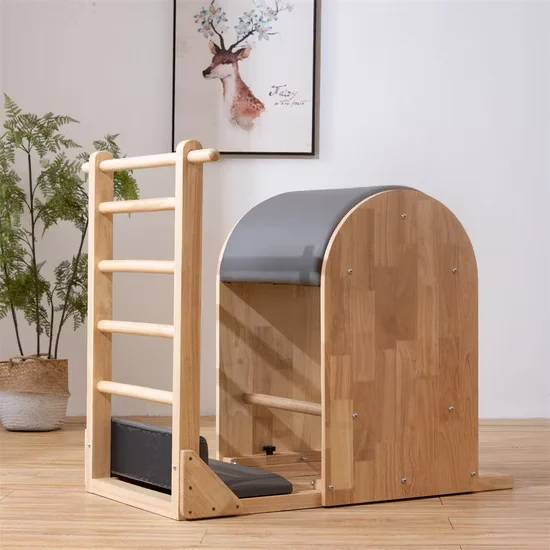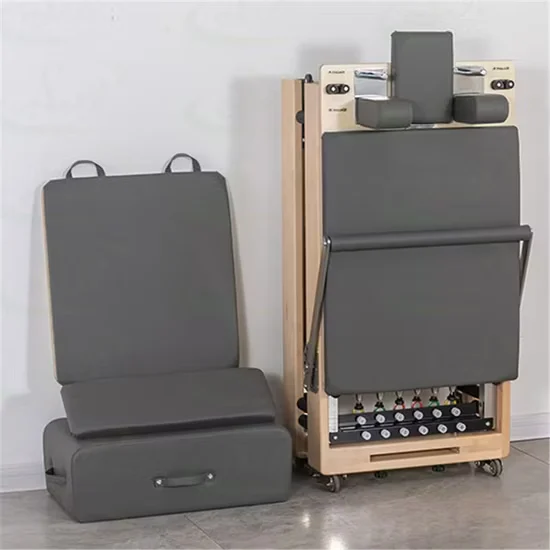
Acoustic-First Construction — Solid oak/maple frame inherently absorbs vibration, eliminating structural noise transmission to adjacent occupied spaces.
Technical Specifications
| Parameter | Value |
|---|---|
| Product Type | Pilates Reformer |
| Designation | SRY-20B |
| Frame Material | Wood (Oak/Maple) |
| Resistance Type | Spring-based |
| Resistance Levels | Adjustable via spring configuration |
| Max User Weight | 100 kg |
| Product Dimensions | 2400 × 600 × 350 mm |
| Net Weight | 100 kg |
| Foldable | Yes |
| Accessories | Long Box, Jump Board, Platform available |
| Color | Solid Color (customizable finishes available) |
| Logo | Customized logo placement allowed |
| Warranty | 3 Years |
| Certification | CE, ISO 9506911900 |
| Standards | ISO 9001 |
Application Suitability
| Deployment Scenario | Typical Use |
|---|---|
| Boutique Pilates studio | Group reformer classes requiring premium wood aesthetics and quiet operation between back-to-back sessions |
| Hotel wellness center on guest room floors | 24-hour guest access where vibration and noise must not transfer through flooring to occupied rooms below |
| High-end residential home gym | Private training environments where equipment noise disrupts adjacent living spaces during early or late sessions |
| Rehabilitation and physical therapy facility | Controlled spring-resistance rehabilitation with smooth progressive loading and low-impact movement paths |
| Corporate wellness room | Multi-purpose fitness spaces where foldable storage allows rapid room conversion between wellness sessions and meetings |
Why Floor-Transmitted Vibration Triggers Complaints Before Equipment Failures Do
A wood-frame reformer transmits a fraction of the vibrational energy that metal frames deliver into structural flooring.
I have seen metal-frame reformers deployed on upper hotel floors generate enough low-frequency vibration during jump board exercises to trigger guest complaints two levels down. The problem is not the equipment malfunctioning — it is the structural coupling between rigid steel and concrete slabs acting as a sounding board. Facility managers receive noise calls before maintenance tickets, and the equipment gets pulled from service while still mechanically sound [NEED_CITE: vibration transmission characteristics of rigid vs. damped frames in multi-story hospitality deployments]. A commercial foldable Pilates reformer wooden oak maple frame addresses this at the material level rather than requiring aftermarket isolation pads.
Positioning Within a Dedicated Pilates and Movement Zone
This reformer covers the full spectrum of classical and contemporary Pilates repertoire, from supine footwork sequences through advanced suspension work. The spring-based resistance system provides smooth progressive loading across multiple tension levels, accommodating beginners learning controlled movement patterns and advanced practitioners demanding high-resistance challenges. In a multi-discipline facility, it pairs with mat-work zones and complements reformer-with-tower configurations for clients requiring vertical resistance vectors. The commercial foldable Pilates reformer wooden oak maple construction suits studios running eight to twelve group classes daily or hotel wellness suites operating around the clock. User weight capacity supports a broad practitioner demographic without requiring heavier-gauge equipment variants.
Continuous Operation and Floor-Level Deployment Requirements
Studios scheduling consecutive classes with minimal turnover time place different demands on equipment than residential users running one session per day. The foldable mechanism must withstand repeated folding cycles in commercial environments where instructors collapse units for mat-work segments and redeploy them multiple times daily [NEED_CITE: foldable hinge durability requirements under commercial deployment cycles]. Deploying on upper hotel floors demands attention to subfloor composition — engineered wood over concrete behaves differently from timber joist construction in transmitting low-frequency vibration. Adequate clearance around each unit, typically matching the equipment footprint on all sides, prevents practitioner interference during group sessions and allows instructor circulation for form correction.
Spring Resistance Mechanics and Frame Damping Characteristics
The spring-based resistance system delivers a progressive load curve that increases with carriage displacement, unlike constant-force mechanisms. This means exercises begin with lighter resistance at the start of range and build intensity through the movement, matching natural muscle force-length relationships. Multiple spring attachment points allow practitioners to fine-tune total resistance and balance bilateral loading. The solid oak and maple frame construction serves a mechanical purpose beyond aesthetics — dense hardwood naturally dampens high-frequency vibration generated by carriage travel along the rails, preventing the resonant buzzing that lightweight metal frames can produce during rapid directional changes. The foldable hinge mechanism must maintain precise alignment under repeated load cycles to prevent carriage tracking drift, which is why hinge material grade and bearing specification matter as much as the primary frame joints.
What Happens When Specifications Are Compromised at Procurement
I once traced a batch of reformer returns to underspecified springs that lost tension consistency after several hundred compression cycles — practitioners reported uneven resistance between left and right sides, and the studio replaced the entire fleet rather than servicing individual units. Foldable mechanisms specified for residential duty cycles develop play at the hinge points when subjected to commercial folding frequency, causing carriage wobble that compromises exercise precision and generates audible clicking [NEED_CITE: foldable mechanism failure modes under commercial vs. residential duty cycles]. Budget-grade upholstery on the carriage and platform surfaces degrades rapidly under sweat exposure and frequent cleaning protocols, forcing premature reupholstery that costs more than the original savings. These failures do not appear in showroom demonstrations — they surface months into deployment when the equipment has accumulated real usage hours.
Why This Product Line Addresses Deployment Realities
The solid hardwood frame was selected specifically because it solves vibration transmission at the material level rather than requiring facility-level mitigation. Spring tension consistency is validated through compression cycle testing to ensure progressive resistance remains uniform across the full carriage travel range. The foldable design reduces the stored footprint substantially, allowing boutique studios to convert reformer rooms into mat-work or movement spaces within minutes. Accessory modularity — Long Box, Jump Board, Platform — means studios expand their class programming without purchasing additional equipment platforms. Customizable logo placement and wood finish options allow the equipment to match existing interior design specifications rather than forcing visual compromise. OEM customization extends to spring tension configurations, so facilities can specify resistance profiles matched to their primary client demographics.
Documentation & Test Records
- CE declaration of conformity covering mechanical safety requirements for fitness equipment
- EN 957 test report validating structural integrity under static and dynamic loading
- ISO 9001 certificate covering manufacturing quality management systems
- Spring tension durability test record documenting compression cycle performance
- Wood frame material certification specifying oak/maple grade and treatment process
- Installation and commissioning guide with foldable mechanism alignment procedures
Installation, Commissioning & Maintenance
- Maintain clearance equal to equipment length on all sides for safe carriage travel and instructor access
- Verify floor levelness before assembly to prevent carriage drift along the 2400 mm rail length
- Inspect spring attachment hooks and tension consistency monthly under commercial class schedules
- Lubricate carriage rail contact surfaces per manufacturer interval to maintain smooth travel
- Clean wood frame surfaces with pH-neutral products to preserve finish under frequent sweat exposure
- Test foldable hinge alignment quarterly to confirm carriage tracking remains centered during operation
Sizing Your Reformer Deployment
Share your studio floor plan with room dimensions and ceiling height to receive a 3D layout showing optimal reformer spacing, instructor circulation paths, and foldable storage zones. Specify whether the deployment floor sits above occupied spaces to confirm vibration isolation requirements. Indicate your target weekly class volume so spring tension specifications can be matched to anticipated compression cycle accumulation. State whether custom wood finish or logo placement is required to align with existing interior design standards.
Frequently Asked Questions
Q: How does a wood frame compare to metal for noise and vibration in studio environments?
A: Solid oak and maple frames naturally absorb high-frequency vibration generated during carriage travel and directional changes, preventing the resonant transmission that rigid metal frames deliver into structural flooring. This material-level damping is particularly relevant for studios on upper floors or adjacent to quiet zones, where vibration complaints often precede mechanical service calls.
Q: What should I verify about the foldable mechanism before committing to a commercial deployment?
A: Confirm that hinge material grade and bearing specifications are rated for commercial folding frequency rather than residential use patterns. Studios that collapse and redeploy reformers multiple times daily accumulate hinge cycles rapidly, and underspecified mechanisms develop play that causes carriage wobble and audible clicking during operation. Request hinge load capacity documentation and cycle test records.
Q: Which accessory configurations suit group class programming versus private training?
A: Group classes benefit from standardized accessory sets — typically the Long Box for seated and supine exercises — ensuring all stations offer identical programming options. Private training environments may add the Jump Board for plyometric sequences and the Platform for standing work. Modular attachment points allow facilities to expand accessory inventory as class programming evolves.
Q: What customization options are available for branding and finish specifications?
A: Logo placement can be positioned on the frame end or carriage surface per facility branding requirements. Wood finish options allow matching existing interior design palettes, and spring tension configurations can be specified to match primary client demographics — lighter progressive curves for rehabilitation-focused studios or higher resistance ranges for athletic conditioning programs.