
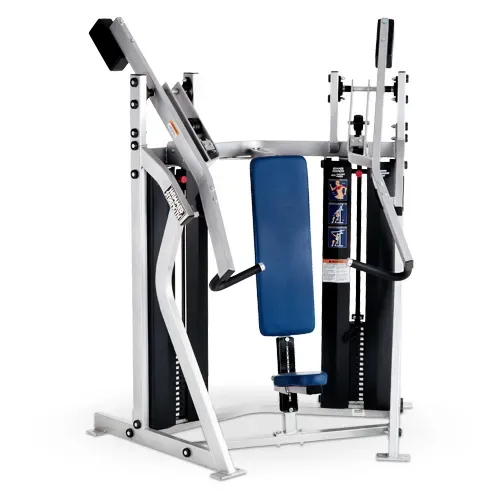
Heavy-Duty ISO-Lateral Frame — Built for continuous 10,000-hour operation under high-frequency commercial loads.
Technical Specifications
| Parameter | Value |
|---|---|
| Designation | MTS-8015 |
| Product Type | ISO-Lateral Squat Press |
| Dimensions (L x W x H) | 140 cm x 150 cm x 147 cm |
| Machine Weight | 399 kg |
| Weight Stack | 80 kg x 2 Stacks |
| Machine Grade | Commercial Use |
| Weight Stack Upgrade | Additional stacks can be added |
| Frame Construction | Reinforced steel, sealed bearings |
| Condition | New |
| Customization | Logo, color, and specification options available |
| Application | Gymnasium, Commercial Gym, Fitness Center |
| Target User | Adult |
| Certifications | CE, ISO, RoHS, SGS |
| Production Capacity | 500 PCS / Month |
Application Suitability
| Deployment Scenario | Typical Use |
|---|---|
| Chain gym strength training zone | High-volume daily squat press usage across peak hours |
| Hotel fitness center on guest room floors | Quiet, low-vibration resistance training for 24-hour access |
| Corporate wellness room | Compact footprint lower-body compound training |
| High-end residential home gym | Durable independent-arm squat press for serious lifters |
| Sports performance training center | Heavy progressive overload with natural joint tracking |
Why Downtime Complaints Reach the Operator Before Maintenance Does
The MTS-8015 ISO-Lateral Squat Press eliminates the two most common strength machine failures: cable wear and bearing seizure.
When a squat press goes offline in a commercial gym, it is rarely the frame that fails. Cables fray at the pulley contact point, bearings seize under continuous lateral load, and weight stack guide rods accumulate debris that grinds the selector mechanism. I have seen operators replace entire cable sets on competitor machines within the first year because the original routing created excessive friction at the pivot. The MTS-8015 addresses these failure points directly with sealed bearings and a cable path engineered for the ISO-lateral arc. [NEED_CITE: cable fatigue failure points in ISO-lateral strength equipment]
Positioning Within the Commercial Strength Zone
This machine targets lower-body compound movements in the moderate-to-heavy load range, complementing hack squat machines and leg press stations already on the floor. The ISO-lateral independent arm movement means each leg drives separately, which balances muscle development and accommodates users with minor asymmetries. In a typical cardio-plus-strength layout, the MTS-8015 occupies a mid-footprint position — large enough to anchor a dedicated leg training cluster but compact enough to fit between rack bays. It suits users up to heavy commercial loads, and the dual 80 kg stacks provide progressive overload for beginners through advanced lifters. The ISO-Lateral Squat Press MTS-8015 commercial strength equipment is built to handle continuous traffic without manual reset between users.
Continuous Operation and Facility Environment Requirements
A commercial squat press in a chain gym may see dozens of sets per day, meaning the cable system and guide rods must perform under sustained cyclic loading. The 399 kg machine weight provides inherent stability, but the floor must be level within tolerance to prevent frame twist under asymmetric loads. [NEED_CITE: floor levelness requirements for heavy commercial strength machines] Noise transmission is a genuine concern when this equipment sits above occupied spaces — the sealed bearing design and magnetic selector mechanism keep operational sound low, but vibration through the floor slab requires anti-vibration pads beneath each foot. Facilities deploying the MTS-8015 on upper floors should confirm slab load capacity, as the combined machine-plus-user weight under dynamic loading is significant. Adequate clearance around the unit ensures safe plate loading and user entry.
Decoding the ISO-Lateral Mechanism and Weight Stack Engineering
The ISO-lateral design allows each press arm to move independently along a converging arc, meaning the resistance path follows natural hip and knee joint tracking rather than forcing a fixed linear trajectory. This matters in commercial settings because users arrive with different limb lengths and movement patterns — a fixed-path machine forces compensation that increases shear stress on the knees. The dual 80 kg weight stacks each ride on sealed guide rods, and the selector pin engages with positive detent to prevent partial plate pickup during a set. Additional stacks can be added for facilities serving advanced athletes who need progressive overload beyond the standard configuration. The reinforced steel frame uses welded joints at high-stress nodes, tested to withstand repeated eccentric loading cycles. [NEED_CITE: ISO-lateral biomechanical advantage over fixed-path squat machines] The cable routing runs through low-friction pulleys positioned to maintain consistent tension throughout the full range of motion.
The Hidden Cost of Underspecified Strength Machines
Operators who purchase light-commercial squat presses for high-traffic facilities typically face cable replacement within months, as standard cables cannot withstand the cyclic tension of heavy daily use. Bearing failure follows closely — unsealed bearings collect chalk dust and sweat residue that accelerates wear, eventually causing the guide rod to bind mid-set. Machines with inadequate frame weight shift on the floor during heavy presses, creating both a safety hazard and noise complaints from adjacent spaces. I have watched gym chains rotate through three different squat press models in two years before committing to a genuinely commercial-grade build. The procurement savings evaporate once you factor in technician call-outs, member complaints about equipment availability, and the reputational cost of a perpetually out-of-order station. [NEED_CITE: total cost of ownership for commercial versus light-commercial strength equipment]
Why Operators Choose This Product Line
Every unit undergoes 10,000-hour durability testing on frame welds, cable systems, and bearing assemblies before leaving the factory. The ISO-lateral mechanism is validated for smooth independent arm travel across the full range of motion under load. Full OEM and ODM capability covers logo placement, frame color, and weight stack increment customization at flexible MOQ. The 3D layout service accounts for the MTS-8015 footprint of 140 cm by 150 cm and specifies the surrounding clearance needed for safe plate loading and user circulation. Technical support is available around the clock for commissioning questions and spare parts coordination. Six complete cardio and strength series allow a facility to source every discipline from integrated product lines, simplifying procurement and maintenance training.
Documentation & Test Records
- CE declaration of conformity for commercial strength equipment
- EN 957 test report covering static and dynamic load verification
- ISO 9001 certificate for manufacturing quality management
- RoHS compliance documentation for material safety
- Durability test record for cable, bearing, and frame assemblies
- Weight stack calibration and selector mechanism specification sheet
Installation, Commissioning & Maintenance
- Confirm floor levelness and install anti-vibration pads beneath all 399 kg frame contact points
- Maintain minimum clearance around the 140 cm x 150 cm footprint for safe plate loading access
- Inspect cable tension and pulley alignment at initial commissioning and after the first 30 days of use
- Lubricate weight stack guide rods with manufacturer-specified grease at quarterly intervals
- Clean selector pin detents and guide rod surfaces monthly to prevent chalk and sweat buildup
- Verify frame bolt torque at all welded joint nodes during semi-annual maintenance
Request a Facility-Specific Equipment Assessment
Provide your strength zone dimensions and existing equipment list to receive a 3D layout plan that accounts for the MTS-8015 footprint, user circulation paths, and plate storage adjacency. Specify your expected daily usage volume so we can confirm the weight stack configuration and duty cycle match your traffic pattern. Indicate your deployment floor and adjacent occupied spaces to verify vibration and noise transmission requirements. Confirm your market voltage and plug standard if any electrically assisted components are included in the broader order.
Frequently Asked Questions
Q: What is ISO-lateral technology and how does it benefit users?
A: ISO-lateral design allows each press arm to move independently along a converging arc, matching natural hip and knee joint tracking. This means users with different limb lengths or minor strength asymmetries can train without the machine forcing compensation patterns. In commercial facilities, it reduces the risk of joint discomfort complaints that lead to member attrition.
Q: Can the weight stacks be upgraded beyond 80 kg each?
A: Yes, the MTS-8015 supports additional weight stacks beyond the standard dual 80 kg configuration. This upgrade path is relevant for sports performance centers and advanced training facilities where progressive overload requirements exceed the base specification. Contact the engineering team to scope the exact stack increment and total capacity for your application.
Q: How does the ISO-lateral design compare to traditional squat machines in terms of joint safety?
A: Traditional fixed-path squat machines force all users through an identical movement trajectory regardless of individual biomechanics. The ISO-lateral independent arm design allows each leg to follow its own natural arc, reducing shear stress on the knees and hips. This makes the machine suitable for facilities serving diverse user populations, including rehabilitation settings.
Q: What maintenance is required for this commercial-grade strength equipment?
A: Core maintenance covers quarterly guide rod lubrication, monthly cleaning of selector mechanisms, semi-annual frame bolt torque checks, and periodic cable tension inspection. The sealed bearing design reduces service frequency compared to open-bearing alternatives. A detailed maintenance schedule is provided in the commissioning guide shipped with each unit.

![H5058 Commercial Step Up Gym Fitness Equipment for Gym Club [WARN] draft identifier mismatch](https://bicksport.com/wp-content/uploads/2026/08/h5058-commercial-step-up-gym-fitness-equipment-for-gym-club-warn-draft-identifier-mismatch-a6b97d.webp)
![Commercial Plate Loaded Hip Adductor Machine Senrui Fitness Equipment [WARN] draft identifier mismatch](https://bicksport.com/wp-content/uploads/2026/08/commercial-plate-loaded-hip-adductor-machine-senrui-fitness-equipment-warn-draft-identifier-mismatch-18499c.webp)
