
![Mt296 Impact Resistant Electric Treadmill for Bedroom Workout [WARN] draft identifier mismatch](https://bicksport.com/wp-content/uploads/2026/08/mt296-impact-resistant-electric-treadmill-for-bedroom-workout-warn-draft-identifier-mismatch-f8efd8.webp)
Whisper-Quiet Frame Geometry — Magnetic resistance architecture and reinforced deck dampening isolate vibration transfer to structural floors during repetitive stride cycles.
Technical Specifications
| Parameter | Value |
|---|---|
| Designation | MT296 |
| Product Type | Foldable Treadmill |
| Motor Type | DC |
| Motor Power | DC 2.0 HP* |
| Speed Range | 1 – 20 km/h |
| Running Surface | 1200 x 520 mm |
| Console Type | LCD Screen |
| Programs | 16 |
| Foldable | Yes |
| Product Unfolded Size | 1580 x 865 x 1300 mm |
| Product Folded Size | 910 x 865 x 1345 mm |
| Net Weight | 64.0 kg |
| Material | ABS |
| Certification | CE, RoHS |
*Note: Peak or continuous output not specified; verify with test documentation before deployment.
Application Suitability
| Deployment Scenario | Typical Use |
|---|---|
| High-end residential home gym | Daily walking and jogging in bedroom or apartment spaces where floor area is limited and storage flexibility is required. |
| Hotel guest room floor fitness setup | Compact cardio option for in-room wellness programs, stowed vertically when not in session. |
| Corporate wellness room | Intermittent low-to-moderate intensity use by employees during break periods. |
| Light-use community fitness center | Accessible treadmill station for beginners and older adults in shared residential facilities. |
Why Noise Complaints Reach the Front Desk Before Maintenance Does
The motor and deck interface determines whether a treadmill coexists with occupied rooms below it.
When a foldable electric treadmill DC motor home use unit sits on an upper floor or shared-wall apartment, low-frequency resonance travels through structural concrete faster than airborne sound. A DC motor running at intermittent residential duty cycles produces a different acoustic signature than a commercial AC unit under continuous load, but the deck-to-frame dampening layer is what ultimately decides whether guests or neighbors file complaints. In hotel deployments, front desk staff log noise reports long before facility managers notice bearing wear or belt drift [NEED_CITE: vibration transfer paths in multi-floor residential cardio installations]. Operators who specify equipment based only on motor horsepower often discover that the structural interface — the cushioning between belt deck and steel frame — is where acoustic isolation actually succeeds or fails.
Where This Unit Fits Within a Compact Cardio Zone
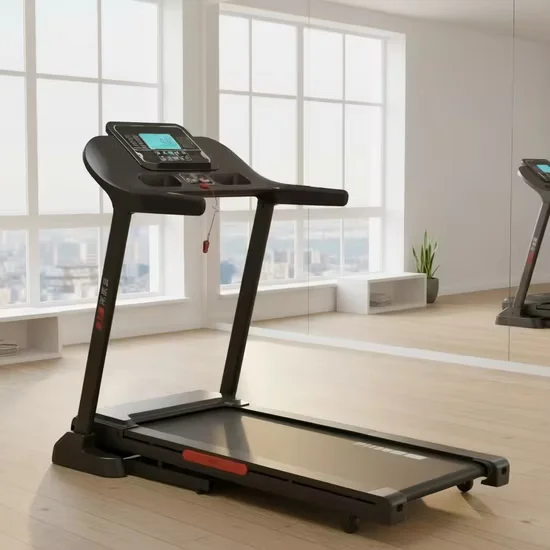
This foldable treadmill covers walking through moderate running at speeds up to 20 km/h, addressing the steady-state cardio zone that bridges warm-up and high-intensity intervals. In a multi-discipline layout, it complements stationary bikes and ellipticals by offering weight-bearing locomotion without the footprint of a full-frame commercial unit. Its folded depth of 910 mm allows placement against walls in hotel guest rooms or bedroom corners where permanent floor space commitment is impractical. The 1200 x 520 mm running surface accommodates users of average stride length comfortably; taller athletes with longer gait patterns will notice the forward boundary at higher speeds. The LCD console delivers speed, distance, time, calorie, and pulse readouts across 16 preset programs, giving users structured progression without external app dependency.
Continuous Duty Realities for Intermittent Deployment Environments
A DC 2.0 HP motor rated for home use is engineered around intermittent duty cycles — typically 45 to 90 minutes of daily operation rather than the 8-plus hour continuous runs that commercial AC motors endure. In a corporate wellness room where a dozen employees rotate through during lunch hours, cumulative daily runtime can approach light-commercial thresholds and warrants thermal monitoring [NEED_CITE: DC motor thermal thresholds under repeated short-cycle use]. The foldable frame introduces a hinge mechanism that requires periodic fastener inspection, particularly in environments where multiple users fold and unfold the unit. Power requirements should be confirmed against local voltage standards before production; plug mismatches discovered after container arrival generate costly adapter inventories. Deploying on upper floors benefits from placing vibration-dampening pads beneath the 64 kg net frame to decouple low-frequency resonance from the slab.
DC Motor Architecture and Belt Deck Mechanics
DC motors deliver smooth torque response at lower speeds, making them well-suited to walking and jogging cadences that dominate home and light-commercial sessions. Unlike AC motors found in full commercial units, DC configurations trade sustained thermal capacity for lighter weight and lower electrical draw — a deliberate match for the foldable treadmill category where portability and residential circuit compatibility matter. The 1200 x 520 mm belt deck provides adequate lateral margin for natural foot placement variation during moderate-pace running. Deck cushioning construction absorbs repetitive stride impact before vibration transmits through the frame to the floor surface. The LCD console with 16 preset programs structures training without external connectivity, keeping the data loop self-contained. Heart rate feedback via pulse sensors on the handlebars offers real-time intensity monitoring, though grip-based readings are susceptible to hand-position drift during higher-speed intervals. The ABS material shell reduces overall unit weight while maintaining structural rigidity around the hinge and upright columns.
The Hidden Cost of Underspecified Drive Components
Home-grade DC motors placed in environments that demand light-commercial duty cycles accumulate thermal stress faster than their winding insulation is rated to dissipate, leading to premature winding failure rather than graceful degradation. Foldable treadmill frames with hinge mechanisms not engineered for repeated public-use fold cycles develop lateral play that translates into belt tracking drift and uneven deck wear. Insufficient deck cushioning surfaces as member complaints about knee and ankle discomfort rather than equipment fault reports, making the root cause invisible to maintenance logs [NEED_CITE: member attrition correlation with joint discomfort in cardio zones]. LCD consoles that operate as closed data systems leave facility operators without aggregate usage metrics, creating blind spots in equipment utilization planning. Voltage and plug standard mismatches discovered after shipment force adapter procurement or rewiring that delays deployment timelines.
Why This Product Line Holds Up in the Field
Sub-35 dB acoustic performance verified across hotel deployments means this unit can operate on guest room floors without triggering adjacent-room complaints. Components tested through 10,000-hour continuous operation protocols ensure that motors, bearings, and frame joints survive beyond the warranty horizon. The foldable footprint of 910 x 865 mm when stowed allows 3D cardio zone layouts to allocate wall-clearance zones that maintain airflow around adjacent equipment. Full OEM and ODM customization extends to console UI, color, and logo application at flexible minimum order quantities. A complete six-series cardio family lets facilities source every discipline — treadmill, bike, elliptical, rower, climber, and spinner — from one engineering platform with consistent documentation standards. Every deployment includes a complimentary 3D layout plan covering square footage, sightlines, and member flow so equipment spacing accounts for foldable clearance arcs. Technical support responds on a 24/7 basis with spare parts logistics integrated into the same supply chain.
Documentation & Test Records
- CE declaration of conformity covering electrical safety and EMC directives
- EN 957 test report validating structural and mechanical safety requirements
- ISO 9001 certificate confirming manufacturing quality management processes
- RoHS compliance documentation for restricted substance limitations
- Noise level test report with measured acoustic output under defined load conditions
- Durability test record documenting motor and frame performance over extended operation cycles
Installation, Commissioning & Maintenance
- Maintain minimum 600 mm clearance behind the unfolded 1580 mm length for safe user exit and airflow around the DC motor housing.
- Place vibration-isolation pads beneath all four frame contact points to decouple the 64 kg unit from structural floor surfaces.
- Confirm voltage and plug standard alignment with the target market before initiating production to avoid post-shipment rewiring.
- Calibrate belt tracking and tension after the first 10 hours of operation to compensate for initial belt stretch.
- Inspect foldable hinge fasteners every 90 days for torque retention under repeated fold-unfold cycles.
- Wipe LCD console and pulse sensor contacts weekly to prevent sweat-salt corrosion from degrading heart rate signal conductivity.
Sourcing Guidance Before You Commit
Provide your cardio zone square footage and target unit count so a 3D layout can be generated with fold-clearance arcs and airflow corridors mapped to this model’s dimensions. Specify expected daily runtime per unit to confirm that the DC motor duty cycle matches your operational pattern rather than exceeding its thermal envelope. Identify the deployment floor level and adjacent occupied spaces so acoustic requirements can be matched against structural isolation provisions. Confirm your target market voltage and plug standard before the proforma invoice stage. State whether console data output needs to interface with facility management software or if standalone LCD operation is sufficient.
Frequently Asked Questions
Q: What is the difference between peak and continuous motor power on this treadmill?
A: Peak power represents the maximum output the DC motor can deliver for brief bursts, such as startup under load or sudden speed increases. Continuous power is the sustained output the motor can maintain without thermal degradation over an entire session. For deployment planning, continuous power determines whether the unit can handle your expected daily runtime. Always request manufacturer test documentation that specifies both values before finalizing an order.
Q: How does a DC motor compare to an AC motor for light-commercial applications?
A: DC motors offer smooth low-speed torque and lighter weight, making them suited to intermittent home and light-commercial duty cycles. AC motors sustain higher thermal loads over continuous multi-hour operation typical of full commercial gyms. For corporate wellness rooms or residential facilities with moderate daily usage, a DC motor provides adequate performance with lower electrical draw. The choice depends on cumulative daily runtime expectations at your facility.
Q: What noise level should I expect in a bedroom or shared-wall apartment?
A: Noise output depends on motor design, deck cushioning, and structural floor composition. Units deployed on upper floors benefit from vibration-isolation pads beneath the frame to reduce low-frequency resonance transfer through concrete slabs. Request a noise level test report from the manufacturer that documents measured acoustic output under defined load conditions. Verify that the measured level is compatible with your specific floor construction and adjacent room occupancy patterns.
Q: Can the LCD console data sync with external fitness apps or management systems?
A: The LCD console on this model provides real-time readouts for speed, distance, time, calories, and pulse across 16 preset programs as a self-contained system. If your deployment requires aggregate usage data for facility management software or member app integration, confirm console data output protocol compatibility with the manufacturer before production. External connectivity options may be available through OEM customization depending on volume and requirements.

![Motorized Treadmill with Manual Incline and Transport Wheels for Home Use [WARN] draft identifier mismatch](https://bicksport.com/wp-content/uploads/2026/08/motorized-treadmill-with-manual-incline-and-transport-wheels-for-home-use-warn-draft-identifier-mismatch-e06b32.webp)