![Mt026m Fold Home Use Motorized Treadmill Endurance Training [WARN] draft identifier mismatch](https://bicksport.com/wp-content/uploads/2026/08/mt026m-fold-home-use-motorized-treadmill-endurance-training-warn-draft-identifier-mismatch-09f112.webp)
DC Drive Quiet Operation — magnetic resistance tuning and cushioned belt layers deliver low-noise output suitable for apartments and shared living spaces.
Technical Specifications
| Parameter | Value |
|---|---|
| Product Type | Foldable Treadmill |
| Motor Type | DC |
| Motor Power | 1.5HP* |
| Speed Range | 1–12 km/h |
| Running Surface | 1200 x 460 mm |
| Console Type | LCD (Speed / Distance / Time / Calories / Pulse) |
| Preset Programs | 12 |
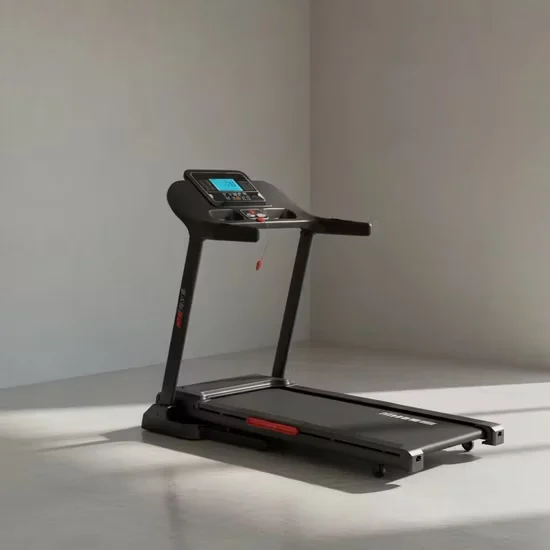
| Product Unfolded Size | 1465 x 750 x 1150 mm |
| Product Folded Size | 1465 x 750 x 390 mm |
| Net Weight | 46.0 kg |
| Foldable | Yes |
| Material | ABS |
| Certification | CE, RoHS |
| OEM/ODM Custom | Yes |
*Peak or continuous duty rating not specified in source — request motor specification sheet for daily use validation.
Application Suitability
| Deployment Scenario | Typical Use |
|---|---|
| High-end residential home gym | Daily walking and light jogging with foldable storage |
| Compact studio apartment fitness corner | Space-saving endurance training with quick-fold capability |
| Corporate wellness room | Employee cardio sessions during breaks with LCD program guidance |
| Boutique wellness studio | Light cardio warm-up stations before group classes |
Why Home Treadmills Fail Before the Warranty Expires
DC motor thermal management determines whether a foldable home treadmill DC motor MT026M survives daily use or burns out in months.
Home users expect commercial-level reliability at a fraction of the cost, yet most residential treadmills ship with DC motors rated for intermittent duty cycles. When a household logs multiple thirty-minute sessions daily, the motor winding temperature climbs beyond safe thresholds, triggering thermal cutoffs or permanent winding damage. The result is a treadmill that runs fine for the first six weeks then develops stuttering belt movement and eventual motor failure [NEED_CITE: motor duty cycle classification for continuous home operation]. Console data quality compounds the problem — LCD panels that display speed and pulse but cannot export workout records leave users without longitudinal training feedback, reducing long-term adherence.
Where the MT026M Fits in a Home Cardio Setup
This foldable motorized treadmill covers walking through light jogging at speeds up to 12 km/h, filling the steady-state endurance slot in a home gym. It pairs naturally with a stationary bike or elliptical for cross-training rotation, giving users low-impact alternatives on recovery days. The 1200 x 460 mm running surface accommodates walking and moderate jogging gaits for most adult users, while the foldable frame collapses to 390 mm height for apartment storage. The foldable home treadmill DC motor MT026M serves users who need structured workout variety through 12 preset programs without dedicating permanent floor space to a single machine.
Daily Run-Time Limits and Room Placement Considerations
A DC motor in this class is designed for personal daily sessions rather than continuous multi-user rotation typical of commercial facilities. Plan for individual sessions of thirty to forty-five minutes with cool-down intervals between consecutive users. The foldable home treadmill DC motor MT026M should be positioned on a level surface with clearance behind the deck for safe dismount, and a rubber mat beneath the frame helps isolate vibration transmission to floors below [NEED_CITE: vibration isolation requirements for residential cardio equipment]. Standard household voltage powers the unit, but verify plug type matches the destination market before shipment. Rooms with shared walls or floors above occupied spaces benefit from the DC motor’s inherently lower acoustic output compared to equivalently rated AC motors.
DC Motor and LCD Console Specifications Explained
The DC motor driving this foldable home treadmill DC motor MT026M produces lower audible noise than an AC motor of similar output, making it suitable for bedrooms and living areas. DC motors achieve this through permanent magnet stators that eliminate the electromagnetic hum associated with AC induction designs. The 1.5HP rating requires clarification — continuous duty horsepower sustains output indefinitely under load, while peak horsepower describes short-burst capacity, and specifying only the peak figure overstates real-world performance [NEED_CITE: continuous vs peak horsepower rating standards for treadmill motors]. The LCD console displays speed, distance, time, calories, and pulse across 12 preset programs, providing structured workout progression without app dependency. Pulse data is captured through handgrip sensors, which offer adequate accuracy for steady-state zone monitoring but may lag during rapid intensity transitions. The 1200 x 460 mm running surface provides sufficient belt length for walking and jogging strides, though taller users approaching maximum stride length should verify comfort during extended sessions.
What Specification Shortcuts Cost After Deployment
Home-grade DC motors pushed beyond their duty cycle develop winding degradation that manifests as belt hesitation and speed fluctuation before total failure. Insufficient deck cushioning transfers repeated impact to knee and ankle joints, generating user complaints and equipment abandonment within the first quarter. LCD consoles that lack any data export capability prevent users from tracking fitness progress over time, undermining the motivation that drives consistent machine use. Deploying a treadmill rated for light home use in a corporate wellness room with multiple daily users accelerates every one of these failure modes simultaneously [NEED_CITE: equipment failure patterns in light-commercial vs residential deployments].
Why Source This Cardio Line
Every unit undergoes sub-35dB acoustic verification, confirming that the DC motor and belt system operate quietly enough for hotel guest floors and apartment bedrooms. Motor and bearing assemblies are validated through 10,000-hour continuous operation testing, establishing durability benchmarks that separate commercial-grade components from light-duty alternatives. The six-series cardio family — treadmills, bikes, ellipticals, rowers, stair climbers, and spinning bikes — lets a facility source every discipline from one manufacturing line with consistent build quality. OEM customization extends to console UI branding and color-matched frame finishes at flexible minimum order quantities. Free 3D cardio-zone layout planning covers square footage, sightlines, and member flow, ensuring that the foldable home treadmill DC motor MT026M and companion units are positioned for maximum utilization. Technical support remains available around the clock for commissioning and spare parts coordination.
Documentation & Test Records
- CE declaration of conformity for EU market entry
- EN 957 test report covering structural and safety requirements
- ISO 9001 quality management certificate
- RoHS compliance verification for restricted substances
- Noise level test report with measured dB values
- Motor specification sheet detailing continuous and peak ratings
Installation, Commissioning & Maintenance
- Allow minimum clearance of 500 mm behind the 1465 mm deck length for safe user dismount
- Place vibration-isolating mat beneath the 46 kg frame on hard flooring to reduce structure-borne noise
- Verify household circuit capacity before connecting the DC motor to a shared outlet
- Run the belt at low speed for five minutes on first start-up to confirm tracking and tension
- Inspect belt alignment and deck lubrication every ninety days under regular home use
- Wipe LCD console and handgrip pulse sensors after each session to prevent sweat corrosion
Planning Your Equipment Order
Provide room dimensions and intended unit count to receive a 3D layout plan that accounts for fold-down clearance and user circulation paths. Specify expected daily session frequency so the motor duty cycle can be matched to actual use patterns. Identify the deployment floor level and adjacent room types to confirm whether the DC motor noise profile meets local requirements. State destination market voltage and plug standards to avoid post-shipment adapter complications. Indicate whether console data export or facility management software integration is required for your operation.
Frequently Asked Questions
Q: What is the difference between continuous duty and peak horsepower on a home treadmill?
A: Continuous duty horsepower is the output a motor sustains indefinitely without overheating, while peak horsepower describes short-burst capacity during acceleration or incline load. A treadmill listing only peak horsepower may overstate real-world performance. For daily home use, confirm the continuous duty rating from the motor specification sheet to ensure the unit handles repeated sessions without thermal degradation.
Q: How does a DC motor compare to an AC motor for home treadmill noise?
A: DC motors use permanent magnets instead of electromagnetic induction, producing less audible hum during operation. This makes them suitable for bedrooms and apartments where noise travels through shared walls and floors. AC motors deliver higher sustained output for commercial multi-user environments but generate more electromagnetic noise. For residential settings prioritizing quiet operation, DC drive systems are the standard choice.
Q: Can the LCD console export workout data to fitness apps?
A: The LCD console on this unit displays speed, distance, time, calories, and pulse in real time across 12 preset programs. The current specification sheet does not list Bluetooth or app connectivity features. If workout data export is required for your users, request console technical documentation to confirm available interface options before placing your order.
Q: How does foldable design affect running surface stability?
A: A foldable frame introduces hinge points that must be engineered to eliminate lateral play during use. The 1465 x 750 x 1150 mm unfolded dimensions and 46 kg net weight provide a stable base for walking and jogging at speeds up to 12 km/h. Verify that the locking mechanism engages positively when deployed and that deck cushioning layers remain intact across the hinge zone to maintain consistent joint impact absorption.