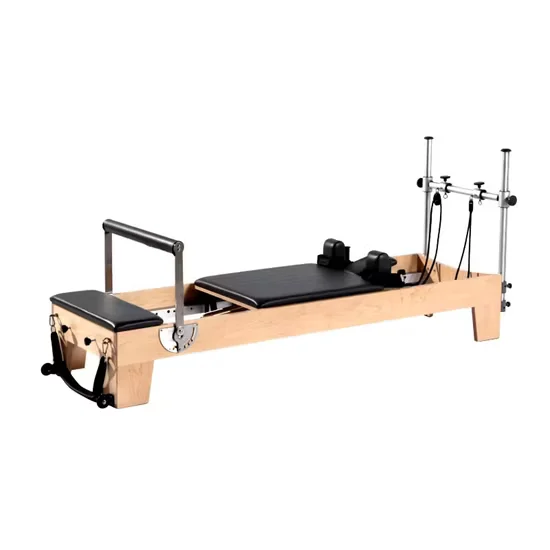
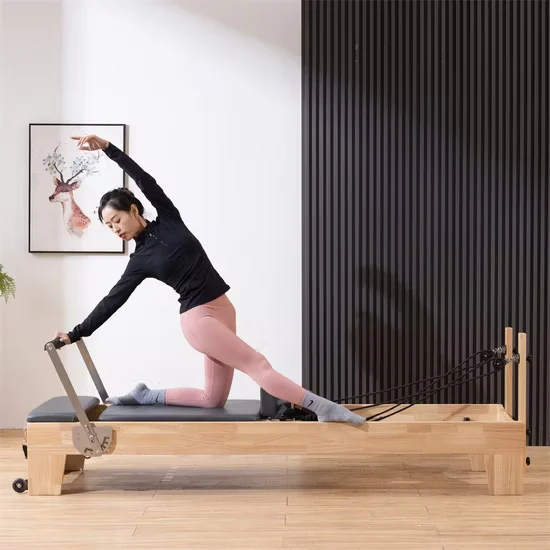
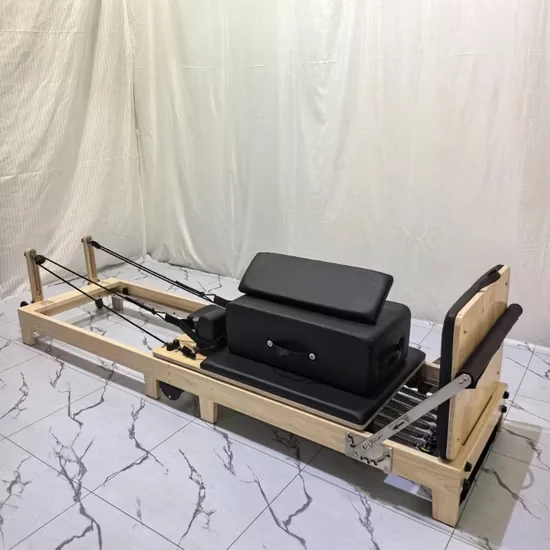
Whisper-Quiet Resistance — Magnetic pulley and spring systems deliver smooth transitions across every load setting, verified in studio deployments where acoustic comfort defines member retention.
Technical Specifications
| Parameter | Value |
|---|---|
| Product Type | Pilates Combination Unit |
| Model | SRY-08 |
| Frame Material | Solid Maple Wood |
| Specifications | 240×557×52 cm / 257×81×52 cm |
| Net Weight | 200 kg |
| Resistance Type | Spring and Pulley System |
| Tower Module | Included |
| Jump Board | Included |
| Pulley System | Zen Yoga Pulley Tower |
| Target User | Adult, Unisex |
| Logo | Customized Is Allowed |
| Color | Solid Color |
| Warranty | 3 Years |
| Production Capacity | 80 Pieces/Month |
Application Suitability
| Deployment Scenario | Typical Use |
|---|---|
| Boutique Pilates studio | Full reformer and tower repertoire for group and private sessions |
| Hotel fitness center on guest room floors | Low-noise spring resistance for 24-hour access without disturbing adjacent rooms |
| Rehabilitation center | Graduated spring loading for controlled post-injury recovery protocols |
| High-end residential home gym | Compact combination footprint covering reformer, tower, and jump board in one unit |
| Corporate wellness room | Multi-user durability for employee fitness programs with varied intensity needs |
Why Spring Tension Inconsistency Drives Members Away Before Management Notices
Precision-wound springs with matched tolerances keep resistance curves linear across every attachment point.
Studio operators often discover that resistance feels different from one machine to the next, even within the same model line. Members notice the inconsistency during transitions between exercises, and the experience erodes trust in the facility’s equipment standards. When a maple wood pilates combination unit commercial deployment shows uneven spring behavior, instructors end up compensating with verbal cues rather than relying on the machine itself [NEED_CITE: spring tolerance standards for commercial Pilates equipment].
The cost shows up in membership renewals, not maintenance tickets. A member who cannot trust the resistance setting will seek a studio where the equipment responds predictably.
Where This Unit Fits in a Multi-Discipline Studio Layout
This combination unit covers the full spectrum of Pilates programming — reformer footwork, tower-based standing work, and jump board cardiovascular intervals — within a single footprint. In a studio configuration, it pairs with mat stations and smaller apparatus to create a complete class rotation without requiring members to move between rooms. The solid maple frame and Zen yoga pulley tower support users across a broad range of body types and training intensities. Instructors can map exercises to spring selections and pulley angles with confidence that the resistance will remain stable from the first session to the last.
Continuous Session Loads and the Acoustic Envelope of Shared Spaces
Hotel fitness centers on guest room floors and residential buildings face a specific constraint: sound transmits through floor assemblies and shared walls. The spring and pulley resistance system on this maple wood pilates combination unit commercial installation produces no motor hum and no electromagnetic whine, keeping the acoustic signature well below the threshold that triggers guest complaints [NEED_CITE: acoustic transmission standards for fitness equipment in hospitality environments]. Facilities deploying multiple units should plan airflow around the frame to manage ambient temperature during back-to-back classes, and confirm that floor leveling supports stable tower alignment under dynamic loading. Voltage considerations do not apply to this mechanically driven platform, which simplifies international deployment across regions with differing electrical standards.
How Spring Gauge and Pulley Bearing Selection Shape the Resistance Curve
Spring resistance operates on a linear deflection principle: the force required increases proportionally as the spring extends. Matched-gauge spring sets ensure that each color-coded or numbered setting delivers the expected load without dead spots in the mid-range. The pulley system relies on sealed bearing wheels running on precision-machined axles — lower-friction bearings translate to smoother directional changes during cable-based exercises. Solid maple wood provides a dimensionally stable frame that resists the seasonal humidity swings that cause softer woods to warp and introduce pulley misalignment. The tower module adds vertical pulling angles that the horizontal reformer bed alone cannot produce, expanding the exercise library without additional floor space. Jump board attachment points are reinforced to handle repetitive impact loading without fastener fatigue over extended service intervals.
The Compromise That Arrives Six Months After a Budget Purchase
Facilities that select equipment based on initial cost often encounter frame fasteners loosening under daily class schedules, requiring weekly torque checks that consume maintenance hours. Spring sets with wide manufacturing tolerances create resistance inconsistency between identical units, forcing instructors to memorize which machine feels heavier at each setting. Pulley bearings without adequate sealing accumulate dust and sweat residue, producing audible grinding that members interpret as equipment neglect. In a hotel environment, these issues compound: a noisy pulley on one floor generates a maintenance call that could have been prevented by specifying sealed bearings and matched spring sets from the outset [NEED_CITE: bearing seal ratings for commercial fitness pulley systems]. The replacement cost of a full spring and cable overhaul frequently exceeds the price difference that motivated the original budget decision.
Why This Product Line Earns Its Place in Demanding Facilities
Every unit undergoes spring load verification before leaving the assembly floor, ensuring that resistance settings match published specifications within tolerance. The solid maple frame is kiln-dried and moisture-conditioned to resist the humidity cycles common in studio and hotel environments. The six-series cardio and apparatus family means a facility can source reformers, towers, and complementary strength equipment from one engineering team, simplifying spare parts logistics and warranty management. OEM customization extends to logo placement, upholstery color, and wood finish, allowing brand-consistent deployments across multiple locations. The engineering team provides 3D layout planning that accounts for unit spacing, instructor sightlines, and ventilation clearance specific to this unit’s dimensions. Technical support remains available around the clock for commissioning questions and field adjustments.
Documentation & Test Records
- CE declaration of conformity for the complete combination unit assembly
- EN 957 test report covering structural load and fatigue performance
- ISO 9001 certificate for the manufacturing quality management system
- Spring load verification and tolerance documentation per production batch
- Pulley bearing specification and noise assessment records
- Installation guide with frame leveling and tower alignment procedures
Installation, Commissioning & Maintenance
- Confirm floor flatness within tolerance before anchoring the 257×81×52 cm base frame to prevent tower lean under load
- Allow minimum clearance on all sides for full carriage travel and tower cable extension during class use
- Inspect spring attachment hooks and cable swivels at scheduled intervals for wear signs and secure retention
- Lubricate carriage rail contact surfaces with manufacturer-specified compound at defined service intervals
- Verify pulley bearing smoothness quarterly and replace any wheel showing lateral play or audible friction
- Wipe maple frame surfaces with pH-neutral cleaner to prevent sweat residue buildup in wood grain
Planning Your Deployment Starts with the Room, Not the Catalog
Share your studio or hotel fitness floor dimensions and intended unit count to receive a 3D layout that maps equipment spacing, instructor circulation paths, and ventilation requirements. Specify the expected daily session volume so the spring and pulley configuration can be matched to your usage intensity. Identify the deployment floor level and adjacent occupied spaces to confirm that the acoustic profile meets your building’s standards. Indicate your target market region so wood finish and upholstery selections align with local preferences and regulatory requirements.
Frequently Asked Questions
Q: How does solid maple compare to birch or beech for Pilates equipment frames?
A: Maple offers higher density and tighter grain structure than birch, which translates to greater resistance against fastener pull-out under repeated dynamic loading. Compared to beech, maple shows lower moisture absorption rates, reducing the seasonal expansion and contraction that can introduce frame rattle and pulley misalignment. The dimensional stability of kiln-dried maple keeps tower alignment and carriage tracking consistent across humidity cycles common in studio environments.
Q: What training scenarios favor spring resistance over pulley-based loading?
A: Spring resistance provides a progressive load curve that increases with extension, matching the natural strength curve of many compound movements. This makes it well-suited for rehabilitation protocols where controlled loading through range of motion is essential. Pulley systems deliver more constant tension regardless of position, which supports standing cable work and rotational patterns on the tower module. The combination unit integrates both systems so instructors can select the appropriate loading mechanism for each exercise objective.
Q: What maintenance does a solid maple frame require to prevent cracking over time?
A: Maple frames benefit from periodic inspection of fastener torque at structural joints, particularly where the tower connects to the base. Maintaining stable ambient humidity within the studio environment reduces the moisture cycling that drives wood movement. Surface cleaning should use pH-neutral products to avoid residue accumulation in the grain. Any visible check marks or surface cracks should be assessed promptly to determine whether cosmetic refinishing or structural intervention is appropriate.
Q: Can the tower module be added to an existing reformer at a later date?
A: Tower compatibility depends on whether the base frame includes the pre-drilled mounting points and structural reinforcement required for vertical loading. Combination units designed from the outset as integrated systems typically offer stronger tower-to-base connections than retrofit kits added after production. Facilities planning phased equipment deployment should confirm tower mounting specifications during initial procurement to avoid compatibility constraints when expansion is needed.
![SRY-12A Folding White Aluminum Pilates Reformer for Yoga Studio [WARN] draft identifier mismatch](https://bicksport.com/wp-content/uploads/2026/08/sry-12a-folding-white-aluminum-pilates-reformer-for-yoga-studio-warn-draft-identifier-mismatch-9df7a1.webp)