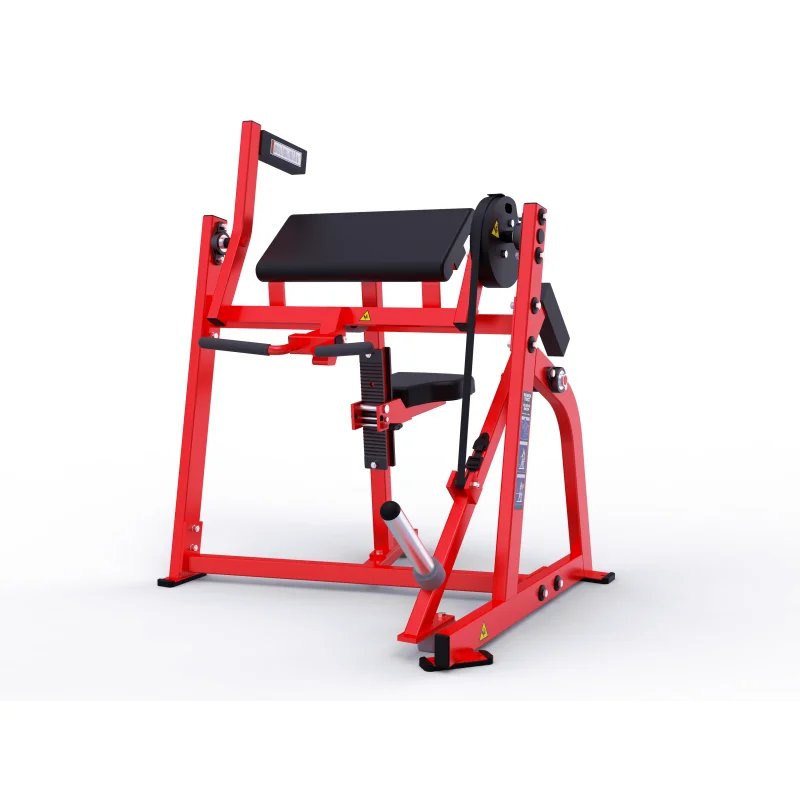
Steel Frame Rigidity — 148kg net weight and reinforced pivot bearings engineered for continuous high-frequency commercial use without structural play.
Technical Specifications
| Parameter | Value |
|---|---|
| Designation | 5031 |
| Product Type | ISO-Lateral Leg Press |
| Movement Mechanism | ISO-Lateral Independent Arms |
| Frame Material | Steel |
| Product Dimensions | 1989 × 1771 × 1545 mm |
| Net Weight | 148 kg |
| Max User Weight | 180 kg |
| Exercise Target | Lower Body / Legs |
| Application Fit | Professional Gym and Club, Community Fitness Center |
| OEM/ODM | Available (frame color, upholstery, branding) |
| Certification | ISO 9001, CE |
Application Suitability
| Deployment Scenario | Typical Use |
|---|---|
| Commercial gym strength zone | High-frequency bilateral and unilateral leg training for general membership |
| Boutique fitness club | Compact footprint deployment alongside squat racks and functional rigs |
| Community fitness center | Durable lower-body station accommodating diverse user fitness levels |
| Hotel fitness facility | Heavy-duty steel construction for 24/7 access with minimal maintenance oversight |
| Corporate wellness room | Space-efficient leg training for time-constrained professionals |
| Sports performance training center | Independent arm loading for athlete rehabilitation and balanced strength development |
Why Frame Gauge and Pivot Play Dictate Machine Lifespan
A 148kg steel frame with reinforced bearings resists the lateral torsion that causes cheaper units to loosen and rattle within months.
When light-commercial leg presses enter a busy gym floor, the pivot points and movement arm bearings face thousands of articulation cycles per week. Units built with inadequate frame thickness and standard bushings develop visible play, generating noise that travels across the weight room and prompting member complaints before maintenance even logs a ticket. The ISO-lateral mechanism compounds this stress because each arm moves independently, placing asymmetric loads on the central frame junction. Specifying a commercial ISO-lateral leg press strength machine with verified welding quality and sealed bearings prevents the premature downtime that forces facility operators into costly mid-year replacements. [NEED_CITE: structural fatigue patterns in independent-arm strength equipment under continuous loading]
Independent-Load Biomechanics for Balanced Lower-Body Development
The ISO-lateral design allows each leg to push through its own resistance path, eliminating the dominant-side compensation that occurs on fixed-bar leg presses. In a commercial strength zone, this unit pairs naturally with hack squat machines and leg extension stations to create a comprehensive lower-body training cluster. The 1989 × 1771 mm footprint fits efficiently into high-density layouts while maintaining adequate user clearance on all sides. The independent arm mechanism accommodates users across the full 180kg capacity range, and the bilateral isolation supports rehabilitation protocols where unilateral loading is prescribed by sports physiotherapists.
Continuous Operation Demands on Bearings and Frame Joints
A leg press in a 24/7 commercial facility endures articulation cycles that accumulate rapidly across hundreds of daily users. The sealed pivot bearings on this commercial ISO-lateral leg press strength machine are selected to withstand continuous loading without the degradation that causes grinding and lateral wobble in standard bushing assemblies. Floor deployment requires a level concrete subfloor with vibration-dampening mats beneath the 148kg frame to prevent transmitted noise from reaching occupied spaces below. The steel frame’s reinforced welding at stress junctions maintains structural integrity through the thermal expansion cycles that occur during peak usage periods. [NEED_CITE: bearing lifecycle expectations for commercial selectorized and plate-loaded strength equipment]
Decoding the Frame and Movement Specifications
The 148kg net weight reflects the steel gauge and reinforcement density throughout the main frame and movement arms. Heavier construction translates directly to resistance against the torsional forces generated when users load plates asymmetrically on independent arms. The ISO-lateral mechanism uses precision-machined pivot points rather than simple pin-and-bushing joints, maintaining smooth articulation through the full range of motion without the dead spots that develop in worn lighter-duty units. The 1989 × 1771 × 1545 mm envelope positions the user at an angle that aligns with natural hip and knee joint tracking, reducing shear forces on connective tissue during heavy loading. Steel frame rigidity ensures that the resistance path remains consistent whether one arm or both are loaded, which matters when athletes train unilaterally for sport-specific strength. The 180kg maximum user weight rating reflects both structural capacity and the load limits of the pivot bearing assembly.
The Hidden Cost of Underspec’d Pivot Components
Facilities that install light-commercial leg presses in high-traffic environments typically see bearing failure and frame joint loosening within the first year of intensive use. Once pivot play develops, the movement arm oscillates unpredictably under load, creating a safety concern that forces the machine offline until parts arrive. Noise from degraded bearings travels through the floor structure, generating complaints from adjacent studio spaces or upper-floor guest rooms. Repeated tightening of loosened bolts is a temporary fix that accelerates thread wear and eventually requires complete pivot assembly replacement. These cascading failures drain maintenance budgets and erode member confidence in the facility’s equipment standards. [NEED_CITE: maintenance frequency comparison between commercial and light-commercial pivot bearing assemblies]
Why This Line Covers the Full Strength Zone
The 10,000-hour durability testing protocol applies to pivot bearings and frame joints across the entire product family, meaning this commercial ISO-lateral leg press strength machine is validated for the same continuous operation standards as the cardio range. The six-series equipment family lets facilities source leg presses, functional trainers, cable crossovers, and cardio units from one manufacturing line with consistent build quality. OEM customization extends to frame powder-coat color, upholstery material, and logo placement, ensuring the unit matches existing facility design standards without extended lead times. The 1989 × 1771 mm footprint integrates into 3D strength-zone layouts that account for plate-loading clearance, user entry and exit paths, and sightlines from the reception desk. Full documentation packages accompany each shipment, supporting compliance audits and facility insurance requirements. [NEED_CITE: integrated strength and cardio sourcing advantages for multi-unit gym deployments]
Documentation & Test Records
- CE declaration of conformity for commercial strength equipment deployment
- EN 957 test report covering structural integrity and user safety requirements
- ISO 9001 certificate verifying manufacturing quality management systems
- Pivot bearing and movement arm durability test records
- Steel frame welding inspection and material gauge report
- OEM customization specification sheet with color and upholstery options
Installation, Commissioning & Maintenance
- Position on level concrete with vibration-dampening mats beneath all four frame contact points
- Maintain 800mm clearance behind and 600mm on each side for plate loading and user access
- Torque-check all pivot bolts and frame junction fasteners after the first 500 articulation cycles
- Lubricate sealed pivot bearings per the schedule in the commissioning guide
- Inspect upholstery and back pad mounting hardware monthly for sweat-induced corrosion
- Verify floor load capacity supports the 148kg machine weight plus maximum user load
Equipment Selection and Deployment Inquiry
Provide your strength zone square footage and planned equipment list to receive a 3D layout that positions this ISO-lateral leg press within member flow patterns and plate-loading clearances. Specify the expected daily user volume so we can confirm pivot bearing specifications match your occupancy profile. Confirm the target market voltage standard if any motorized accessories or integrated console units are part of the configuration. Indicate whether frame color and upholstery must match an existing facility design palette for OEM scoping.
Frequently Asked Questions
Q: What distinguishes an ISO-lateral leg press from a standard plate-loaded version for gym deployment?
A: ISO-lateral units feature independent movement arms that allow each leg to push through a separate resistance path, accommodating unilateral training and rehabilitation protocols. Standard plate-loaded presses use a single fixed platform that forces both legs to share the load equally. For commercial facilities serving diverse membership including athletes and post-injury clients, the independent-arm design broadens the machine’s utility and justifies its floor space allocation.
Q: How should facility operators evaluate frame durability for 24/7 gym environments?
A: Request the frame material gauge specification and welding inspection report, then cross-reference the pivot bearing durability test records against your expected daily articulation volume. A unit deployed in a high-traffic commercial gym should demonstrate tested endurance well beyond typical light-commercial duty cycles. Net weight and reinforcement density at stress junctions provide reliable physical indicators of long-term structural resilience.
Q: What OEM options exist for matching facility branding and interior design?
A: Frame powder-coat color, upholstery material and stitching pattern, and logo placement on the shroud or back pad are all customizable. Console UI customization applies if the configuration includes any digital display or integrated tracking module. Minimum order quantities for OEM runs are flexible, and color samples are provided for approval before production begins to ensure exact matching with existing facility design standards.
Q: How do you plan strength zone layout around this leg press for optimal member flow?
A: Start with the 1989 × 1771 mm machine footprint and add clearance zones for plate loading, user approach, and emergency egress on all sides. Position the unit where sightlines from the reception or training desk remain unobstructed. Consider adjacency to complementary lower-body stations and ensure adequate ventilation around the frame to manage heat buildup during peak usage periods across the strength training cluster.