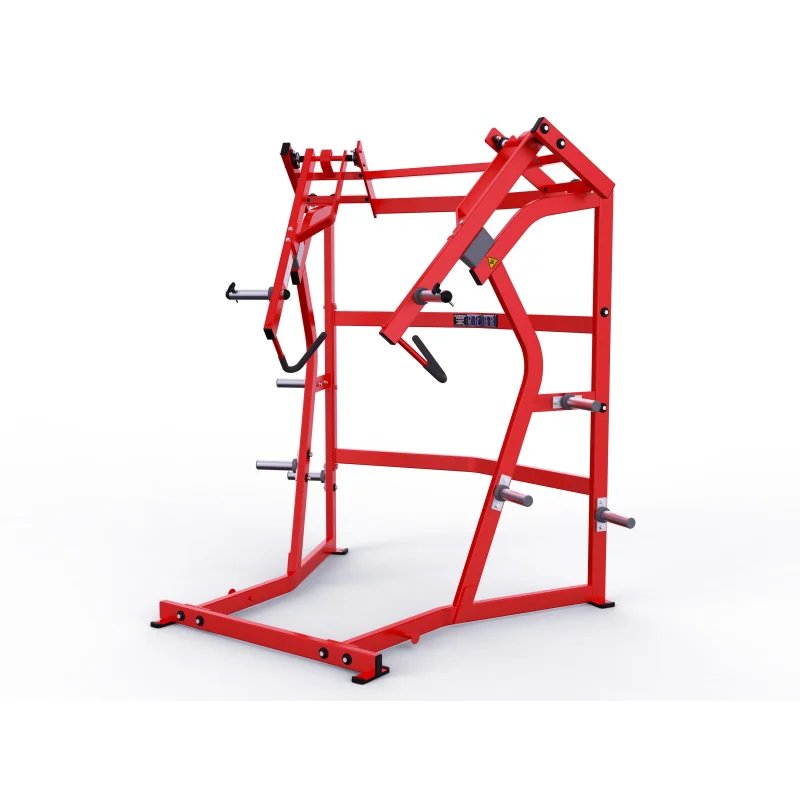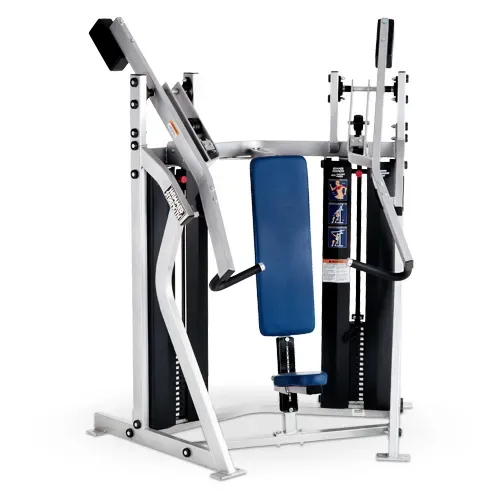
Heavy-Duty Dual Stack Frame — 354 kg net weight and sealed bearing pivots engineered for continuous high-frequency strength training cycles.
Technical Specifications
| Parameter | Value |
|---|---|
| Designation | MTS-8007 |
| Product Type | ISO-Lateral High Row |
| Resistance Type | Dual Weight Stacks |
| Weight Stack | 80 kg × 2 Stacks |
| Machine Weight | 354 kg |
| Product Dimensions (L × W × H) | 119 cm × 183 cm × 196 cm |
| Frame Construction | Reinforced Commercial Steel |
| Pivot Bearings | Sealed |
| Foldable | Unfolded |
| Certification | CE, ISO, RoHS, SGS |
| Max User Weight | Commercial Grade |
| Origin | China |
Application Suitability
| Deployment Scenario | Typical Use |
|---|---|
| Chain gym strength training zone | High-volume back and shoulder work during peak hours |
| Corporate wellness facility | Accessible loading ranges for mixed-fitness employee populations |
| Sports performance training center | Athlete-specific unilateral loading and imbalances correction |
| Hotel fitness center | Durable, low-maintenance operation with limited on-site technical staff |
Why Pulley Rattle and Guide Rod Wear End Up on the Manager’s Desk
Sealed bearings and precision-machined guide rods keep the MTS-8007 ISO-Lateral High Row smooth through thousands of cycles.
When cable-driven stack machines start rattling, the noise travels across the weight floor and reaches the front desk long before a maintenance ticket gets filed. In facilities running sixteen-hour days, guide rods that lack proper sealing accumulate dust and sweat residue, causing the weight stacks to drag and produce grinding sounds [NEED_CITE: typical failure modes in cable-driven commercial strength equipment]. Members notice the stutter mid-set, and the complaints compound. The ISO-Lateral High Row commercial strength machine MTS-8007 addresses this by routing cables through sealed bearing pulleys and housing guide rods within the frame structure, reducing exposure to airborne particulates.
Positioning Within the Strength Floor Layout
This unit targets the upper back, rear deltoids, and biceps through a converging high-row arc. In a commercial strength zone, it complements lat pulldown stations and seated row machines by providing an overhead pull angle that those units cannot replicate. The ISO-Lateral High Row commercial strength machine MTS-8007 suits deployment against walls or in back-to-back rows where ceiling height exceeds 200 cm. The dual 80 kg stacks accommodate beginners selecting single-plate increments and advanced lifters loading both stacks simultaneously, while the ISO-Lateral arm design allows each side to move independently, supporting users with unilateral strength discrepancies.
Daily Cycle Demands and Floor-Level Considerations
Facilities operating from early morning through late evening subject stack machines to near-continuous loading cycles. The 354 kg frame mass anchors the unit against lateral sway when users perform explosive concentric pulls. Deployment on suspended floors requires verifying load-bearing capacity at the specific footprint [NEED_CITE: structural load requirements for commercial gym floors]. Adequate clearance around the machine—particularly overhead for the full range of motion—prevents interference with ceiling-mounted HVAC ducts or lighting rigs. Proper leveling on the installation surface ensures the guide rods remain plumb, which directly affects stack travel smoothness over months of use.
Decoding the Dual-Stack and ISO-Lateral Mechanics
The twin 80 kg weight stacks operate on independent cable and pulley systems, meaning each arm of the ISO-Lateral High Row commercial strength machine MTS-8007 draws from its own stack without cross-contamination of resistance. This independence matters when a user has a dominant side: the stronger arm cannot compensate for the weaker one, which forces balanced development. The converging motion arc pulls the handles from an elevated, wide position down and inward, matching the natural fiber orientation of the latissimus dorsi and rhomboids. Sealed bearings at every pivot point reduce friction and eliminate the need for periodic lubrication that open bushings demand. The reinforced steel frame, combined with the substantial machine weight, prevents the unit from shifting during heavy loaded sets.
The Hidden Cost of Underspecified Guide Rods and Pulleys
Machines built with open bushings and lightweight pulleys develop lateral play within the first year of commercial deployment. That play translates into uneven stack travel, which accelerates cable fraying and eventually requires full cable replacement [NEED_CITE: cable replacement intervals in high-use commercial strength equipment]. Operators who select machines based on upfront cost often face compounding maintenance expenses and member-facing downtime. A warped guide rod or a seized pulley can take the entire unit offline until parts arrive, and in facilities with limited inventory depth, that means one fewer high-row station during peak traffic.
Why This Product Line Holds Up Under Continuous Deployment
Every unit undergoes durability testing covering repeated full-cycle loading across the 160 kg total stack capacity. The manufacturing process integrates CNC-machined pivot points and welded frame joints inspected against commercial-grade tolerances. For facilities planning an entire strength floor, the six-series product family allows sourcing every cable, plate-loaded, and functional trainer position from a single production line. The OEM program covers frame color, upholstery, and weight stack increments, and the 3D layout service maps machine spacing, member flow, and ventilation requirements around units like the MTS-8007. Technical support remains available around the clock for commissioning and troubleshooting.
Documentation & Test Records
- CE declaration of conformity for the MTS-8007 strength platform
- EN 957 compliance test report covering structural integrity and safety
- ISO 9001 quality management certificate for manufacturing processes
- RoHS compliance documentation for material and coating safety
- Durability test record logging repeated full-stack cycle performance
- Assembly, commissioning, and spare parts catalog
Installation, Commissioning & Maintenance
- Allow minimum clearance of 60 cm on all sides and overhead for full arm travel
- Level the frame on the floor surface before tightening anchor bolts to prevent guide rod bind
- Connect to a dedicated circuit matching the local voltage standard for any integrated console options
- Inspect cable tension and pulley alignment after the first 500 operational cycles
- Wipe down guide rods and upholstery weekly with non-corrosive cleaner to prevent sweat-induced oxidation
Planning Your Strength Zone Procurement
Provide the total strength area square footage and planned machine count to receive a 3D layout addressing spacing, sightlines, and airflow between units. Specify the daily operating hours so the duty-cycle matching aligns with your traffic volume. Identify the deployment floor and adjacent room types to confirm acoustic requirements. State the target market voltage and plug standard to ensure any electronic components arrive configured correctly.
Frequently Asked Questions
Q: How does ISO-Lateral differ from a fixed-path high row machine?
A: Fixed-path machines link both handles to a single bar or cable, forcing the stronger side to compensate during the pull. The ISO-Lateral design on the MTS-8007 gives each arm its own pivot and weight stack, so both sides must produce independent force throughout the entire range of motion, addressing imbalances directly.
Q: What does the dual 80 kg stack configuration support in practice?
A: Each side of the ISO-Lateral High Row commercial strength machine MTS-8007 carries an independent 80 kg stack, providing 160 kg total available resistance. Beginners can select single-plate increments, while advanced users can load both stacks for heavy unilateral or bilateral sets without needing external plates.
Q: What maintenance do sealed bearings require compared to open bushings?
A: Sealed bearings contain their own lubrication and block dust and sweat from entering the race, which eliminates the periodic greasing schedule that open bushings demand. Operators typically inspect sealed bearings during annual preventive maintenance rather than servicing them monthly.
Q: How should the strength zone layout account for this machine’s dimensions?
A: The MTS-8007 measures 119 × 183 × 196 cm and requires overhead clearance for the full arm arc. Positioning it against a perimeter wall or in a back-to-back row with adequate lateral spacing ensures members can load and unload plates without obstructing adjacent traffic lanes.