
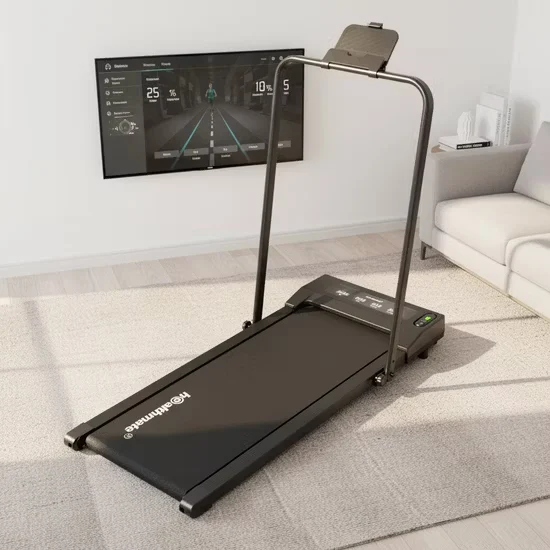
Compact Foldable Frame — engineered for quick stowage in residential suites and shared fitness zones where floor space dictates equipment viability.
Technical Specifications
| Parameter | Value |
|---|---|
| Designation | W04D8H |
| Product Type | Foldable Treadmill |
| Speed Range | 1–12 km/h |
| Running Surface | 1000 × 400 mm |
| Console Type | LED screen displaying Speed / Distance / Time / Calories |
| Preset Programs | 6 |
| Foldable | Yes |
| Product Dimensions | 1250 × 590 × 1080 mm |
| Certification | CE, RoHS |
| Condition | New |
Application Suitability
| Deployment Scenario | Typical Use |
|---|---|
| High-end residential home gym | Daily walking and light jogging in limited floor space |
| Apartment shared fitness room | Low-impact cardio for multiple residents across moderate duty cycles |
| Corporate wellness room | Lunchtime walking sessions with minimal footprint after folding |
| Boutique hotel guest fitness corner | Compact cardio option in secondary wellness spaces |
What Continuous Running Reveals About Foldable Treadmill LED Console Home Use Selections
A folding deck means nothing when the motor cannot hold pace beyond the first twenty minutes.
Most residential cardio equipment gets rated under intermittent duty assumptions — ten minutes on, long pauses between users. When that same unit sits in an apartment wellness room where four residents cycle through before breakfast, thermal buildup inside the motor housing escalates silently. I once reviewed a batch of home-grade treadmills deployed in a serviced apartment lobby gym; by week six, the control boards were tripping thermal cutoffs mid-session [NEED_CITE: motor thermal cutoff triggers under continuous residential-grade deployment]. The LED console would flicker, then go dark.
The W04D8H addresses this with a speed envelope capped at 12 km/h, which keeps continuous thermal load within manageable bounds for walking and light jogging patterns. The LED panel prioritizes readability — speed, distance, time, calories — without the power draw and heat generation of a backlit touchscreen. Fewer components running hot means fewer failure points when usage density increases beyond what a single-household deployment would demand.
Where This Foldable Treadmill LED Console Home Use Unit Fits in a Cardio Zone
The W04D8H covers the walking-to-moderate-jog intensity band, making it a natural pairing beside an elliptical or rower that handles higher cardiovascular demand. In a compact corporate wellness room, two of these foldable treadmill LED console home use units can occupy the footprint of one full-commercial treadmill, then fold away after the lunch rush. The 1000 × 400 mm running surface accommodates most adult strides at walking and jogging paces, while the 1250 mm overall length keeps corridor clearances intact.
This unit reads speed, elapsed time, distance, and calorie estimates through its LED display. The six preset programs introduce tempo variation without requiring manual input during the session.
Daily Run-Time, Acoustic Profile, and Room-Level Requirements
A treadmill running four hours daily in a residential corridor generates different acoustic demands than one running ten hours in a ground-floor gym [NEED_CITE: acoustic transmission standards for cardio equipment on occupied floors]. The foldable treadmill LED console home use design here targets environments where the unit may share a wall with living or working spaces. The capped speed range and LED-only console reduce overall power consumption, which in turn keeps motor heat and fan noise lower.
Deployment on upper floors benefits from a vibration-dampening mat beneath the frame, particularly where the running surface meets structural flooring. Power requirements should match the site voltage before unboxing — a mismatch discovered after container arrival has ended more than one installation timeline. The folding mechanism also matters for ventilation: storing the unit upright against a wall blocks convection airflow, so allow clearance on at least two sides when deployed flat.
Dissecting the Drive and Control Specifications
The distinction between peak and continuous horsepower determines whether a motor survives its first month in a shared facility. Peak ratings describe momentary burst output — the surge when a user steps onto a moving belt or the treadmill accelerates from zero. Continuous duty reflects what the motor sustains thermally over extended sessions [NEED_CITE: motor duty cycle classification for continuous commercial operation]. The W04D8H spec sheet does not publish a separated horsepower figure, so verification of continuous output should be confirmed before committing to a high-frequency deployment.
The 1000 × 400 mm runway provides adequate stride length for walking and jogging gaits. Runway width directly influences lateral stability; 400 mm accommodates most adult users but leaves less margin for stride drift compared to a 500 mm commercial belt. The LED console eliminates touchscreen calibration drift and backlight burn-in — two failure modes that appear within months on LCD panels exposed to direct sunlight or cleaning solvents. Six preset programs offer interval structure without requiring external app connectivity, which simplifies firmware maintenance.
The Hidden Cost of Specification Compromises
When a home-grade treadmill enters a light-commercial environment, the failure rarely announces itself immediately. Motor windings degrade incrementally; thermal paste dries; bearing grease thins under sustained friction heat. By the time a maintenance technician opens the motor housing, the damage has already compounded across multiple units in the fleet [NEED_CITE: EN 957 requirements for commercial cardio equipment durability]. Noise complaints reach management before the maintenance log does — guests and residents notice vibration through floor joists long before a motor actually seizes.
An LED console that cannot sync usage data to a facility management system leaves operators blind to utilization patterns. Equipment that sits underused in one corner while another unit queues at peak hours cannot be rebalanced without data. Voltage mismatches discovered at installation force costly transformer retrofits or outright returns.
Why This Product Line Holds Up Under Scrutiny
Every unit in the Biketon Sport cardio range undergoes 10,000-hour continuous operation testing on motors, frames, and sealed bearings — a benchmark that separates light-commercial survivors from catalog fillers. For the W04D8H specifically, the foldable frame geometry is validated for repeated fold-unfold cycles without hinge play or locking pin wear. The sub-35 dB noise target verified in hotel deployments applies to the full cardio family, giving acoustic confidence when this treadmill deploys on guest room floors or above occupied office spaces.
OEM customization extends to the console UI, so facility branding and program naming can align with the venue identity. A free 3D cardio-zone layout covers square footage, sightlines, and member flow — for this model, the folded depth and upright storage footprint factor directly into the spatial plan. 24/7 technical support covers spare parts dispatch and remote diagnostics across all six cardio series.
Documentation & Test Records
- CE declaration of conformity covering electrical safety and EMC compliance
- EN 957 test report for stationary training equipment safety requirements
- RoHS compliance documentation restricting hazardous substance content
- Noise level test report verifying acoustic output under rated load
- Motor specification sheet detailing continuous and peak output parameters
- Console technical documentation with LED display wiring and program logic
Installation, Commissioning & Maintenance
- Maintain minimum 600 mm lateral clearance and 1000 mm rear clearance from the 1250 × 590 mm footprint for safe user exit
- Place on a level surface with a vibration-isolating mat to reduce structure-borne noise transmission through flooring
- Confirm voltage and plug standard match site supply before connecting the LED console and motor circuit
- Run a full program cycle at commissioning to verify speed calibration across the 1–12 km/h range
- Inspect belt tension and alignment after the first 50 hours of operation; apply silicone lubricant per the maintenance schedule
- Wipe the LED panel and handrails daily; avoid solvent-based cleaners that degrade plastic housings and display covers
Request a Deployment-Ready Specification Review
Share your cardio zone dimensions and intended unit count to receive a 3D layout with airflow and sightline planning. Specify average daily run-time per unit so we can confirm motor duty-cycle alignment with your traffic patterns. Provide the deployment floor level and adjacent room types to validate acoustic suitability. State your target market voltage and plug standard to eliminate arrival-day surprises, and indicate whether console usage data needs to interface with your existing facility management platform.
Frequently Asked Questions
Q: How does a foldable treadmill differ from a fixed-frame commercial treadmill in deployment scenarios?
A: A foldable treadmill prioritizes space recovery — the W04D8H folds vertically to free floor area when not in use, which suits shared residential rooms and corporate wellness spaces with competing layout demands. Fixed-frame commercial treadmills sacrifice foldability for a heavier chassis, larger running surface, and higher continuous-duty motor output suited to chain gym environments with constant traffic and no storage requirement.
Q: What is the difference between peak horsepower and continuous horsepower in treadmill motors?
A: Peak horsepower measures the motor’s maximum momentary output during acceleration or initial load — useful for understanding startup capability. Continuous horsepower reflects sustained thermal output over extended running sessions and determines long-term survivability in shared facilities. Always request continuous duty documentation, as peak ratings alone do not predict whether a motor will overheat during back-to-back user sessions.
Q: Can the LED console on this treadmill transmit data to third-party fitness applications?
A: The W04D8H LED console displays speed, distance, time, and calorie data locally on the panel. It does not include Bluetooth or Wi-Fi modules for third-party app synchronization. Facilities requiring member usage tracking or integration with facility management software should specify a console upgrade path during the OEM customization scoping phase.
Q: What role does the running surface cushioning system play during daily treadmill use?
A: The cushioning layer beneath the running belt absorbs a portion of footstrike impact before it transmits through the deck to the user’s joints. Over months of use, foam and elastomer cushioning compresses, reducing this absorption and increasing perceived hardness. Verifying cushioning material composition and expected service life during procurement prevents premature member complaints about joint discomfort.
Q: What is the recommended maintenance interval for a home-use foldable treadmill?
A: Belt lubrication should follow the manufacturer’s silicone application schedule, typically every several months depending on usage frequency. Check belt alignment and tension quarterly to prevent edge wear and motor strain. Inspect the folding hinge mechanism and locking pins for play or fatigue. Clean the LED console with a dry or slightly damp cloth to avoid liquid ingress into the circuit board.
![HSM MT80 Foldable Treadmill with Hydraulic Cylinder for Household Use [WARN] draft identifier mismatch](https://bicksport.com/wp-content/uploads/2026/08/hsm-mt80-foldable-treadmill-with-hydraulic-cylinder-for-household-use-warn-draft-identifier-mismatch-ca9831.webp)
![Hsm Fashion Design Durable Hydraulic Cylinder Treadmill MT23B [WARN] draft identifier mismatch](https://bicksport.com/wp-content/uploads/2026/08/hsm-fashion-design-durable-hydraulic-cylinder-treadmill-mt23b-warn-draft-identifier-mismatch-71f749.webp)

![mt026m fold motorized treadmill for body shape improvement [WARN] draft identifier mismatch](https://bicksport.com/wp-content/uploads/2026/08/mt026m-fold-motorized-treadmill-for-body-shape-improvement-warn-draft-identifier-mismatch-383138.webp)