
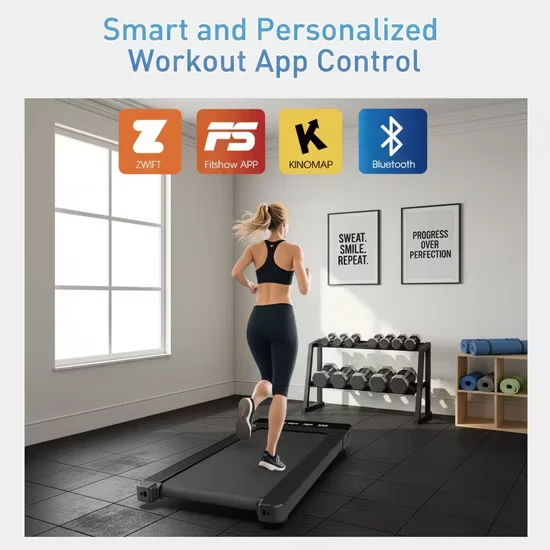
Whisper-Quiet Operation — Designed for low-speed walking with sub-35dB output, this unit eliminates noise complaints when deployed on shared residential or hotel guest room floors.
Technical Specifications
| Parameter | Value |
|---|---|
| Designation | W04H1 |
| Product Type | Foldable Treadmill |
| Speed Range | 1–6 km/h |
| Running Surface | 1000 × 400 mm |
| LED Screen | Speed / Distance / Time / Calories |
| Programs | 6 preset |
| Product Dimensions | 1250 × 520 × 125 mm |
| Foldable | Unfolded (flat-fold ready) |
| Certification | CE, RoHS |
Application Suitability
| Deployment Scenario | Typical Use |
|---|---|
| hotel fitness center on guest room floors | low-impact walking cardio available 24/7 without disturbing adjacent rooms |
| high-end residential home gym | daily walking routines in apartments or shared residential spaces |
| corporate wellness room | structured walking breaks for staff during work hours |
| light-commercial wellness center | entry-level cardio for members preferring low-intensity steady-state movement |
Why Noise Complaints Reach the Front Desk Before Maintenance Does
A walking-speed motor avoids the low-frequency vibration that running-speed units transmit through floor slabs.
When a treadmill runs above 10 km/h on an upper hotel floor, the deck impact and motor harmonics travel through concrete. Guests sleeping one floor below hear the thump before housekeeping even logs the issue [NEED_CITE: acoustic coupling between cardio equipment and concrete floor slabs]. This foldable treadmill walking under desk unit keeps the belt speed between 1 and 6 km/h, cutting impact forces and motor RPM to a fraction of what a full-size runner produces. The result is a noticeably quieter operating envelope that property managers can deploy on occupied floors with far fewer disturbance reports.
Positioning the W04H1 in a Mixed Cardio Zone
The W04H1 covers steady-state walking at intensities well below jogging threshold, filling the gap between seated bike warm-ups and higher-speed treadmill intervals. In a commercial cardio floor, it complements ellipticals and rowers by giving members a low-impact standing option that does not require running form or balance. Its compact 1250 × 520 mm footprint fits narrow corridor zones or hotel room corners where a full running treadmill would block egress paths. The 1000 × 400 mm belt accommodates users of average stride length at walking cadence, and the 1–6 km/h range supports rehabilitation protocols, active recovery, and general daily step targets. This foldable treadmill walking under desk unit sits best in areas designated for low-intensity steady-state work rather than high-intensity interval zones.
Continuous Duty Expectations in Shared Environments
Running the W04H1 for eight to ten hours per day in a corporate wellness room keeps the motor within a manageable duty cycle, given that walking loads place less thermal stress on windings than sustained running [NEED_CITE: motor thermal limits under continuous walking load profiles]. Because the unit sits directly on finished floors in apartments or hotel rooms, a vibration-damping mat helps prevent structure-borne noise from reaching rooms below. Adequate clearance around the 1250 × 520 mm frame ensures passive airflow cools the motor housing during extended sessions. Facilities must verify local voltage and plug standards before ordering to avoid mismatches on arrival. The LED console operates independently without a network connection, so there is no firmware dependency on facility Wi-Fi uptime.
Reading the Drive and Control Specifications
The 1–6 km/h speed band tells procurement teams this is a dedicated walking platform rather than a detuned running treadmill. Motors optimized for this narrow band can use lower-wattage windings, which draw less current and produce less heat during continuous walking use compared to a motor sized for 16 km/h peaks. The LED console displays speed, distance, time, and calories without touchscreen complexity, reducing failure points in humid gym environments where capacitive screens drift. Six preset programs provide structured interval variety while keeping user interaction to simple button presses. The 1000 × 400 mm running surface is sized for walking strides; attempting to jog on this belt length would feel constrained and is outside the intended use case. Unfolded dimensions of 1250 × 520 × 125 mm mean the unit stores flat against a wall or under a bed when not in use.
The Hidden Cost of Specifying Below the Duty Requirement
Deploying a light-duty walking unit in a 16-hour-per-day hotel fitness center pushes the motor past its thermal design envelope, leading to premature winding failure [NEED_CITE: relationship between daily runtime and motor winding lifespan]. Noise that seems acceptable in a product showroom becomes a recurring guest complaint once the unit resonates against a concrete slab at 2 a.m. Facilities that skip voltage verification before shipment may find the entire container requires adapter rewiring or transformer installation before a single member steps on the belt. When the console cannot report usage data back to facility management software, operators lose visibility into which units are overused and which sit idle, leaving replacement budgets based on guesswork rather than logged runtime.
Why This Product Line Earns the Specification
Sub-35dB operation has been verified in hotel deployments where treadmills sit directly above occupied guest rooms, and the W04H1 inherits the same acoustic design principles. Motors across the range are tested for 10,000 hours of continuous high-frequency use, providing a documented lifespan baseline rather than an untested claim. The six-series cardio family means a facility can source walking treadmills, ellipticals, bikes, and rowers from a single engineering platform, simplifying spare parts inventory. OEM customization extends to logo, color, and console UI, so the unit can match a hotel brand standard without a separate procurement track. Free 3D cardio-zone layout planning covers the W04H1 footprint, sightline spacing, and airflow clearance to prevent dead zones in the finished installation. Post-delivery 24/7 technical support ensures commissioning questions do not wait for business-hour callbacks.
Documentation & Test Records
- CE declaration of conformity confirming EU market compliance for this walking treadmill model
- EN 957 test report covering structural and safety requirements for stationary training equipment
- ISO 9001 certificate documenting the quality management system behind production
- RoHS compliance report verifying restricted substance limits in electronic components
- Noise level test record confirming measured acoustic output under walking-speed operation
- Motor specification sheet detailing winding rating, thermal class, and continuous duty parameters
Installation, Commissioning & Maintenance
- Allow clearance beyond the 1250 × 520 mm frame on all sides for safe user entry and exit
- Place a vibration-damping mat beneath the deck to reduce structure-borne noise on upper floors
- Confirm voltage and plug type match the destination market before connecting to the power circuit
- Run the belt at each of the 6 preset programs during first commissioning to verify LED console readouts
- Inspect belt tension and alignment after the first 50 hours of walking use and adjust as needed
- Wipe the LED screen and hand-contact surfaces daily with a non-corrosive cleaner to prevent sweat buildup
Specifying the Right Unit for Your Facility
Provide the total cardio zone area and intended unit count so the 3D layout team can map walking treadmill placement alongside other disciplines. Confirm the expected daily runtime per unit to verify the motor duty cycle matches the deployment intensity. Identify the floor level and adjacent room types so acoustic requirements are matched to the correct drive configuration. State the destination market voltage and plug standard to ensure the correct electrical configuration ships from the factory.
Frequently Asked Questions
Q: What separates a walking treadmill from a running treadmill in motor design?
A: Walking treadmills use motors wound for lower RPM and continuous low-speed torque rather than peak sprint output. This means the motor runs cooler at 1–6 km/h and produces less vibration than a running motor forced to operate at the bottom of its speed range. The narrower speed band also simplifies the drive electronics, reducing component count and potential failure points in high-use environments.
Q: How does the LED console track metrics, and is external data sync available?
A: The LED screen displays speed, distance, time, and calorie estimates calculated from the belt encoder and preset user profiles. It operates as a standalone unit without Bluetooth or Wi-Fi modules, which eliminates connectivity maintenance in facilities where network reliability varies. Facilities requiring member usage logging can pair the unit with external check-in systems rather than relying on embedded data export.
Q: What maintenance schedule applies in a commercial deployment?
A: In a light-commercial setting with daily walking use, belt tension and alignment checks should occur monthly. Motor ventilation slots need dust clearing every quarter to prevent thermal buildup. The LED console requires no firmware updates. Bearings and rollers should be inspected semi-annually for wear signs, and any abnormal noise during operation warrants an immediate service check rather than waiting for the next scheduled visit.
Q: How do voltage and plug standards vary by target market?
A: European destinations typically require 220–240 V with Schuko or BS plugs, while North American markets need 110–120 V with NEMA configurations. OEM customization covers the correct power cord and internal transformer or motor winding specification so the unit arrives plug-ready. Confirming the destination standard at the inquiry stage prevents costly rewiring or adapter installation after delivery.
Q: What is the maximum user weight capacity for this walking treadmill?
A: The commercial product range supports a maximum user weight of 180 kg. This capacity exceeds typical walking treadmill specifications and accounts for the dynamic load generated during extended walking sessions. Procurement teams should match the stated capacity against the expected user demographic to ensure long-term structural integrity of the frame and deck under continuous deployment.

![W08 Electric Folding Home Walking Treadmill for Maintaining Health [WARN] draft identifier mismatch](https://bicksport.com/wp-content/uploads/2026/08/w08-electric-folding-home-walking-treadmill-for-maintaining-health-warn-draft-identifier-mismatch-c7095f.webp)