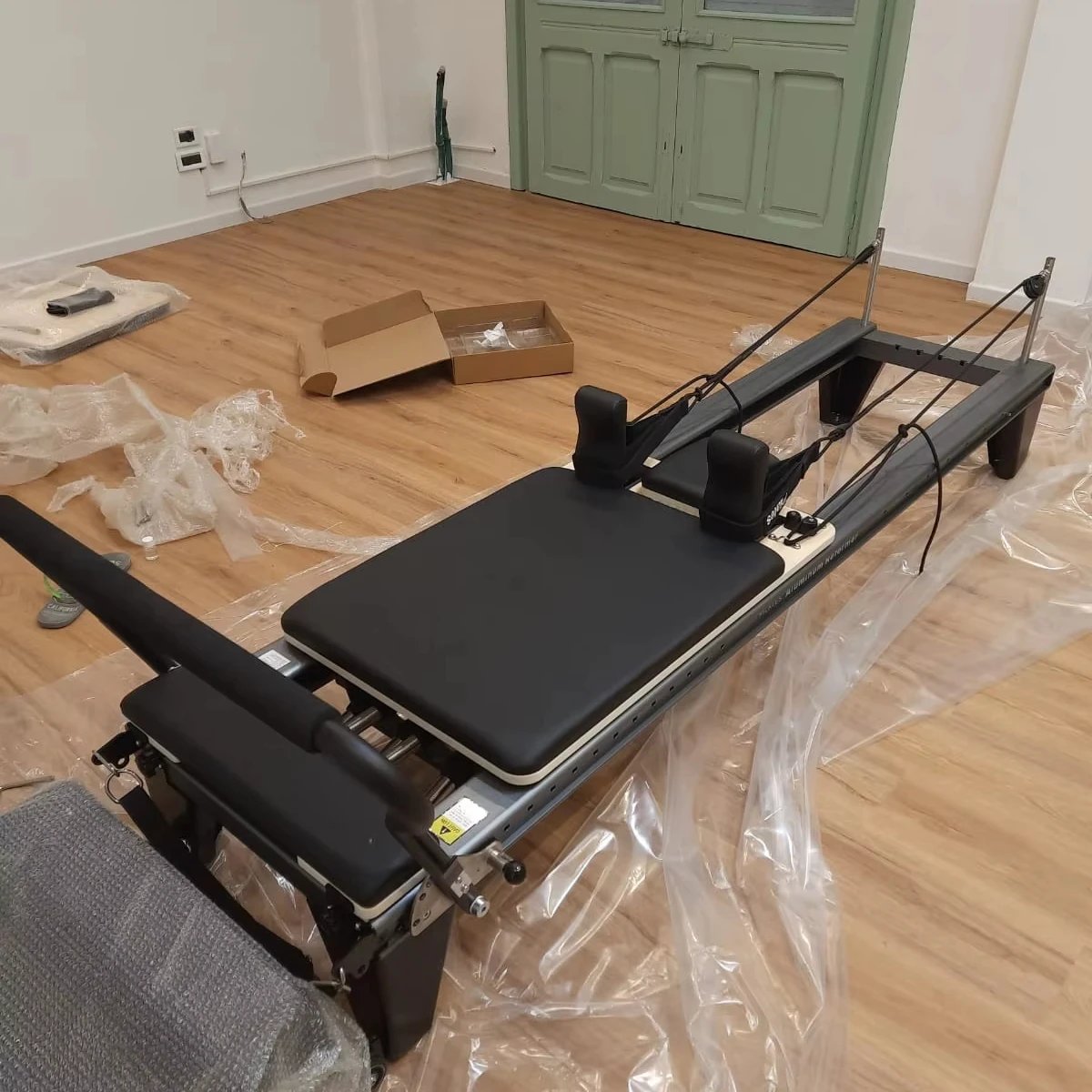
Quiet Glide Performance — Precision aluminum rail and carriage system verified under continuous studio schedules to eliminate rattle during back-to-back Pilates sessions.
Technical Specifications
| Parameter | Value |
|---|---|
| Designation | SRY-12 |
| Product Type | Pilates Reformer |
| Specification | 2570 × 730 × 270 mm |
| Net Weight | 90 kg |
| Accessory | Long Box / Jump Board / Platform |
| Logo | Customized Is Allowed |
| Color | White (custom options available) |
| Age / Gender | Adult / Unisex |
| Certification | CE / EN 957 / ISO 9001 |
| Warranty | 3 Years |
| Transport Package | Standard Wood Case |
Application Suitability
| Deployment Scenario | Typical Use |
|---|---|
| Boutique Pilates studio | Back-to-back group apparatus classes requiring silent carriage travel |
| Hotel wellness facility | Guest-facing reformer stations on shared wellness floors |
| High-end residential home gym | Private commercial-grade reformer with full accessory range |
| Rehabilitation and physiotherapy center | Low-impact controlled resistance programming for patient recovery |
| Corporate wellness room | Employee Pilates sessions during midday break windows |
Why Rattling Frames End Up Replaced Before the Lease Expires
Aluminum extrusion absorbs resonance where welded steel amplifies it.
Walk into any studio six months after opening and listen — the reformers that rattle during footwork sequences are the ones with consumer-grade frames and loose carriage tolerances. I’ve seen boutique operators pull entire fleets off the floor because the noise migrated through the slab into guest rooms below. The commercial aluminum Pilates reformer machine you spec on day one either holds its alignment through thousands of spring-loaded cycles or it becomes a liability that disrupts adjacent tenants. [NEED_CITE: vibration transmission through floor assemblies in shared-use wellness facilities]
Positioning the SRY-12 Within a Commercial Pilates Floor Plan
The SRY-12 covers full-body reformer programming from foundational footwork through advanced jump board plyometrics, fitting the mid-to-high intensity band that bridges mat work and tower apparatus. In a mixed cardio and movement studio, it pairs alongside our treadmills and ellipticals so members transition from cardiovascular warm-up to controlled resistance work without leaving the same zone. The 2570 × 730 mm footprint allows side-by-side deployment with adequate instructor clearance, and the unisex frame accommodates users across the full adult height range. This commercial aluminum Pilates reformer machine serves as the primary apparatus in group class configurations where throughput and silence both matter.
Continuous Class Schedules Demand More Than Aesthetic Frames
Running six to eight back-to-back classes per day means the carriage rail, spring anchors, and pulley mounts experience repeated load cycles that expose any tolerance stacking. Facilities above occupied floors — hotel guest room levels, residential wellness basements — must account for structure-borne vibration traveling through the slab. Adequate cross-ventilation prevents the upholstery and spring housings from accumulating moisture in high-humidity wellness environments. The SRY-12 ships calibrated for standard mains, but operators deploying across export markets should confirm voltage compatibility before the container sails. [NEED_CITE: EN 957 durability requirements for commercial resistance training equipment]
Rail Precision, Pulley Alignment, and Spring Progression Explained
The aluminum rail profile on the SRY-12 is machined to maintain consistent carriage glide without lateral play, which is the primary source of rattle noise in reformers after the first thousand cycles. Pulley alignment directly affects rope wear and resistance feel — misaligned pulleys create uneven drag that instructors notice during controlled eccentric sequences. Spring resistance progresses from light to heavy across the included set, giving instructors predictable tension steps from beginner rehabilitation loads through advanced athletic programming. The Long Box, Jump Board, and Platform accessories mount to the same carriage and frame hardpoints, so load paths remain consistent regardless of configuration. Unlike wood or steel frame alternatives, aluminum extrusion resists humidity-driven warping in spa-adjacent environments where ambient moisture fluctuates daily.
What Compromised Specs Actually Cost a Studio
Frames built to residential duty cycles develop carriage slop within months of commercial use, forcing warranty claims that leave equipment offline during peak membership seasons. Noise complaints from neighboring tenants escalate into lease disputes, especially when studios occupy mixed-use buildings with residential or hospitality above. Spring sets that lack calibration documentation cause instructors to second-guess resistance prescriptions mid-class, undermining member confidence in programming quality. Accessories that don’t share the primary frame’s load rating create failure points during jump board plyometrics, where dynamic forces far exceed static body weight. [NEED_CITE: dynamic load factors during plyometric reformer exercises]
Why Operators Source This Line for Multi-Unit Rollouts
Quiet carriage operation is verified in actual hotel wellness deployments where guest rooms sit directly above the fitness floor — a scenario where structure-borne noise ends tenancies. Every spring, rail, and pulley mount undergoes 10,000-hour continuous cycle testing that mirrors real studio throughput, not laboratory burst loads. The six-series cardio and apparatus family means a single-source purchase covers treadmills through reformers without managing multiple vendor relationships. Full OEM customization extends to logo placement, frame color, and upholstery — critical for franchise groups deploying consistent brand identity across locations. Free 3D floor layouts account for the SRY-12’s 2570 mm length plus instructor clearance, ensuring sightlines and airflow are planned before the first unit ships. 24/7 technical support covers commissioning questions from day one through long-term spare parts needs.
Documentation & Test Records
- CE declaration of conformity for the SRY-12 reformer assembly
- EN 957 test report covering structural load and carriage cycle endurance
- ISO 9001 certificate from our vertically integrated Shandong manufacturing facility
- Spring resistance calibration record documenting progressive tension values
- Frame material certification and weld inspection records for aluminum construction
- Installation and commissioning guide with spare parts list
Installation, Commissioning & Maintenance
- Position the 2570 × 730 mm frame with minimum clearance on all sides for instructor movement and accessory storage.
- Level the aluminum frame on a flat subfloor; use vibration isolation pads when deploying above occupied spaces.
- Verify mains voltage matches the local standard before connecting any electronic accessory modules.
- Inspect rail lubrication and pulley rope tension after the first 200 hours of carriage travel.
- Wipe down carriage rails and spring housings after each class session to prevent sweat corrosion on aluminum surfaces.
- Cross-reference spring color codes with the included calibration chart before each programming cycle.
Planning Your Reformer Deployment
Provide your studio square footage and target unit count so we can generate a 3D layout that accounts for the SRY-12’s footprint, instructor sightlines, and cross-ventilation requirements. Specify whether units will sit on floors adjacent to occupied guest rooms or residences so we confirm noise isolation measures before production. Confirm your target market’s voltage and plug standard to avoid mismatches at the port. Indicate whether you need custom logo placement or upholstery colorways to match your franchise branding guidelines.
Frequently Asked Questions
Q: What are the trade-offs between aluminum and steel frames in commercial Pilates reformers?
A: Aluminum frames weigh less than steel equivalents, which reduces shipping cost and makes repositioning easier during studio reconfigurations. The material also dampens carriage resonance during high-repetition sequences, a meaningful difference when reformers sit on shared wellness floors. Steel offers higher raw load capacity but adds mass that increases structure-borne vibration transmission. For multi-unit studio rollouts, aluminum’s corrosion resistance in humid environments reduces long-term maintenance burden.
Q: How should I evaluate carriage rail smoothness before committing to a fleet purchase?
A: Run the carriage through full travel under loaded conditions — body weight on the foot bar — and listen for any binding, lateral play, or tonal change at mid-stroke. A precision-machined aluminum rail should deliver uniform resistance feel from end to end without audible friction shifts. Request cycle test documentation showing the rail and carriage assembly has been validated under continuous commercial loading, not just static inspection at the factory gate.
Q: What spring resistance progression should I verify for beginner through advanced classes?
A: Confirm that the spring set provides distinct, repeatable tension steps from the lightest rehabilitation load through the heaviest athletic resistance. Calibration documentation should show measured force values at each spring color, not just nominal labels. Instructors rely on predictable progression to program safe transitions for mixed-level group classes, and undocumented spring variation undermines that reliability over time.
Q: Are the Jump Board and Platform accessories rated for the same user weight as the primary frame?
A: Every accessory that mounts to the carriage must share the primary frame’s load rating, especially the Jump Board where dynamic plyometric forces significantly exceed static body weight. Request load-bearing confirmation documents for each accessory under maximum rated conditions. Mismatched accessory ratings are a common gap in commercial reformer specifications that only surfaces after dynamic use begins in class programming.
Q: What lead times should I expect for custom logo and upholstery on multi-unit orders?
A: Customization lead time depends on the scope of changes — logo placement on the aluminum frame, upholstery color selection, and any console or accessory branding each follow separate production timelines. For franchise rollouts requiring consistent visual identity across dozens of units, confirm all customization specifications during the scoping phase before the proforma invoice. Production capacity runs at 80 pieces per month, so large orders benefit from early specification lock-in.
![Wood Folding Pilates Reformer Portable Quality Machine [WARN] draft identifier mismatch](https://bicksport.com/wp-content/uploads/2026/08/wood-folding-pilates-reformer-portable-quality-machine-warn-draft-identifier-mismatch-f2a0aa.webp)